
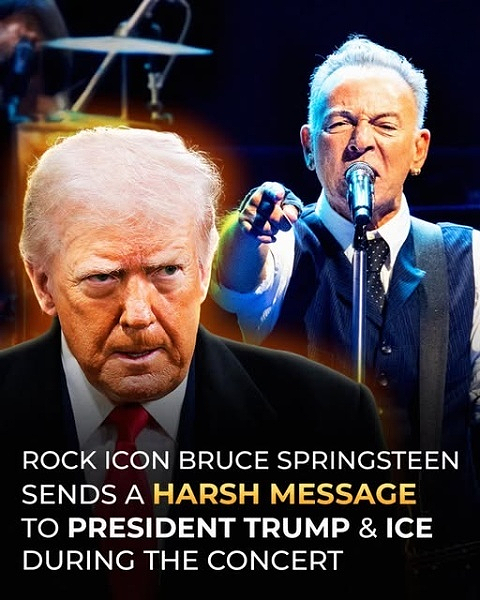
Bruce Springsteen delivered a forceful and unexpected political message during his appearance at the Light of Day Winterfest in Red Bank, New Jersey, turning a highly anticipated musical performance into a moment of national attention. While audiences gathered expecting an evening centered on music and charity, the veteran rock artist used the stage to address deep concerns about the state of the nation and recent federal immigration enforcement actions in Minneapolis.
The remarks, delivered with intensity and urgency, quickly reverberated far beyond the concert hall. Springsteen’s statements drew strong reactions from supporters in attendance, sparked widespread debate across the political spectrum, and prompted a direct response from the White House.
A Moment That Shifted the Night
The concert took place on January 17, 2026, as part of the annual Light of Day Winterfest, an event traditionally focused on music and fundraising. Just before launching into his well-known song The Promised Land, Springsteen paused to address the crowd, reframing the meaning of the track in the context of current events.
He told the audience that the song once reflected optimism about opportunity and national ideals, but that its message felt fundamentally altered in the present moment.
“Right now, we face incredibly critical times,” he said. “The United States, the ideals and values it has upheld for 250 years, are being tested like never before.”
The statement set the tone for a broader call to civic engagement and moral responsibility, delivered with the gravity that has long characterized Springsteen’s public addresses.
Direct Criticism of Federal Actions
Springsteen continued by urging listeners to actively defend principles he described as essential to the country’s identity. His remarks turned sharply toward federal law enforcement operations connected to immigration enforcement.
“If you oppose heavily armed federal troops invading a city and targeting citizens with Gestapo-like tactics; if you believe no one deserves to be killed for protesting, you must act.”
The language drew an immediate reaction from the audience, many of whom responded with applause and vocal support. Springsteen then referenced a statement made by Minneapolis Mayor Jacob Frey during the fallout from recent events.
“ICE should get the [expletive] out of Minneapolis.”
The quote prompted loud cheers throughout the venue, amplifying the intensity of the moment.
Dedication to a Victim of the Minneapolis Incident
Springsteen dedicated the performance that followed not only to those in attendance but also to Renee Nicole Good, the woman who died during an encounter with Immigration and Customs Enforcement officers in Minneapolis on January 7. The dedication underscored the emotional weight of his remarks and connected the performance directly to the unfolding national debate.
Good’s death has become a focal point in discussions surrounding immigration enforcement, protest activity, and the use of force by federal agents. Vigils, demonstrations, and public statements from officials have continued in the days since the incident, reflecting the depth of public concern and division.
Rising Tensions in Minneapolis
In the aftermath of Good’s death, Minneapolis has experienced heightened tension. Federal authorities took precautionary measures as protests and public demonstrations intensified. The Pentagon placed 1,500 soldiers on alert, including two infantry battalions from the Army’s 11th Airborne Division.
Any deployment of those forces would require President Donald Trump to invoke the Insurrection Act of 1807, a law that allows the president to deploy the military domestically under specific circumstances. While the option exists, such a move has been widely regarded as unlikely at this stage, given the legal and political implications associated with its use.
The situation has placed renewed focus on the balance between public safety, civil liberties, and the role of federal authority in responding to unrest tied to law enforcement actions.
A Longstanding Pattern of Political Engagement
Springsteen’s comments did not come as a surprise to longtime followers of his career. For decades, he has blended music with social commentary, often addressing economic inequality, civil rights, and the struggles of working-class Americans.
During the 2024 election cycle, Springsteen openly endorsed Kamala Harris and repeatedly criticized Donald Trump. He warned that Trump posed a danger to democratic norms, threatened civil rights protections, and showed admiration for authoritarian leaders abroad.
While touring in England last year, Springsteen publicly stated that Trump had no business leading a nation. The comments drew swift backlash from the president, who responded with personal attacks, calling the musician “dumb as a rock” and telling him to “KEEP HIS MOUTH SHUT until he gets back into the Country.”
The exchange highlighted the increasingly personal nature of political discourse involving public figures and entertainers.
Broader Cultural and Political Clashes
Springsteen’s criticism has not been limited to Trump alone. The former reality television star president has also accused other prominent figures, including Oprah Winfrey and Beyoncé, of secretly supporting Harris using Democratic funds. Those claims further fueled tensions between the administration and influential voices in entertainment and media.
The ongoing clashes reflect a broader cultural struggle over the role of celebrities in political debate, particularly when they use large platforms to influence public opinion on controversial issues.
White House Response to the Performance
Following Springsteen’s comments in New Jersey, the White House issued a response the next day. On January 18, press secretary Abigail Jackson dismissed the singer’s remarks and defended federal immigration enforcement actions.
Jackson emphasized that many Americans expect criminal migrants to be deported and maintained that federal agents acted within the law during the Minneapolis operation. She specifically referenced ICE officer Jonathan Ross, stating that he discharged his weapon only after Renee Nicole Good allegedly threatened his life by driving toward him.
The administration’s response sought to reinforce its position on immigration enforcement and portray federal agents as acting in self-defense under dangerous conditions.
A Nation Divided Over Enforcement and Protest
Despite the official explanation, skepticism remains widespread. For Springsteen and many others, the incident represents deeper concerns about the use of force, accountability, and the treatment of civilians during federal operations.
The debate extends beyond Minneapolis, touching on fundamental questions about immigration policy, protest rights, and the boundaries of federal authority. Springsteen’s decision to address these issues from the stage reflects his belief that artists have a role to play in confronting moments of national crisis.
As reactions continue to unfold, the performance stands as another example of how music, politics, and public discourse intersect in times of heightened division. Whether viewed as a necessary act of conscience or an inappropriate use of a concert platform, Springsteen’s remarks ensured that the events in Minneapolis—and the broader issues they represent—remain firmly in the national spotlight.