
Boy With Down Syndrome Rescued From Family Attic Later Honored by the Officers Who Saved Him
A Child Found Hidden Inside a Kansas Home
In 2010, a 6-year-old boy with Down syndrome was found in the attic of his family’s Kansas home after police returned to the property for a second search.
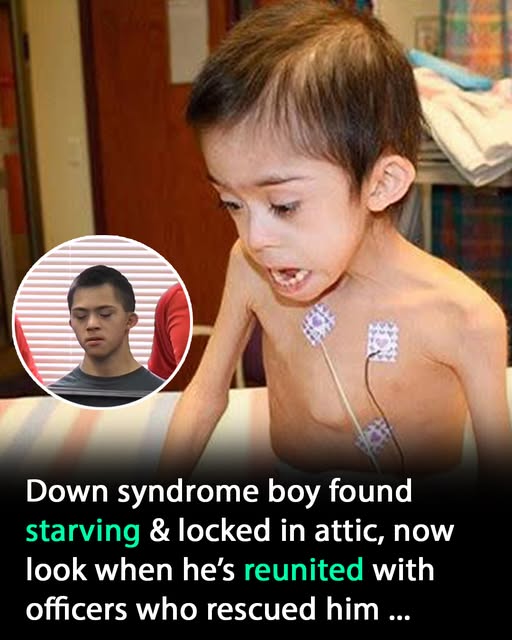
The child, Giovanni “Govi” Eastwood, had been left in extreme neglect and was in a severely weakened condition when officers located him. Though he was nearly 7 years old, his weight and physical size reflected the condition of a much younger child.
Govi weighed only 17 pounds at the time he was discovered. His body showed the effects of starvation, prolonged isolation, and lack of proper care from the person responsible for protecting him.
His mother, Rachel Perez, had already been taken into custody because of outstanding warrants. Police had located her other children and removed them from the home to a safe place, but Govi was not with them.
At first, officers did not find him. Perez gave an explanation about his whereabouts that caused the initial search to end without the boy being rescued.
“She (Perez) concocted some story about where Govi was,” said Sergeant John Klingele who discovered the boy. “So they all ended up leaving and Govi was still there.”
Officers Returned After Suspecting He Was Still Inside
Even after leaving the home, officers remained uneasy about the situation. They suspected the missing boy might still be somewhere inside the house.
That concern led them back to the property. Their decision to return proved critical, because Govi had remained hidden in the attic while the other children had already been removed from danger.
Officers began calling out for the child. As they searched again, they eventually realized that he was above them, inside the attic space.
When Sergeant Klingele first saw Govi, the condition of the child was shocking. The boy’s body had been reduced by neglect to a fragile state, and his appearance reflected the severity of what he had endured.
“He looked like a kid out of a concentration camp, skin and bones,” Klingele recollected when he first saw Govi. “We were told he was going to be 7 and size-wise he looked 3 maybe.”
Govi could not walk when he was found. He could barely speak. He was covered in excrement, and the attic where he had been left contained none of the basic comforts expected for a child.
There was no blanket for him. There were no toys. He had been left in the attic without the care, warmth, and attention a young child needs to survive.
The Extent of Govi’s Neglect
The condition of Govi’s body revealed the depth of his suffering. Starvation had deprived him of the nutrients essential for growth, strength, and basic health.
He had lost hair from his head because of the lack of nourishment. His bones had become brittle and bowed due to rickets, a condition linked to severe nutritional deficiency.
The neglect had also caused the fatty tissue on his bottom to waste away. His body had been forced into survival mode, and he was near the point where recovery might no longer have been possible.
Medical staff later made clear that the timing of the rescue was crucial. Govi would not have survived much longer if officers had not found him that night.
Authorities believed his mother had placed him in the attic to hide him away. The discovery of the child confirmed that the initial explanation about his whereabouts had concealed the reality of his condition.
The case exposed a severe failure of care within the home. A child who depended entirely on adults for safety, food, and protection had instead been isolated and allowed to deteriorate.
Legal Consequences for Rachel Perez
Rachel Perez later faced legal consequences for the treatment of her son. She was sentenced to an eight-year prison term for attempted murder related to what happened to Govi.
The sentence reflected the seriousness of the abuse and neglect that had brought the child close to death. By the time he was found, his life had been placed in immediate danger through prolonged deprivation.
The case also became a lasting memory for the officers who entered the home and searched again after suspecting that something was wrong. Their decision to trust that suspicion changed the course of Govi’s life.
Had the officers accepted the explanation they were first given and not returned to the home, Govi might have remained in the attic. Medical staff believed the boy’s condition had already become life-threatening.
The rescue did more than remove him from a dangerous place. It opened the possibility for a new life, one in which he could receive food, care, medical attention, and the safety that had been missing.
A New Home With Family
After he was rescued, Govi and his two sisters were taken in by relatives. Their great aunt and uncle, Stacy and Joe Eastwood, adopted them and gave them a stable home.
For Govi, recovery was not immediate. The damage he had suffered was physical, emotional, and deeply tied to the conditions he had endured as a young child.
At first, he would sleep only on the floor. Even after being placed in a safe home, his early habits and fears showed how much the neglect had shaped his sense of security.
He also reacted with fear to ordinary gestures. When someone tried to give him a high five, he worried that he was going to be hit.
Those reactions revealed that safety had to be learned over time. In his new home, Govi slowly began to understand that the people around him were not there to hurt him.
With consistent love and care from Stacy and Joe Eastwood, he began to feel safe. His new family provided the support he needed as he grew stronger and more secure.
His transformation became visible not only in his body but also in his personality. The child who had once been found starving in an attic became a boy known for warmth, joy, and affection.
“The Kid Is Magical”
Stacy Eastwood described Govi in terms that captured the way he affected the people around him. His presence, she said, brought out kindness in others.
“The kid is magical. Everybody he comes in contact with, he just brings out a better person in them,” Eastwood said.
Those words reflected a remarkable change from the condition in which he had been found. Govi had gone from near death to becoming a source of joy and strength for the people who loved him.
His recovery took patience. It required medical care, emotional support, daily stability, and a family environment where he could begin to trust again.
Over time, the fear that had shaped his early reactions gave way to confidence. He learned that his home was safe and that the people reaching toward him were offering affection, not harm.
The transformation was especially meaningful to the officers who remembered the night he was rescued. They had seen him at his weakest, when he could not walk, barely spoke, and appeared far younger than his age.
A Reunion Six Years Later
Six years after Govi was found in the attic, the officers who had rescued him were reunited with him. By then, he was 12 years old, and the change they saw was extraordinary.
The reunion took place at the Sherriff’s Department in 2016. Officers who had once carried the memory of a starving child now saw a boy who had grown, healed, and developed a bright spirit.
Govi visited the department and met the people who had helped save his life. He shook the hands of the officers and thanked them for rescuing him that day.
The moment carried deep meaning for the officers. They had been part of a rescue that began with suspicion, continued with a second search, and ended with the discovery of a child whose life was in immediate danger.
Seeing him years later gave them the chance to witness the result of that decision. The boy who had once been hidden away was now standing before them, able to express gratitude and receive recognition.
Govi Becomes an Honorary Deputy
During the 2016 visit, Govi was made an honorary deputy. He was also awarded a plaque, a symbol of the department’s recognition and affection for him.
The honor marked a powerful reversal from the conditions of his early childhood. Once hidden in an attic and denied basic care, he was now welcomed and celebrated by the officers who had helped bring him to safety.
For Sergeant Klingele, the reunion was emotional. He did not describe the officers as the center of the story. Instead, he pointed to Govi’s courage and spirit.
“That boy is the hero. Seeing how big his heart is and his smile is… It’s really good to see him,” Klingele said.
The plaque meant a great deal to Govi. His great aunt said he slept with the special plaque that night, showing how important the honor was to him.
The gesture from the department was more than ceremonial. It connected Govi’s present life with the night he was found, while emphasizing how far he had come since that rescue.
A Story of Rescue, Recovery, and Love
Govi’s story began with a discovery that exposed severe neglect. A young child with Down syndrome had been left in an attic, starving, weak, and hidden from those who came to help.
His survival depended on the officers who trusted their instincts and searched again. Their return to the home made the difference between continued suffering and rescue.
By the time he was found, Govi’s body showed the consequences of deprivation. He was underweight, unable to walk, barely speaking, and suffering from medical problems caused by lack of nutrients.
Yet his later life showed a different reality. With Stacy and Joe Eastwood, Govi found a home where he and his sisters could be cared for, protected, and loved.
His adjustment took time because the effects of his early trauma did not disappear quickly. Sleeping on the floor and fearing a raised hand were signs of what he had learned before rescue.
But with patience and stability, he began to change. He grew safer in his surroundings, more comfortable with affection, and able to share the warmth that his family saw in him.
The reunion with officers six years later gave those who saved him a chance to see the impact of their actions. It also gave Govi a chance to thank them directly.
Being named an honorary deputy and receiving a plaque turned the department visit into a lasting memory. For Govi, the plaque was special enough to keep close even as he slept that night.
The child once found in desperate condition had become a boy whose heart, smile, and resilience moved the people around him. His story remains one of a life saved at a critical moment and rebuilt through care, family, and love.