
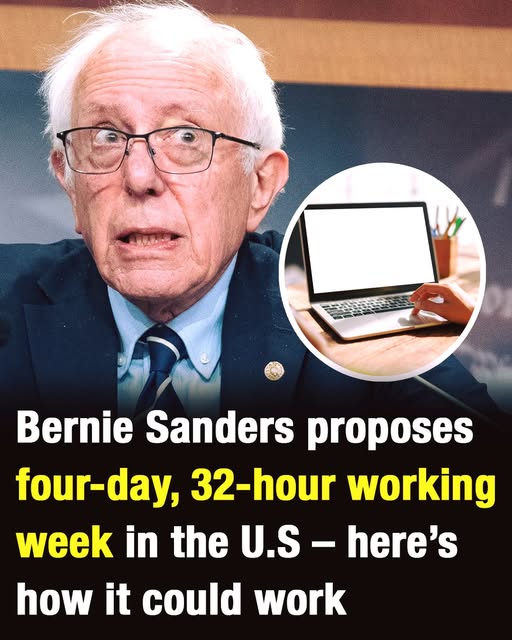
Bernie Sanders Discusses AI, the Future of Work, and the Case for a 32-Hour Workweek
A Debate About Work in the Age of Artificial Intelligence
A recent discussion involving U.S. Senator Bernie Sanders has renewed attention on the future of work, artificial intelligence, and the possibility of reducing the standard workweek.
During a public conversation on The Joe Rogan Experience, Sanders spoke about how advances in technology and productivity could change the amount of time people are expected to spend working.
His remarks focused on a central idea: if artificial intelligence and automation make work more efficient, then workers should share in the benefits of that efficiency.
Rather than allowing new technology to be used mainly to cut labor costs, replace employees, or increase pressure on remaining workers, Sanders suggested that it could be used to improve working conditions.
One way to do that, he argued, would be to reduce the traditional workweek. In that context, he referenced the idea of a 32-hour workweek, a concept that has become part of broader policy discussions about labor, productivity, and quality of life.
The discussion highlighted a larger question now facing governments, companies, and workers: if technology allows society to produce more with less human labor, who should benefit from that change?
The Core Argument Behind a Shorter Workweek
Sanders’ position is built around the belief that technological progress should not only benefit corporations or business owners. He argued that workers should also gain from improvements in productivity.
Artificial intelligence has the potential to automate repetitive tasks, speed up decision-making, and reduce the time required for many kinds of work. That could make companies more efficient and profitable.
However, Sanders warned against a future in which those gains are used mainly to eliminate jobs or demand more output from workers without improving their lives.
Instead, he suggested that productivity gains could be shared through reduced working hours. If the same amount of work can be completed in less time, then employees may not need to remain tied to the traditional 40-hour workweek.
The idea challenges a long-standing structure of modern employment. The 40-hour week has been treated as normal for decades, but Sanders argued that it was established in a very different economic era.
As technology changes the nature of work, he suggested that society should reconsider whether that older structure still makes sense.
Why Artificial Intelligence Is Central to the Discussion
Artificial intelligence has become a major force in conversations about the future of labor. Its rapid development has raised questions about which jobs may change, which tasks may disappear, and how workers will adapt.
Sanders’ comments placed AI at the center of a broader economic debate. The issue is not only whether machines can perform more tasks, but how the benefits of that performance will be distributed.
If AI systems can reduce the time needed to complete certain work, there are several possible outcomes. Employers might reduce staff, increase output expectations, or use the technology to boost profits.
Sanders argued for a different path. He suggested that workers should receive some of the benefit in the form of more free time.
This approach treats AI not only as a business tool, but as a social and economic turning point. If managed differently, technological progress could allow people to spend less time at work while maintaining their income.
That would mark a major shift in how society thinks about productivity. Instead of measuring success only through profit or output, the debate would include quality of life, rest, family time, and personal freedom.
The 32-Hour Workweek Concept
The idea of a 32-hour workweek generally refers to reducing the standard full-time work schedule from 40 hours to 32 hours. In many discussions, the goal is to make that change without cutting workers’ pay.
Sanders has previously supported legislative efforts connected to this idea, including proposals such as the “Thirty-Two Hour Workweek Act.”
Although different versions of reduced-workweek proposals have been discussed over time, the general goal remains consistent. Supporters want to explore whether modern productivity can support shorter working hours while protecting income.
The proposal is often linked to a four-day workweek, though the exact structure could vary depending on the workplace or industry. Some jobs might reduce hours across five days, while others might shift to fewer working days.
For Sanders, the broader principle is that workers should not be expected to maintain the same schedule forever if the economy becomes more efficient through automation and AI.
He framed the issue as a question of fairness. If technology produces major gains, those gains should not flow only upward.
Quality of Life as an Economic Issue
Supporters of shorter workweeks argue that reduced hours could improve quality of life. They point to potential benefits such as better work-life balance, more time with family, less stress, and stronger mental health.
For many workers, time is one of the most valuable resources. A shorter workweek could give people more space for rest, caregiving, education, community involvement, or personal interests.
Sanders’ argument treats free time as a meaningful benefit of economic progress. If productivity rises, he suggested, workers should be able to experience that progress in their daily lives.
This view challenges the idea that increased productivity should automatically lead to higher workloads or greater corporate profits. Instead, it asks whether workers should receive a direct share of productivity gains through time.
The concept also reflects a broader frustration with modern work culture. Many people feel that technological improvements have made work faster and more demanding, rather than easier or more humane.
A 32-hour workweek proposal attempts to reverse that pattern by linking efficiency to relief rather than pressure.
Supporters Point to Productivity Gains
Supporters of reduced working hours often argue that productivity has increased significantly over time. They believe many workers can now produce more in less time than previous generations could.
From that perspective, the traditional 40-hour week may no longer reflect the actual amount of time needed to complete many kinds of work.
If employees can maintain output in fewer hours, supporters argue that shorter workweeks could benefit both workers and employers. Workers might feel more rested and motivated, while employers could see improved retention and satisfaction.
Some trials of shorter workweeks in various countries and companies have shown positive results in areas such as employee satisfaction, productivity, and retention.
These examples have helped keep the idea alive in policy discussions. They suggest that reduced hours may be practical in at least some settings.
However, moving from individual trials to a national labor standard would be far more complex. Different industries, business models, and staffing needs would require careful planning.
Why Implementation Would Be Complicated
Although the idea of a 32-hour workweek is appealing to many workers, putting it into practice across an entire economy would not be simple.
Businesses vary widely in how they operate. Some companies may be able to reduce hours without major disruption, while others may struggle with scheduling, customer demand, staffing shortages, or increased costs.
Industries that rely on around-the-clock service, physical labor, health care, transportation, or direct customer support may face different challenges than office-based workplaces.
Labor laws would also need to adapt. A national reduction in working hours could require changes to overtime rules, wage protections, staffing models, and employer obligations.
Sanders has acknowledged that such a shift would not happen immediately. Any transition toward a shorter workweek would likely need to be gradual.
A phased approach would allow businesses, workers, and institutions to adjust while reducing the risk of economic disruption.
A Gradual Transition Toward Change
The idea of reducing the workweek is not presented as an overnight transformation. Sanders’ comments suggested that structural change would need time.
A gradual transition could help employers test new schedules, measure productivity, and identify problems before a broader shift takes place.
It could also allow policymakers to determine which industries need special rules or additional support. Different sectors may require different timelines.
For workers, a phased approach could help preserve income and stability. The goal of many shorter-workweek proposals is not simply to reduce hours, but to do so without reducing pay.
That distinction is central. A shorter week with lower income would not necessarily improve quality of life for workers who already face financial pressure.
For the idea to meet its intended purpose, it would need to protect wages while reducing time spent on the job.
AI, Jobs, and Economic Inequality
Beyond the workweek debate, Sanders has raised broader concerns about artificial intelligence and its effects on employment and inequality.
AI technology is advancing quickly, and many workers are concerned about whether automation could replace jobs or reduce wages. Sanders has argued that these changes must be managed carefully.
His concern is that technological progress could concentrate wealth if the benefits are captured mainly by corporations and those who own the technology.
If AI makes companies more productive while workers lose jobs or face greater insecurity, economic inequality could worsen.
Sanders’ position is that innovation should be paired with policies that protect workers. In his view, technology should raise living standards rather than create deeper economic divides.
The 32-hour workweek fits into that larger vision. It is one example of how productivity gains might be shared more broadly.
Labor Policy in a Changing Economy
The debate over shorter working hours is part of a larger conversation about how labor policy should adapt to a changing economy.
Traditional employment structures were built around older assumptions about production, time, and workplace organization. AI and automation are challenging many of those assumptions.
If machines can complete tasks that once required many hours of human labor, policymakers must decide how that saved time should be handled.
One option is to allow companies to increase profits and reduce labor costs. Another is to use productivity gains to improve workers’ lives.
Sanders’ comments clearly support the second approach. He believes the economy should be structured so that workers directly benefit when technology makes work more efficient.
This reflects his long-standing focus on workers’ rights, income inequality, and labor protections.
Concerns Beyond the Workplace
Sanders has also spoken about concerns related to AI beyond ordinary employment. He has warned that the technology could affect global security and military decision-making if not properly regulated.
One area of concern involves military applications of artificial intelligence, including autonomous systems and robotic warfare.
According to his remarks, technologies that reduce direct human involvement in conflict could change how wars are fought. They could also alter how political leaders think about the cost of conflict.
Historically, the human cost of war has played a major role in public and political decision-making. If future systems rely heavily on automation, that relationship could change.
Sanders suggested that this possibility raises serious ethical and strategic questions. A world where machines play a larger role in warfare could create new risks that governments have not fully addressed.
Although these concerns are separate from the workweek debate, they reflect the same broader theme: AI must be governed carefully because its effects could be profound.
Technology as a Tool for Public Benefit
Across his remarks, Sanders emphasized that technology should serve people rather than simply increase profits or power.
In the workplace, that means using AI to reduce burdens, improve conditions, and potentially shorten working hours. In society more broadly, it means regulating powerful technologies to avoid harm.
This view treats technological development as a political and ethical issue, not just a business issue.
AI may be created by companies and engineers, but its consequences will affect workers, families, governments, and communities. That is why policy debates around the technology are expanding.
Sanders’ argument is that society should not wait until the effects are already severe. Instead, he believes governments should plan now for how AI will reshape labor and public life.
The 32-hour workweek is one proposal within that larger debate about how to turn technological progress into human benefit.
Support and Skepticism Around Shorter Workweeks
The idea of a shorter workweek has supporters and skeptics. Supporters argue that it could improve mental health, reduce burnout, and give workers more control over their lives.
They also believe that increased productivity makes shorter hours more realistic than in the past. If people can produce the same amount in less time, they argue, there is no reason to preserve old schedules without question.
Skeptics point to practical challenges. They worry about business costs, staffing needs, global competition, and the difficulty of applying one standard across many industries.
Some also question whether productivity gains would be enough in every workplace to support the same pay for fewer hours.
These concerns show why the debate remains active. There is no single global approach to reducing working hours at scale.
Still, the continued discussion suggests that many people are questioning whether the current structure of work is the only possible model.
A Larger Conversation About the Future
Sanders’ comments reflect a broader shift in how policymakers, economists, and labor organizations are thinking about the future of work.
Automation and AI are no longer distant possibilities. They are already influencing hiring, productivity, workplace expectations, and economic planning.
As these technologies continue to evolve, questions about hours, wages, job security, and worker protections will likely become more urgent.
The 32-hour workweek is one possible response to that changing landscape. It asks whether productivity gains should be measured not only in profits, but also in time returned to workers.
Even if such a policy is not adopted widely in the near future, the debate itself is significant. It shows that the structure of work is not fixed forever.
Society can reconsider how labor is organized when economic conditions and technology change.
Sanders’ Long-Standing Focus on Workers
Sanders’ support for reduced working hours fits within his broader political identity. He has long focused on workers’ rights, income inequality, wages, and corporate power.
His comments on AI and the 32-hour workweek continue that theme. He is arguing that economic change should be judged by how it affects working people.
From his perspective, a more advanced economy should not leave workers more insecure, exhausted, or replaceable. It should create conditions for a better life.
This is why he connects AI to reduced hours rather than only to job losses or business efficiency. He wants the conversation to include what workers gain, not only what companies save.
That framing is likely to remain part of labor debates as AI becomes more common in workplaces.
The central question is whether policy will guide technological change or whether workers will be left to absorb its consequences on their own.
A Debate Likely to Continue
As artificial intelligence becomes more powerful, discussions about work are likely to intensify. The issue is no longer only about whether technology can do more, but about how society will respond when it does.
Sanders’ proposal for a 32-hour workweek reflects one vision of that future. In that vision, increased productivity leads to more free time, stronger quality of life, and a fairer distribution of technological benefits.
Others will continue to question whether such a shift is economically practical or how it could be applied across different industries.
Even with disagreement, the debate highlights an important reality. The future of work will not be shaped by technology alone.
It will also be shaped by laws, political choices, business decisions, and public pressure.
Sanders’ comments have added momentum to the conversation by connecting AI directly to workers’ daily lives and the structure of the workweek.
What the 32-Hour Workweek Debate Represents
The discussion around Sanders, artificial intelligence, and a 32-hour workweek represents more than a scheduling proposal. It reflects a larger question about the purpose of economic progress.
If technology allows society to become more productive, the benefits can be distributed in different ways. They can increase profits, reduce labor needs, lower costs, or improve life for workers.
Sanders is arguing that workers should not be left out of that equation. He believes that if AI helps generate more efficiency, employees should see direct benefits.
A shorter workweek without reduced pay would be one way to provide that benefit. It would turn productivity gains into time, rest, and better balance.
The idea remains debated and would require careful planning, but it continues to gain attention as automation changes the economic landscape.
Whether or not a 32-hour workweek becomes widely adopted, the conversation shows that traditional work structures are being questioned in new ways.
As AI continues to reshape industries, the central challenge will be deciding whether technology creates a future of greater pressure or greater freedom for workers.
Sanders’ answer is clear: technological progress should improve life for working people, not leave them behind.