
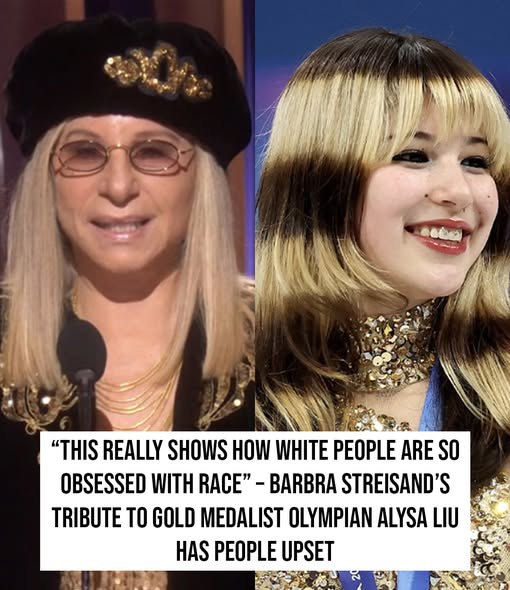
Barbra Streisand’s Congratulatory Message to Alysa Liu Sparks Online Debate After Historic Olympic Triumph
A Landmark Achievement on Olympic Ice
Alysa Liu delivered one of the most memorable performances of the Milano Cortina 2026 Winter Games, securing two gold medals for Team USA and cementing her place in Olympic history.
At just 20 years old, Liu captured gold in women’s singles and contributed to victory in the team figure skating event. The achievement marked the first time in 24 years that an American woman stood atop the Olympic podium in figure skating.
Her routines combined precision, artistry, and composure under pressure, earning widespread admiration from fans and fellow athletes alike.
The long-awaited victory ended a drought that had spanned nearly a quarter century, making Liu’s success more than personal. It represented a milestone moment for American figure skating.
Celebrations followed quickly across social media, with messages of praise highlighting her technical mastery and emotional depth on the ice.
A Message from a Cultural Icon
Among the many public figures offering congratulations was legendary singer and actress Barbra Streisand. She shared a message recognizing Liu’s accomplishment and recalling a meaningful connection from years earlier.
Streisand noted that Liu had once performed to her song “Don’t Rain on My Parade,” a detail that added a personal dimension to the tribute.
In the same message, Streisand reflected on her own childhood in Brooklyn and remembered a Chinese family who had supported her during her early years. She spoke about the care they showed her and the impact they had on her upbringing.
Her words appeared intended as a bridge between past and present — linking a young champion’s achievement with memories from her own life.
The tone conveyed pride and affection, celebrating not only Liu’s victory but also the broader human connections that shape personal journeys.
Online Reactions Take Shape
The response to Streisand’s message was immediate and varied. What began as a congratulatory note quickly became the subject of widespread discussion.
Some observers expressed concern that referencing Liu’s heritage diverted attention from the athlete’s historic accomplishment. They argued that such a milestone deserved to be recognized without additional context.
Others viewed the post differently, interpreting it as a generational style of storytelling — one that naturally blends personal memory with public celebration.
Supporters emphasized that Streisand has often spoken about the diverse influences in her life. To them, the reflection appeared to be an expression of gratitude rather than an attempt to redirect focus.
The divide illustrated how rapidly online platforms can transform a moment of warmth into a broader cultural debate.
The Speed of Digital Interpretation
In today’s fast-moving social media environment, even brief messages can take on layered meanings.
Public figures frequently find their words examined from multiple perspectives, sometimes beyond their original intention.
Streisand’s congratulatory message became part of that dynamic, demonstrating how celebration and controversy can coexist within the same conversation.
For many, the discussion reflected broader sensitivities about identity, representation, and the way achievements are framed in public discourse.
What might once have been received as a personal anecdote instead evolved into a topic of national debate within hours.
Liu’s Journey Beyond the Medals
Amid the online conversation, Alysa Liu’s path to Olympic gold remains a story defined by resilience and self-discovery.
After competing at the 2022 Beijing Olympics, Liu stepped away from the sport at just 16 years old. The intense pressure of elite competition had taken a toll, leaving her emotionally drained.
For a period, she distanced herself from the rink entirely, unable to return to the environment that had once defined her daily life.
During her time away, she pursued studies in psychology and traveled, gradually rebuilding her sense of balance and personal identity.
The break allowed her to reconnect with skating not as an obligation, but as a choice.
A Return on Her Own Terms
When Liu ultimately returned to competition, it was with renewed clarity and independence.
Her comeback was not framed by external expectations but by an internal decision to embrace the sport again.
The transformation was visible in her performances at the Milano Cortina Games. She skated with assurance and emotional depth, free from the strain that once overshadowed her experience.
Becoming a two-time Olympic champion represented not only athletic success but personal healing.
Her victories carried the weight of discipline and training, but also of rest, reflection, and rediscovery.
Advocating for Mental Health in Sport
Liu has spoken openly about the mental challenges faced by elite athletes, using her platform to address topics that were once rarely discussed.
By sharing her own experience of stepping away and returning, she has contributed to a broader conversation about well-being in high-performance environments.
Her visibility offers reassurance to athletes who may feel isolated by pressure or expectation.
In doing so, she has expanded her impact beyond medals and podiums.
Her journey suggests that success can include moments of pause as well as triumph.
Celebration in a Complex Era
The exchange between Streisand and the online community underscores the complexity of modern celebration.
Public recognition, particularly when shared across digital platforms, often carries interpretations shaped by audience experience and cultural context.
Moments intended to honor achievement can become reflections of broader societal conversations.
Yet at the center of this discussion remains the same undeniable fact: Alysa Liu achieved something extraordinary on Olympic ice.
Her gold medals symbolize technical excellence and competitive courage.
The Enduring Image
Long after social media debates fade, the defining image of the Milano Cortina 2026 Winter Games will endure — a young skater delivering flawless routines under the brightest lights in sport.
Her accomplishment ended a 24-year wait for American women in Olympic figure skating and inspired a new generation of athletes.
While the online discourse highlighted differing perspectives, Liu’s achievement stands independent of interpretation.
It reflects preparation, persistence, and the willingness to step back when necessary in order to move forward stronger.
Gold medals shine brilliantly in the moment, but resilience often leaves the deeper imprint.
Alysa Liu’s story, defined by courage both on and off the ice, remains the lasting legacy of her Olympic triumph.