
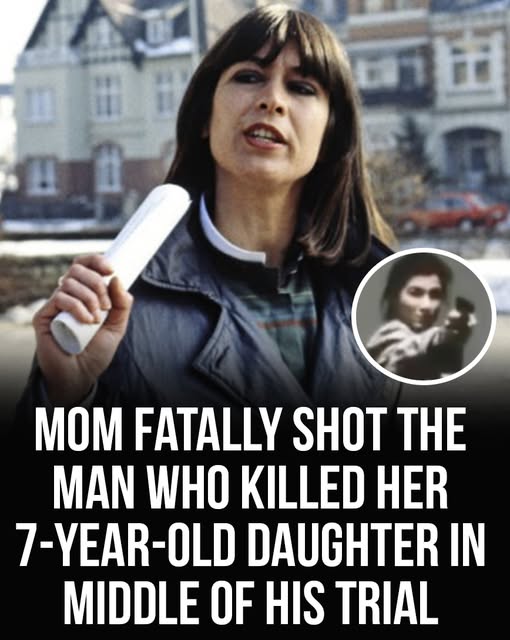
The Case of Marianne Bachmeier: A Courtroom Shooting That Shocked Germany and Sparked Decades of Debate
A Dramatic Moment in a Lübeck Courtroom
On March 6, 1981, Marianne Bachmeier entered a courtroom in Lübeck, Germany with visible determination. The trial underway concerned Klaus Grabowski, a 35-year-old man accused of the kidnapping, abuse, and murder of her seven-year-old daughter, Anna Bachmeier.
In a sudden and shocking turn of events, Bachmeier pulled a loaded pistol from her purse and opened fire. Within seconds, Grabowski was struck by multiple bullets and died on the courtroom floor after being hit by seven shots.
The incident stunned those present and immediately drew international attention. Bachmeier was arrested on the spot and reportedly showed no sign of remorse following the shooting.
The Tragedy That Changed Her Life Forever
The events leading up to the courtroom shooting began nearly a year earlier. On May 5, 1980, Marianne Bachmeier’s life was irrevocably altered by the disappearance of her daughter Anna.
At the time, Bachmeier was a struggling single mother who ran a pub in Lübeck, in northern Germany. Despite the challenges of raising a child alone, Anna was described as a happy and open-minded girl.
That day, after an argument with her mother, Anna skipped school and set out to visit a friend. On her way, she was kidnapped by Klaus Grabowski, a local butcher.
The Crime That Shook the Community
Grabowski held the child captive in his apartment for hours. During that time, he abused her before ultimately strangling her to death.
After committing the murder, he placed her body in a box and hid it near the bank of a canal. Later, he returned to the site to bury the body.
That same evening, he was arrested at his favorite pub in Lübeck after his fiancé alerted police authorities.
Grabowski’s Criminal History and Trial Claims
At the time of his arrest, Grabowski was already a convicted sex offender who had previously served time for sexual assaults on two girls. During his imprisonment in 1976, he had voluntarily undergone castration.
Two years later, he began hormone treatment in an attempt to reverse the chemical castration so he could pursue a relationship with his fiancé.
Although he immediately confessed to killing Anna, he denied sexually abusing her. During the trial, he made disturbing claims, alleging that the child had attempted to seduce and blackmail him.
He further stated that he killed her because she supposedly threatened to reveal inappropriate contact unless he gave her money. The court did not accept his explanation.
A Mother’s Anger and Sense of Powerlessness
The statements made during the trial deeply affected Marianne Bachmeier. Hearing her daughter blamed for the crime reportedly left her in a state of intense anger, grief, and helplessness.
On the third day of the trial, she decided to take action in a way that would later define her legacy and ignite widespread controversy.
Despite courtroom security measures, she managed to smuggle a firearm into the building, bypassing guards and checks.
The Shooting Inside the Courtroom
Shortly after entering the courtroom, Bachmeier removed the loaded gun from her handbag, aimed at Grabowski, and fired repeatedly. Seven of the eight bullets she discharged struck him, and he collapsed immediately.
He died at the scene. After the shooting, Bachmeier dropped the weapon, identified as a Beretta M1934.
Her voice was heard in the courtroom as she declared: “He killed my daughter… I wanted to shoot him in the face, but I shot him in the back … I hope he’s dead.”
According to police officers present, she also referred to Grabowski as a “pig” after opening fire.
Arrest and Legal Proceedings
Bachmeier was immediately arrested and initially charged with murder. Her case quickly became one of the most discussed legal events in Germany and beyond.
During her trial in 1982, she claimed that she acted in a dream-like state after imagining her daughter present in the courtroom.
However, expert testimony suggested that the act appeared planned, noting that the shooting required familiarity and preparation with the firearm.
Evidence and Psychological Examination
Medical examinations and psychological assessments were conducted as part of the legal process. When asked to provide a handwriting sample, Bachmeier wrote: “I did it for you, Anna.”
The message was decorated with seven hearts, which many interpreted as a symbolic tribute to each year of her daughter’s life.
If convicted of murder, she faced the possibility of life imprisonment.
Media Attention and Public Reaction
The case attracted enormous media coverage worldwide. Bachmeier was widely labeled “Revenge mom,” and public opinion became sharply divided.
Many members of the public expressed sympathy, viewing her actions through the lens of a grieving mother seeking justice for her murdered child.
In the early stages, media portrayal often cast her in a sympathetic light. However, journalists later began examining her personal history, including the fact that she had given her first two children up for adoption and spent significant time working at the bar she operated.
These revelations complicated the public image that had initially formed around her.
The Verdict and Sentence
In 1983, the court convicted Marianne Bachmeier of premeditated manslaughter and unlawful possession of a firearm. She was sentenced to six years in prison.
Despite the severity of the crime, she was released after serving three years of her sentence.
The ruling continued to divide public opinion. A survey conducted by the Allensbach Institute showed that 28 percent of respondents considered the sentence appropriate, while 27 percent believed it was too harsh and 25 percent felt it was too lenient.
Life After Prison
Following her release, Bachmeier chose to leave Germany and emigrated to Nigeria, where she married a German teacher. The marriage later ended in divorce in 1990.
Afterward, she relocated to Sicily, Italy, attempting to rebuild her life away from the intense public scrutiny that had followed her case.
Despite her move abroad, the courtroom shooting remained a subject of ongoing discussion in Germany, with newspapers continuing to revisit the story well into the 1990s.
Later Years and Reflections
In 1994, thirteen years after the shooting, Bachmeier gave a rare interview on German radio. In her statements, she contrasted her actions with the brutality of the crime committed against her daughter.
In a later interview with the Das Erste television channel in 1995, she acknowledged that her decision to shoot Grabowski had been made after careful consideration and was influenced by her desire to stop what she viewed as false claims about her daughter.
Her remarks continued to fuel the ethical and legal debates surrounding her actions.
Final Years and Death
Later in life, Bachmeier was diagnosed with pancreatic cancer. She returned to her hometown of Lübeck after her diagnosis, though she had initially wished to die in Sicily.
On September 17, 1996, she died at a hospital in Lübeck. She was subsequently buried next to her daughter Anna in a local cemetery.
Her burial beside her child symbolized the enduring bond that had defined both her life and the act that made her internationally known.
A Case That Continues to Divide Opinion
Decades after the incident, Marianne Bachmeier’s actions remain the subject of intense debate. Some view her as a grieving mother who acted out of overwhelming loss and anger, while others argue that taking justice into one’s own hands undermines the legal system.
A significant portion of the public defended her actions, seeing them as retribution against a man with a history of child abuse convictions.
Critics, however, maintained that regardless of personal tragedy, the responsibility for judgment should remain with the courts rather than individuals.
The case continues to be remembered as one of the most controversial examples of vigilantism in modern German legal history, illustrating the complex intersection of grief, justice, and public morality.