
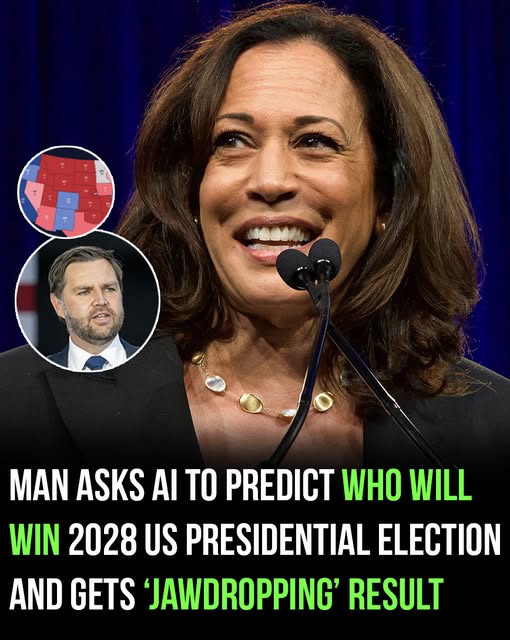
AI Simulation of the 2028 U.S. Election Draws Attention With Hypothetical Electoral Map
An Early Forecast Sparks Online Debate
The 2028 U.S. presidential election is already becoming a topic of speculation, despite the fact that official candidates have not yet been confirmed. A recent simulation using artificial intelligence has intensified the discussion by presenting a hypothetical Electoral College map and projected matchup.
The forecast gained traction after the YouTube channel Election Time asked Grok AI to simulate the race and generate a full electoral projection. The model was tasked with analyzing a potential contest between former Vice President Kamala Harris and incumbent Vice President JD Vance.
The video explains the premise clearly, stating: ”In this video, I asked Grok AI to predict the 2028 presidential election and give us a map forecast.”
How the Simulation Was Conducted
The simulation incorporated early primary polling data, betting market trends, and state-by-state historical voting patterns to create a projected Electoral College outcome. Grok AI, developed by xAI and associated with Elon Musk, was used as the forecasting tool for the exercise.
Rather than presenting a definitive prediction, the model outlined a hypothetical scenario based on current political indicators and recent electoral trends.
The approach included breaking down the race into primary contests, followed by a detailed allocation of solid, likely, and lean states for each candidate.
Democratic Primary Landscape
On the Democratic side, the simulation places Kamala Harris in the lead in early primary polling with 32 percent support. California Governor Gavin Newsom follows at 23.8 percent, while Mayor Pete Buttigieg ranks third at just under 10 percent.
Representative Alexandria Ocasio-Cortez and Pennsylvania Governor Josh Shapiro appear further behind in the early projections.
The host notes that Harris’s polling lead could be unexpected to some observers, particularly because “many people did write Kamala Harris off following her 2024 election defeat.”
However, the simulation indicates renewed momentum, supported by betting market data showing a 56 percent chance that she will run for the Democratic nomination in 2028, compared to just 11.2 percent a few months earlier.
“Today, it is more likely than not that she is going to run again,” the video states.
Republican Primary Projections
On the Republican side, the model shows Vice President JD Vance as the dominant early favorite. He is projected to receive 49.2 percent support in primary polling, significantly ahead of Donald Trump Jr., who trails by 29 points.
Senator Marco Rubio is listed with 12.5 percent support, followed by Florida Governor Ron DeSantis at 9.2 percent.
The simulation assigns Vance a 46 percent chance of securing the Republican nomination, while Rubio is projected at 18 percent.
As summarized in the video, “If nothing big changes, he will very likely become the party’s nominee in the next presidential race.”
Solid States Provide an Early Electoral Edge
The AI model begins its Electoral College map by assigning “solid” states, defined as those decided by margins of 15 points or more. In this category, Vance is projected to secure a large block of reliably Republican states.
These include Utah, Idaho, Montana, Wyoming, North Dakota, South Dakota, most of Nebraska, Kansas, Oklahoma, Missouri, Arkansas, Louisiana, Mississippi, Alabama, Tennessee, Kentucky, West Virginia, Indiana, South Carolina, and Ohio.
The inclusion of Ohio as a solid state is highlighted as a notable shift, as it was once considered a key battleground.
The host remarks: “It is not difficult to see that he will carry the Buckeye State by a solid 15-point margin,” referencing recent electoral trends.
Democratic Strongholds Remain Stable
Harris’s projected solid states largely reflect her previous electoral coalition, with some modest adjustments. The simulation places Washington, California, Hawaii, Vermont, Massachusetts, Connecticut, Delaware, Maryland, the District of Columbia, and Maine’s first district firmly in her column.
Notably, the model predicts Connecticut and Delaware returning to stronger Democratic margins after closer results in 2024.
After assigning solid states, the simulation shows Vance leading 139 to 108 in electoral votes.
Likely States Expand the Gap
The “likely” category, defined as states decided by margins between 5 and 15 points, further increases Vance’s projected advantage.
He is forecast to win Iowa, North Carolina, Florida, Texas, Arizona, Alaska, and Maine’s second district. Florida and Texas are treated as firmly Republican following recent electoral performances, while Arizona is expected to remain in the Republican column after its narrow shift in 2024.
With both solid and likely states included, Vance’s total reaches 246 electoral votes, placing him within 24 votes of the 270 needed to win the presidency.
Meanwhile, Harris’s likely states include Oregon, Colorado, New Mexico, Illinois, New York, Maine statewide, Rhode Island, and Virginia.
The simulation flags Illinois and New York as potential warning signs due to narrower Democratic margins in recent elections.
Key Battlegrounds in the Upper Midwest and Sun Belt
The “lean” category, representing margins between 1 and 5 points, highlights some of the most competitive states in the projection. Nevada and Georgia are placed in the lean Republican column.
Nevada, which had not supported a Republican presidential candidate since 2004 before flipping in 2024, is forecast to remain narrowly Republican in the simulation.
Georgia, historically competitive, is also projected to lean Republican under the modeled scenario.
In the Upper Midwest, Wisconsin, Michigan, and Pennsylvania are predicted to move together once again. These three states have voted for the same presidential candidate in every election since 1992.
After shifting back in 2024, the model forecasts Vance carrying all three states by narrow margins.
Lean Democratic States and Final Tally
On the Democratic side, New Jersey and Nebraska’s second district are classified as lean blue. Harris is projected to win New Jersey by just under five points, a significant drop compared to earlier Democratic margins.
At this stage of the simulation, the Electoral College projection stands at 312 electoral votes for Vance and 212 for Harris.
This outcome reflects the cumulative effect of solid, likely, and lean state assignments within the model’s assumptions.
Online Reactions to the Simulation
The video showcasing the AI-generated forecast quickly sparked strong reactions across online platforms. Viewers debated both the hypothetical matchup and the broader implications of the projected map.
Some comments expressed skepticism about the Democratic primary outlook, with one viewer stating: “I don’t believe the Democrats could be stupid enough to run Kamala again.”
Another added: ”There is no way Kamala wins a primary.”
Others focused on the potential dynamics of a head-to-head race, writing: ”Can you imagine the debates between J.D and Kamala? Lmao!!!”
Broader Political Speculation
Beyond individual candidates, some viewers discussed wider electoral factors that could influence future outcomes. One comment suggested: ”If voter ID is enforced nationwide, there’s no way a Democrat wins the Whitehouse and we could even see House and Senate seats go to more Republicans.”
Another viewer speculated about potential shifts in traditionally competitive states, stating: ”Gosh, I’d crack up laughing so much if Minnesota flips red this year, definitely in 2028. How funny.”
These reactions highlight how early simulations can generate both analysis and speculation, even years before an actual election takes shape.
A Hypothetical Scenario, Not a Prediction
While the simulation has attracted significant attention, it remains a hypothetical exercise based on current data, polling trends, and modeled assumptions. The actual 2028 presidential race will depend on confirmed candidates, campaign dynamics, and evolving political conditions.
With primaries still years away and the political landscape constantly shifting, any forecast at this stage is inherently speculative.
Nevertheless, the AI-generated map demonstrates how emerging technologies are increasingly being used to explore potential electoral scenarios and stimulate public discussion.
Early Interest in the 2028 Race
The growing interest in the 2028 election reflects broader engagement with political forecasting and digital analysis tools. Simulations like this one offer a glimpse into how current trends might shape future contests, even if the final outcome remains uncertain.
As discussions continue, the possibility of a matchup between JD Vance and Kamala Harris remains only one of many potential scenarios.
With several years remaining before the election cycle fully unfolds, the race is still wide open, and future developments will ultimately determine the candidates, strategies, and electoral map that define the 2028 contest.