
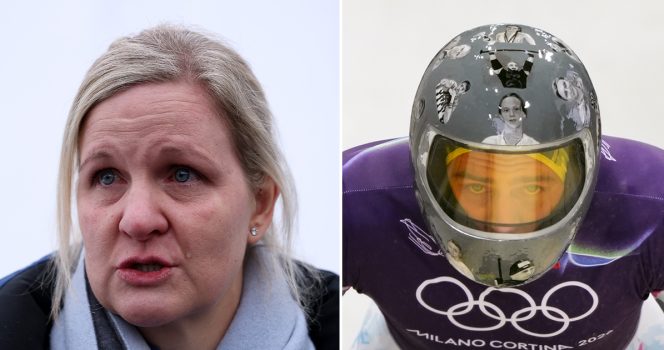
Ukrainian Skeleton Athlete Vladyslav Heraskevych Disqualified From Milano Cortina 2026 Over Helmet Tribute
Last-Minute Decision Before Olympic Competition
Ukrainian skeleton athlete Vladyslav Heraskevych has been disqualified from the Milano Cortina 2026 Winter Olympics following a dispute over a helmet honoring victims of the war in his home country.
The decision was made by the International Olympic Committee just 21 minutes before the first round of the men’s skeleton competition in Cortina on February 12.
Officials confirmed that attempts to reach a compromise with the athlete were unsuccessful.
The ruling immediately prevented him from taking part in the event.
Helmet of Memory at the Center of the Dispute
The helmet worn by Heraskevych, which he referred to as his “helmet of memory”, became the focal point of the controversy.
According to reports, the helmet featured 24 images representing war casualties.
The tribute was intended to honor athletes from Ukraine as well as children killed during the ongoing conflict instigated by Russia.
However, Olympic officials determined that the design did not comply with established regulations.
IOC Cites Guidelines on Athlete Expression
The International Olympic Committee stated that the helmet violated its Guidelines on Athlete Expression.
These regulations govern what athletes may display or wear on the field of play during official Olympic competition.
The IOC maintained that the imagery on the helmet was not compliant with these rules.
As a result, officials concluded that allowing its use during competition would breach Olympic standards.
Efforts to Reach a Compromise
Prior to the final decision, the IOC engaged in multiple discussions with Heraskevych in an attempt to find a solution.
Officials reportedly offered alternative methods for expressing his message.
One proposed option was the use of a black armband as a form of symbolic tribute.
Despite these discussions, no agreement was reached before the competition deadline.
Athlete Refuses Alternative Proposal
Heraskevych declined the IOC’s suggestion to replace the helmet tribute with a black armband.
His refusal to alter the tribute led to the enforcement of the committee’s regulations.
According to the ruling, the athlete’s non-compliance ultimately resulted in his disqualification.
The decision was made shortly before the start of the competition.
Accreditation Revoked Following Decision
After being disqualified, Heraskevych was also stripped of his Olympic accreditation.
This action rendered him ineligible to compete in the Games or access the athletes’ village.
The accreditation removal underscored the seriousness of the violation under Olympic rules.
It effectively ended his participation in the Milano Cortina 2026 Winter Olympics.
Athlete Responds to the Controversy
Breaking his silence following the decision, Heraskevych addressed the situation publicly.
“I never wanted a scandal with the IOC, and I did not create it,” he said.
His statement reflected a desire to avoid conflict while maintaining his intended message of remembrance.
The comments added a personal dimension to the broader regulatory dispute.
IOC President Acknowledges the Message
IOC President Kirsty Coventry spoke about the situation and the sentiment behind the helmet.
She acknowledged the emotional significance of the tribute.
“No one, especially me, is disagreeing with the messaging,” Coventry said.
She described the tribute as “a powerful message, it’s a message of remembrance, of memory.”
Emotional Response From Olympic Leadership
Coventry reportedly became emotional while discussing the matter.
Her remarks indicated that the issue was not about the intent behind the message but about compliance with competition rules.
The situation highlighted the tension between personal expression and Olympic regulations.
It also demonstrated the complex nature of policy enforcement in high-profile international events.
Clarification on the Field of Play Restrictions
In an interview with CNN, Coventry further clarified the reasoning behind the decision.
She explained that the primary challenge involved maintaining regulatory standards during competition.
“The challenge was to find a solution for the field of play. Sadly we’ve not been able to find that solution,” she said.
This statement emphasized the IOC’s focus on rule compliance rather than message content.
Timing of the Decision Adds to the Controversy
The late timing of the ruling intensified the controversy surrounding the case.
With the decision made just minutes before the first round of competition, the situation drew significant attention.
Observers noted that the short timeframe left little room for resolution or adjustment.
The timing contributed to widespread discussion among fans, officials, and media outlets.
Broader Debate Over Athlete Expression
The incident has sparked broader conversations about the limits of athlete expression during international sporting events.
Olympic regulations aim to maintain neutrality and consistency across competitions.
However, athletes often seek to use their platform to highlight personal or national causes.
This case illustrates the ongoing tension between personal advocacy and institutional rules.
Symbolism and Remembrance in Sport
Heraskevych’s helmet tribute was intended as a memorial gesture connected to the war affecting his home nation.
By incorporating images of casualties, the design sought to convey remembrance and awareness.
The symbolic nature of the helmet became central to the dispute.
Its emotional significance contrasted with the regulatory standards governing Olympic competition.
A High-Profile Moment at Milano Cortina 2026
The disqualification has become one of the most discussed controversies of the Milano Cortina 2026 Winter Olympics.
It highlights how off-field decisions can shape the narrative of major sporting events.
The case also underscores the influence of international regulations on athlete participation.
As discussions continue, the incident remains a notable example of the complex intersection of sport, policy, and personal expression.