
The Viral Number Puzzle That’s Dividing the Internet
For many adults, memories of solving math problems in a classroom feel far removed from daily life.
While some people still enjoy working with numbers, others associate arithmetic with stress or monotony.
Despite that, mathematical thinking has found a new home online through puzzles, brain teasers, and logic challenges that circulate widely across digital platforms.
These seemingly simple challenges often spark widespread discussion, with thousands of people debating possible answers and defending their reasoning.
One recent example has captured significant attention due to its deceptive simplicity and open-ended interpretation.
The Puzzle That Started the Debate
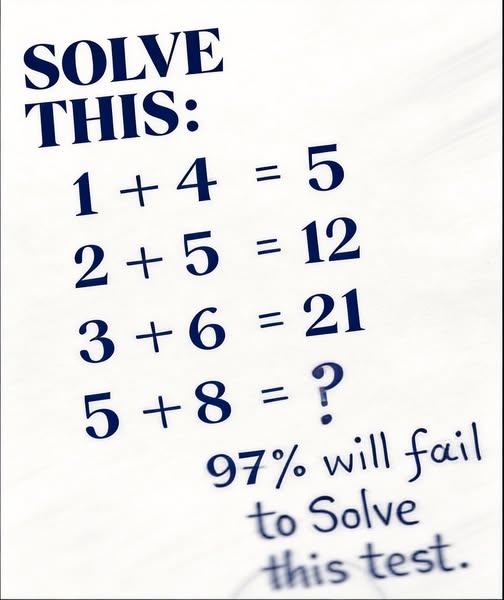
The sequence that has stirred conversation appears straightforward at first glance:
1 + 4 = 5
2 + 5 = 12
3 + 6 = 21
5 + 8 = ?
Initially, it resembles basic addition, the type of exercise taught in early mathematics education.
However, a closer look quickly reveals that standard arithmetic does not explain the results.
Adding 2 and 5 does not normally produce 12, and 3 plus 6 certainly does not equal 21.
This inconsistency is precisely what makes the puzzle compelling.
Rather than applying conventional addition, solvers must search for a hidden rule or underlying pattern connecting each line.
Why Pattern Puzzles Capture Attention
Challenges like this are often referred to as sequence or pattern problems.
The difficulty lies not in calculating correctly, but in identifying the transformation rule governing the numbers.
Such puzzles appeal to a broad audience because they blend logic, reasoning, and creativity.
They reward flexible thinking rather than rote memorization.
Online communities have embraced this specific puzzle, generating thousands of responses and interpretations.
Participants approach it from multiple angles, testing formulas, exploring cumulative sequences, and even experimenting with alternative number systems.
This diversity of thought explains why the discussion remains active and why several different answers continue to circulate.
Approach One: Multiplication Plus Addition
One of the most widely supported interpretations follows a clear mathematical structure.
Under this approach, each equation follows the formula:
Result = (A × B) + A
Applying that rule step by step produces consistent results.
1 + 4 becomes (1 × 4) + 1, which equals 5.
2 + 5 becomes (2 × 5) + 2, which equals 12.
3 + 6 becomes (3 × 6) + 3, which equals 21.
Using the same reasoning, 5 + 8 becomes (5 × 8) + 5.
That calculation equals 45.
Many puzzle enthusiasts consider 45 to be the most logical conclusion because the formula works cleanly across all given lines.
It offers a repeatable rule and produces results that align perfectly with the provided sequence.
For those who favor structured reasoning, this explanation feels both elegant and satisfying.
Approach Two: Cumulative Addition
Another interpretation focuses on building each result from the previous one.
This method assumes the rule:
Result = A + B + previous result
Using that logic, the first equation remains 5.
The second line becomes 2 + 5 + 5, which equals 12.
The third becomes 3 + 6 + 12, which equals 21.
Continuing the pattern, 5 + 8 + 21 equals 34.
This produces 34 as the final answer.
Supporters of this solution argue that the sequence builds naturally from one step to the next.
Instead of altering the arithmetic operation itself, the pattern evolves cumulatively.
Although less immediately obvious than the multiplication approach, it remains logically consistent with the earlier results.
Approach Three: Expanding Sequences
Some solvers interpret the puzzle as a growing sequence influenced by previous outputs in more complex ways.
One such method involves multiplying the second number by the previous result, then adding the first number.
When calculated step by step, the numbers increase rapidly.
Following this pattern leads to much larger outcomes, such as 1325 for the final line.
This dramatic expansion demonstrates how altering the rule slightly can completely change the trajectory of the sequence.
While fewer people endorse this interpretation, it highlights how open-ended the puzzle truly is.
Approach Four: Alternate Number Systems
Creative thinkers have taken the challenge even further by experimenting with binary and other numeral systems.
By converting numbers into alternate bases before performing operations, some arrive at answers such as 1101 or 111.
These unconventional methods reflect the playful nature of the puzzle.
They also show how deeply some participants engage with the challenge.
Although these interpretations are less traditional, they demonstrate the wide range of analytical strategies people bring to the problem.
Why No Single Answer Dominates
One of the most fascinating aspects of this sequence is the absence of a universally accepted solution.
Unlike standard arithmetic exercises, this puzzle does not specify the rule governing the transformations.
Because of that ambiguity, multiple logically defensible answers can coexist.
Some individuals insist that 45 is correct due to its clean formula.
Others argue that 34 better reflects a cumulative pattern.
Still others explore alternative systems that produce entirely different results.
This lack of certainty fuels continued discussion and debate.
Rather than discouraging participants, it encourages deeper thinking and broader interpretation.
Online Reaction and Discussion
The puzzle has generated significant conversation across social platforms and discussion forums.
Thousands of users have shared their calculations and reasoning.
In one particularly active discussion thread, more than 50,000 comments appeared as people exchanged ideas.
Some contributors confidently defended 45 using the multiplication formula.
Others supported 34 based on cumulative addition.
Many simply enjoyed analyzing the different possibilities.
Public reactions illustrate how the puzzle resonates beyond mathematics alone.
“I got 45, but honestly, I could see 34 working too. This puzzle is so fun because it makes you think in different ways.”
“At first, I thought it was simple addition… then I realized that’s not even close. My brain hurts.”
“I tried doing it in binary just for fun, and somehow I ended up with 1101. Math is wild.”
“These puzzles are great for teaching kids about sequences and patterns. It’s not about getting the answer right, it’s about understanding the logic.”
These responses reflect both frustration and enjoyment.
They also reveal how such challenges can foster collaboration and lively debate.
The Educational Value of Sequence Challenges
Beyond entertainment, pattern puzzles encourage essential cognitive skills.
They push individuals to look beyond surface-level information and search for structure.
Recognizing relationships between numbers is often more important than performing quick calculations.
The exercise also reinforces flexibility in thinking.
When one rule fails, solvers must consider alternative explanations.
This mirrors real-world problem-solving, where initial assumptions do not always hold true.
Additionally, articulating reasoning is part of the challenge.
Many people can produce an answer but struggle to explain how they reached it.
Writing out each step strengthens logical communication and analytical clarity.
Broader Applications of Pattern Recognition
The reasoning skills required for this puzzle extend far beyond mathematics.
Identifying patterns is fundamental in technology, data analysis, and programming.
Algorithms rely on predictable sequences to function efficiently.
In financial contexts, spotting trends can inform decisions and assess risk.
Even in daily life, recognizing recurring behaviors or sequences can improve planning and organization.
The ability to test multiple hypotheses and evaluate outcomes is widely valuable.
Puzzles like this serve as informal training grounds for those skills.
More Than Just an Equation
The sequence beginning with 1 + 4 = 5 has evolved into more than a simple arithmetic question.
It has become a shared intellectual exercise that invites exploration.
Whether someone concludes that the answer is 45, 34, 1325, 1101, or another possibility entirely, the true value lies in the reasoning process.
The puzzle illustrates that mathematics can be interactive and social.
It challenges assumptions and rewards creative interpretation.
Most importantly, it demonstrates that even a short list of numbers can inspire hours of thoughtful discussion.
In an era dominated by fast-scrolling content, a deceptively simple equation has managed to capture sustained attention.
Its enduring appeal proves that curiosity and logical inquiry remain powerful forces in the digital age.
Sometimes, the most engaging problems are not the ones with obvious answers, but the ones that encourage us to rethink how numbers connect.
That is the lasting impact of this viral sequence: it transforms ordinary arithmetic into an invitation to think differently.