
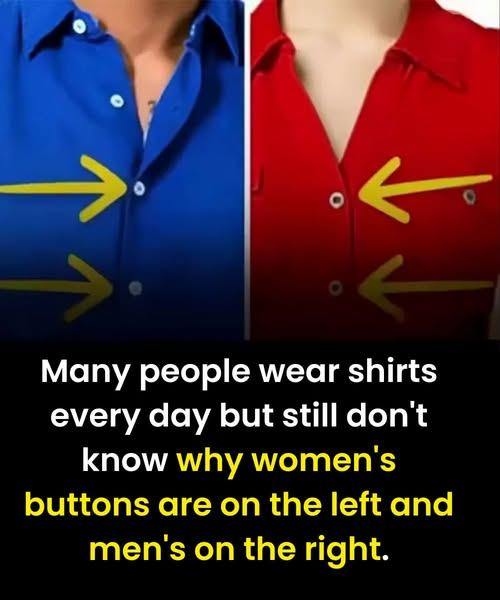
Why Men’s and Women’s Shirts Button on Opposite Sides
Each day, countless people perform a simple action without a second thought: fastening the buttons on a shirt. The task is automatic, woven into daily routine.
Yet a closer look at this ordinary garment reveals a subtle but consistent difference. Men’s shirts typically fasten on the right side, while women’s shirts button on the left.
This contrast is not random. It reflects a tradition shaped by centuries of social customs, practical needs, and historical realities that continue to influence modern clothing design.
The Historical Origins of Button Placement
To understand why shirts are constructed differently for men and women, it is necessary to look back to the 18th and 19th centuries. During this period, clothing carried clear signals about class, gender, and social standing.
Fashion was elaborate and layered, especially among wealthier segments of society. Garments were not only functional but also symbolic, reflecting position and privilege.
Button placement emerged as one small yet meaningful detail within this broader framework of design and status.
Why Women’s Shirts Button on the Left
In the Victorian era, affluent women often wore highly structured outfits. Corsets, petticoats, and multi-layered dresses were common components of formal attire.
Putting on such garments was rarely a solitary task. Many women of means relied on attendants to help them dress.
Because the majority of people were right-handed, a servant standing face-to-face with the wearer could fasten buttons more easily if they were positioned on the wearer’s left side. This arrangement simplified the process and reduced awkward movements.
The placement allowed attendants to work efficiently while maintaining the expected decorum of the time. Practicality blended with social hierarchy to establish a pattern that became standard.
As clothing production evolved and garments became more widely available, the design convention persisted. Even after women began dressing themselves without assistance, the left-side button orientation remained in place.
Over time, what began as a practical solution tied to class structure became a defining feature of women’s clothing. It transitioned from necessity to norm, eventually viewed as an inherent characteristic of feminine garments.
Why Men’s Shirts Button on the Right
Men’s clothing developed along a different trajectory, influenced by distinct roles and daily activities. Unlike many upper-class women, men typically dressed themselves.
Button placement for men aligned with right-handed dominance. With buttons positioned on the right side of the garment, fastening a shirt or jacket felt more intuitive for someone using their right hand.
Beyond dressing convenience, historical considerations related to combat also played a role.
In earlier centuries, men frequently carried swords, which were usually worn on the left side of the body. This positioning allowed the weapon to be drawn swiftly with the right hand.
If a coat or shirt overlapped in a way that obstructed movement, the fabric could interfere with accessing the weapon. Designing garments to open from left to right minimized the chance of snagging during a quick draw.
Thus, right-side buttons supported both daily independence and martial practicality. Clothing design served functional needs shaped by the realities of the time.
The Influence of Social Structure
The contrasting button orientations illustrate how clothing once reflected clear divisions in gender roles and class systems. Women’s fashion was intertwined with domestic structures and assisted dressing, while men’s attire emphasized autonomy and readiness.
These distinctions were reinforced through repetition. As tailors and dressmakers followed established practices, button placement became embedded in cultural expectations.
By the time large-scale garment production expanded, the conventions were already firmly established.
Industrialization and Standardization
The Industrial Revolution marked a turning point in clothing manufacturing. Garments that were once custom-made increasingly became standardized and mass-produced.
Manufacturers favored consistency. Maintaining separate button orientations for men and women aligned with established traditions and simplified production planning.
Consumers, accustomed to the familiar layout, came to expect the difference. Altering such a visible detail would have required not only manufacturing adjustments but also a shift in public perception.
As a result, the historical pattern endured. The left-right distinction transitioned seamlessly from bespoke tailoring to factory production.
Why the Tradition Persists Today
In modern life, swords are no longer part of everyday attire, and most individuals dress without assistance. The original practical reasons for opposing button placement have largely disappeared.
Even so, clothing design often retains elements rooted in history. Once a standard becomes widespread, it tends to continue unless there is a compelling reason to change it.
Button orientation is a small detail, yet it reflects broader patterns in how traditions endure. Manufacturers maintain familiar designs because consumers recognize and accept them.
Adjusting such a convention would require rethinking production systems and challenging long-standing expectations. For many brands, there is little incentive to do so.
Does Button Placement Affect Function?
For most people, the side on which buttons are placed has little practical impact. Fastening a shirt is guided by habit rather than conscious thought.
Muscle memory takes over, and the orientation feels natural regardless of the wearer’s gender. In everyday situations, the difference rarely affects comfort or ease of use.
Nevertheless, the detail remains a quiet reminder of the historical influences embedded in modern garments. It is an example of how design choices can outlast the circumstances that created them.
Shifts in Contemporary Fashion
Some modern designers and gender-neutral clothing brands have begun to question traditional norms. In certain collections, button placement is no longer dictated by gender conventions.
These shifts reflect changing attitudes toward identity and fashion. As societal roles evolve, so too does clothing design.
Despite these emerging variations, the majority of shirts available today continue to follow the traditional arrangement. The right side for men and the left side for women remains the prevailing standard.
A Detail That Tells a Larger Story
Button placement may appear insignificant, but it carries layers of meaning shaped over centuries. It connects modern wardrobes to historical practices involving attendants, combat readiness, and structured social systems.
The next time a shirt is buttoned before leaving home, it may be worth pausing to notice which side the fastening rests on. That small design feature reflects decisions made generations ago.
In the fabric of daily life, even the most ordinary objects can hold traces of history. A simple row of buttons serves as a quiet link between the present and the past.
Through habit and tradition, these details persist. What began as practical solutions tied to social hierarchy and historical necessity continues today as an accepted norm in clothing design.
Though rarely considered, the orientation of shirt buttons illustrates how enduring conventions can shape everyday experiences. In that sense, fastening a shirt is not merely a routine act but a continuation of a long-standing custom woven into the structure of modern attire.