
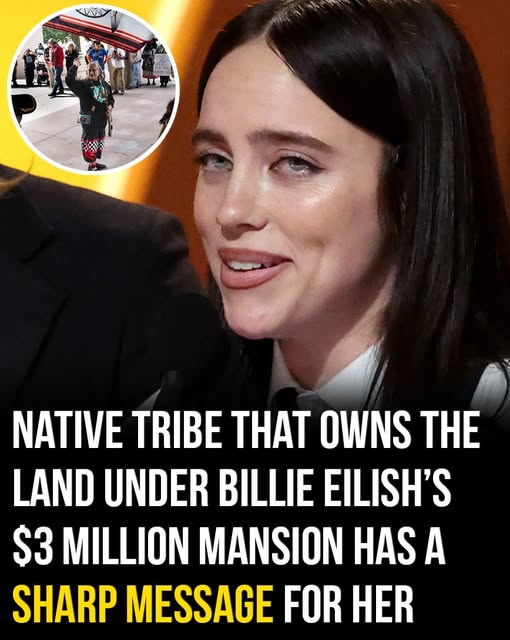
Billie Eilish made headlines at the 65th Annual Grammy Awards on February 1, 2026, not only for winning Song of the Year for “Wildflower,” but also for using her acceptance speech to deliver a pointed political message about immigration, ICE, and the legacy of colonization in North America.
Standing alongside her brother and co-writer Finneas O’Connell, the 24-year-old singer said, “As grateful as I feel, I honestly don’t feel like I need to say anything but that no one is illegal on stolen land.” She added, “And f**k ICE, that’s all I’m gonna say, sorry!”
The remarks immediately went viral, drawing praise from supporters and fierce criticism from detractors, and reigniting a broader debate over the relationship between historical injustice, modern politics, and personal wealth.
The Tongva Tribe Responds
Eilish’s Los Angeles home, valued at roughly $3 million, sits on land historically inhabited by the Gabrieleno Tongva people, the Indigenous community that lived in the Los Angeles basin for thousands of years before European colonization.
Following her speech, the Tongva tribe released a statement acknowledging Eilish’s comments while emphasizing the importance of accurately naming the people whose land is being discussed.
A tribal spokesperson told The Daily Mail: “We appreciate the opportunity to provide clarity regarding the recent comments made by Billie Eilish. As the First People of the greater Los Angeles basin, we do understand that her home is situated in our ancestral land. Eilish has not contacted our tribe directly regarding her property, but we do value the instance when public figures provide visibility to the true history of this country.”
The spokesperson added that the tribe hopes future discussions will explicitly reference the Gabrieleno Tongva people so the public understands that “the greater Los Angeles basin remains Gabrieleno Tongva territory.” The tribe also said it had reached out to Eilish’s team to express appreciation for her comments.
Praise and Backlash
Supporters quickly applauded Eilish for using a global platform to highlight the history of colonization and the ongoing impact on Indigenous peoples. Many praised her for bringing a conversation about “stolen land” into a mainstream cultural moment watched by millions.
Critics, however, focused on what they saw as a contradiction between her message and her personal wealth, particularly her ownership of a multi-million-dollar home on ancestral Tongva land. Some argued that acknowledging “stolen land” should come with concrete action, such as land restitution or significant financial support.
Political commentator Eric Daugherty wrote on X: “Americans are calling on Hollywood elitist Billie Eilish to RETURN her $14M LA mansion to the Tongva tribe after she claimed, ‘no one is illegal on stolen land.’ She could also graciously host illegal aliens in her mansion. After all, she has the moral high ground. Put up or shut the F up.”
Sen. Mike Lee (R-Utah) added: “Any White person who does a public ‘stolen land’ acknowledgment should immediately give his or her land to Native Americans. Otherwise, they don’t mean it.”
Minnesota state Rep. Walter Hudson echoed the sentiment, writing: “‘No one is illegal on stolen land.’ Okay. So… the states and the union they created, along with every deed to property on the continent, is illegitimate. Why aren’t you acting accordingly? Donate everything and leave.”
Other figures weighed in as well. Conservative commentator Greg Price mocked what he described as celebrity hypocrisy, while Florida Gov. Ron DeSantis dismissed the remarks as “this ‘stolen land’ nonsense” and suggested Eilish should forfeit her mansion if she truly believed her claim. Elon Musk responded to one criticism with a single word: “Exactly.”
A History of Activism
Eilish has long been outspoken on immigration and law enforcement, particularly in her criticism of ICE. In past interviews, she has accused the agency of engaging in violent or coercive actions, including raids she says have resulted in deaths. Her Grammy speech tied those concerns to the broader history of colonization and Indigenous displacement, suggesting that modern immigration debates cannot be separated from that past.
The Tongva and the Legacy of the Land
The Gabrieleno Tongva are the original inhabitants of the Los Angeles basin, with a culture that predates Spanish colonization by thousands of years. The arrival of European settlers in the 18th century brought displacement, disease, and systemic cultural erasure.
Today, the Tongva are not federally recognized as a sovereign tribe, a status that complicates land claims and legal authority. Even so, they continue to advocate for recognition, cultural preservation, and public acknowledgment of historical injustices. Their response to Eilish’s comments reflected that balance: appreciation for increased visibility, coupled with a call for more precise and consistent recognition of their people.
Social Media and the Bigger Questions
Online reaction mirrored the broader divide. Supporters praised Eilish for “speaking truth” and using her platform for justice. Critics argued that words were not enough and demanded to see actions that matched the rhetoric.
At the heart of the controversy are larger, unresolved questions: If modern Americans acknowledge that much of the country sits on land taken from Indigenous peoples, what responsibility follows? Is acknowledgment alone meaningful, or does justice require restitution, policy changes, or material support? And how should historical claims intersect with modern property law, especially when many tribes lack federal recognition?
A Cultural Flashpoint
Eilish’s Grammy speech became a flashpoint in the ongoing debate over celebrity activism, wealth, and historical responsibility. By linking past colonization to present-day immigration policy, she forced a conversation that is rarely centered on a mainstream awards-show stage.
While the reactions ranged from praise to outrage, the moment also brought renewed attention to the Gabrieleno Tongva and the history of the land beneath Los Angeles. In that sense, the controversy underscored a familiar reality of modern public discourse: celebrity statements can amplify long-suppressed histories, but they also invite scrutiny over how words, wealth, and actions align.