
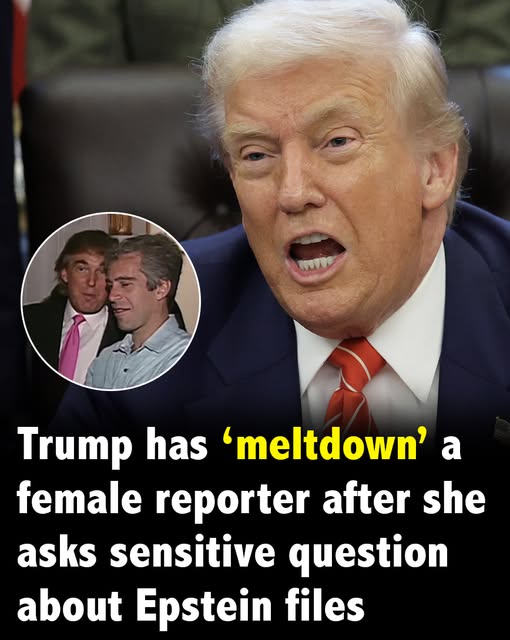
A heated exchange in the Oval Office underscored how sensitive the Jeffrey Epstein investigation remains for President Donald Trump as questions continue to surround the recent release of millions of pages of government records. The confrontation unfolded during a joint appearance with U.S. House Speaker Mike Johnson, when CNN White House correspondent Kaitlan Collins raised the issue of Epstein’s survivors and the broader implications of the newly disclosed files.
The moment came at a time when public attention has intensified around the scope, timing, and completeness of the disclosures. A comparison circulating in political circles and online commentary has highlighted how frequently Trump’s name appears within the Epstein-related records, contrasting that frequency with the number of times the name “Harry Potter” appears across seven novels. The comparison has added fuel to a debate that the president has repeatedly signaled he wants to end.
Speaking to reporters, Trump said the country should move past the issue following the Justice Department’s latest document release. “I think it’s really time for the country to get on to something else,” he said in the Oval Office. The remark came days after the department made public nearly three million additional pages connected to the long-running investigation into Epstein, the financier who died in custody in 2019 after being charged with sex trafficking.
Despite the call to move on, the topic quickly returned to center stage when Collins asked about the impact on victims. Trump, 79, responded sharply. Turning toward the reporter, he opened with a personal jab: “Look, CNN is thrilled… She never smiles. Someday I’ll see her smile.” The comment drew attention in the room, but Collins continued, attempting to ask about those who survived Epstein’s crimes. “What would you say to the survivors…” she began.
The president cut her off and escalated his criticism. “You are the worst reporter. No wonder CNN… CNN has no ratings because of people like you. You know she’s a young woman. I don’t think I’ve ever seen you smile. I’ve known you for 10 years, I don’t think I’ve ever seen a smile on your face,” he said.
Collins replied evenly, “Well, I’m asking you about survivors.” Trump immediately pushed back again. “You know why you’re not smiling? Because you know you’re not telling the truth…You’re a very dishonest organization, and they should be ashamed of you.”
The exchange played out in front of cameras and staff, turning a policy discussion into a public dispute over media credibility and tone. It also highlighted the broader tension between the administration and news organizations as scrutiny of the Epstein files continues.
Collins, 33, began her career as an entertainment reporter before becoming a White House correspondent for The Daily Caller in 2016. She joined CNN a year later and has since anchored multiple programs while continuing to cover the White House. Following the incident, the network issued a statement in her defense: “Kaitlan Collins is an exceptional journalist, reporting every day from the White House and the field with real depth and tenacity. She skillfully brings that reporting to the anchor chair and CNN platforms every day, which audiences around the world know they can trust.”
The Oval Office clash was not an isolated moment. Trump has criticized Collins in the past and has used social media and public appearances to single out other journalists as well. In December 2025, he referred to Collins as “always stupid, and nasty” after she asked about a White House ballroom remodeling project. He has also targeted CBS News correspondent Nancy Cordes, calling her “a stupid person,” and New York Times reporter Katie Rogers, whom he labeled “ugly, both inside and out.”
These comments have unfolded against the backdrop of a complex legal and political process tied to the Epstein Files Transparency Act. The law required the Justice Department to disclose all documents related to Epstein by December 19, 2025. The final release, totaling more than three million pages, arrived more than a month after the deadline, prompting criticism from advocates for victims and from lawmakers who argue that the public still does not have a complete picture.
The documents span years of investigations, interviews, and internal communications. They also include redactions that have become a focal point of controversy. While the department has stated that the release meets legal requirements, critics contend that significant gaps remain and that the pace of disclosure has undermined confidence in the process.
Jennifer Plotkin, who represents more than 30 victims, reacted sharply to the scope and presentation of the files. “The release of the files proves the government failed the victims over and over again,” she said. Women’s rights attorney Dr. Ann Olivarius has argued that the materials do not clearly explain the immunity arrangements that once shielded Epstein from earlier prosecution, an issue that has long been a point of contention in legal and advocacy circles.
Other attorneys have raised specific questions about what is still missing. Jennifer Freeman, who represents Maria Farmer, one of the earliest known accusers, pointed to gaps in the records. “Where is the rest of Maria Farmer’s FBI file? Where are the records of complaints that so many other women made to FBI and how the FBI investigated those complaints?” she asked.
Concerns have also reached Capitol Hill. Congressman Jamie Raskin addressed the scope of the disclosures and the extent of the redactions. “They’ve only released 3m with more than 10,000 redactions. What about the other 3m files? We’re just getting the dribs and drabs of information coming out, the stuff that they want us to see,” he said.
The Justice Department has rejected the notion that it is withholding material in violation of the law. A department official responded to the criticism with a blunt statement: “This is a tired narrative. Just because you wish something to be true, doesn’t mean it is. This Department produced more than 3.5 million pages in compliance with the law and has disclosed to the public and to Congress what items were not responsive, in accordance with the Act.”
The debate over numbers and timing has kept the Epstein case in the headlines years after his death. Epstein, once a well-connected financier, was accused by numerous women of sexual abuse and trafficking. His arrest and subsequent death in a New York jail cell set off a wave of investigations, lawsuits, and calls for transparency that continue to reverberate through the legal system and the political arena.
For the administration, the challenge has been balancing legal obligations with political pressure. The president’s insistence that the country should “get on to something else” reflects a desire to close a chapter that remains uncomfortable and contentious. Yet the persistence of questions from lawmakers, attorneys, and the media suggests that the issue is far from settled.
The confrontation with Collins illustrates how quickly the discussion can shift from policy to personality. While the original question focused on survivors, the exchange became a dispute over media conduct and credibility. Supporters of the president argue that the press has pursued the story with excessive hostility, while critics contend that aggressive questioning is necessary given the gravity of the allegations and the long history of institutional failures surrounding the case.
The public release of millions of pages has done little to quiet those disagreements. Instead, it has produced a new phase of scrutiny centered on what the documents reveal, what they omit, and how the information is being presented. For victims and their advocates, the focus remains on accountability and clarity. For the administration, the emphasis has been on compliance with the law and moving forward.
The president’s age and long public career have also shaped the way the moment is being interpreted. At 79, Trump is no stranger to confrontations with reporters, and his exchanges with the press have been a defining feature of his political style. The comments directed at Collins fit a broader pattern of combative interactions that have drawn both praise and criticism over the years.
Yet the underlying issue goes beyond a single press conference. The Epstein case represents one of the most troubling criminal scandals of recent decades, involving allegations of abuse, trafficking, and systemic failures that allowed wrongdoing to continue for years. The Transparency Act was designed to address those failures by forcing a full accounting of what happened and how institutions responded.
Whether the recent document release fulfills that promise remains a subject of intense debate. The presence of redactions, the questions about missing files, and the delayed timeline have all fueled skepticism. At the same time, the sheer volume of material made public underscores the scale of the investigation and the complexity of the record.
In the Oval Office, however, the focus returned to a simpler message. “I think it’s really time for the country to get on to something else,” the president said. The remark captured a desire to close the book on a story that continues to produce difficult questions. The reaction from critics suggests that many are not ready to do so.
As the legal process moves forward and as more analysis of the released files takes place, the Epstein case is likely to remain a point of contention. The clash with Collins may fade from the news cycle, but the broader issues it highlighted—transparency, accountability, and the treatment of survivors—are unlikely to disappear.
For now, the episode stands as another example of how the intersection of politics, media, and unresolved legal questions can turn a routine press appearance into a flashpoint. The documents are public, the arguments continue, and the debate over what remains unseen shows no sign of ending.