
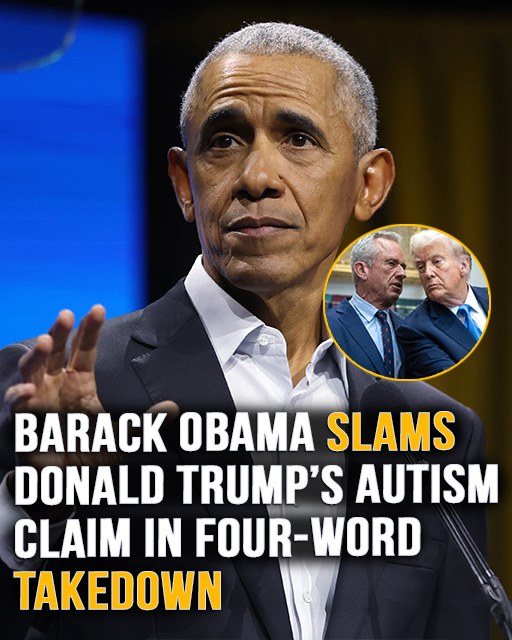
Barack Obama has emerged with a sharp rebuke of his successor, labeling Donald Trump’s recent assertion linking Tylenol use to autism as “violence against the truth.” The former president’s remarks come in response to a heated and controversial announcement from Trump earlier this week—one that has rattled the medical community and provoked fierce debate.
The controversy took off at a memorial event in Glendale, Arizona, honoring activist Charlie Kirk. Speaking to a large crowd, Trump teased a bombshell discovery: “I think we found an answer to autism,” he said, promising that a forthcoming press conference would be “one of the most important” of his career. The bold claim drew widespread attention.
Days later, Trump did deliver. Standing beside his Health and Human Services Secretary, Robert F. Kennedy Jr.—a known skeptic of established medical science—he announced that the Food and Drug Administration would warn doctors of a “very increased risk” of autism tied to prenatal use of acetaminophen (Tylenol). He asserted that his directive would go into effect “immediately,” urging pregnant women to avoid the drug. Citing intuition over data, he added, “I go by what I feel,” while questioning scientific findings that contradict his stance.
Medical experts responded swiftly and sternly. Across the field—from the CDC to global health organizations—there is no credible evidence supporting a causal link between Tylenol and autism. Many scientists said the proclamation not only lacks grounding, but also sets a dangerous precedent: public health messaging led by emotion, not by rigorous evidence.
During a speaking engagement in London, Obama entered the fray. Confronting the claim head-on, he said, “We have the spectacle of my successor … making broad claims around certain drugs and autism that have been continuously disproved.” He continued: “It undermines public health … and that can do real harm to women.” Calling Trump’s assertions “violence against the truth,” Obama delivered one of his most pointed critiques in years.
His intervention breaks with a pattern of restraint—since leaving office in 2017, Obama has generally avoided personally attacking Trump, focusing instead on broader themes of democracy and civic responsibility. But the stakes in public health, he implied, demanded he speak out.
On social media and in public discourse alike, reactions have been sharply divided. Trump’s backers praised him for taking on what they called the “deep state” in medical institutions. Critics warned that his advice could dissuade pregnant women from using the safest available options for pain and fever relief—especially dangerous when untreated fever itself can pose risks.
Robert F. Kennedy Jr.’s presence only amplified alarm. Known for challenging vaccine science and promoting fringe theories, his role signals the administration’s willingness to embrace unorthodox—and widely disputed—medical positions.
Obama’s framing may have elevated the discussion: calling misinformation itself a form of violence. He positioned the controversy not as a dispute over one drug, but as part of a deeper battle over whether scientific reality is respected by those in power.
As the backlash mounted, health professionals and autism advocates mobilized. Obstetricians emphasized that acetaminophen remains safe when used appropriately during pregnancy. Advocates cautioned that the president’s claims could stigmatize families and mislead vulnerable parents.
The clash between Trump’s intuition-driven approach and Obama’s defense of evidence underscores a broader political fault line: one side increasingly distrusts expert institutions, while the other warns of the consequences when facts are discarded for political convenience.
Whether Obama’s harsh critique will shape public opinion or policy remains uncertain. But in his sharp phrasing, he touched a nerve.
Read Part 2