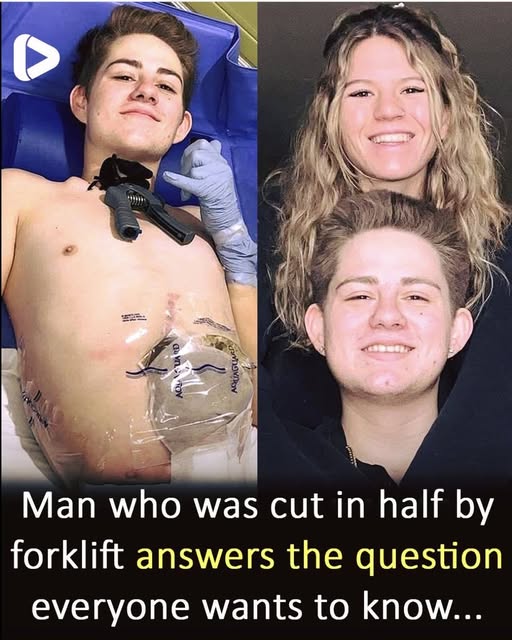
Loren Schauers was a young worker in Montana with a routine life and ordinary plans, until a single moment in September 2019 reshaped everything. One day at work turned into a medical emergency that would test the limits of endurance, decision-making, and survival.
At just 19 years old, Schauers, who is from Great Falls, Montana, was operating a forklift and driving it across a bridge. The structure failed beneath the heavy machine, sending both the vehicle and its operator plunging roughly 50 feet to the ground. The fall left the four-ton forklift on top of him, trapping him beneath its weight and turning an ordinary workday into a fight for life.
Emergency responders arrived to find a scene defined by urgency and danger. Schauers remained conscious throughout the ordeal. He could see what was happening to his body and understand the severity of his injuries as they unfolded. His right arm was crushed, and the lower part of his body was pinned beneath the massive machine. The injuries were catastrophic, and the situation left little room for delay or uncertainty.
Doctors faced a grim reality as they assessed his condition. The damage to his body was so severe that standard treatment options offered little hope of survival. The injuries were not confined to one area; they threatened his entire system. In the hospital, as teams worked to stabilize him, Schauers was confronted with a decision that few people ever have to face, especially at such a young age.
In an interview, he described the moment when the choice was placed before him: “The doctors presented me with a decision. The question was, do you wish to live or die? Would you prefer to live with your current condition or die with the life you once had?”
The choice was as stark as it was irreversible. To survive, Schauers would have to undergo a procedure that would remove half of his body. The alternative was to decline the surgery and accept that he would not live. In the midst of shock, pain, and uncertainty, he chose life.
The operation that followed was extreme, but it was the only path forward. Surgeons performed a hemicorporectomy, a rare and drastic procedure that involves amputating the lower half of the body. The goal was not restoration, but survival. Every step was focused on stopping the spread of damage and giving his body a chance to recover.
While Schauers fought for his life in the hospital, his girlfriend, Sabia, remained at his side. The situation was so uncertain that she said goodbye to him six times during his stay, each time believing it might be the last. Medical staff repeatedly told her that he was not expected to survive another day. The prognosis shifted from hour to hour, and hope was fragile.
Those early days were marked by constant monitoring, emergency interventions, and the steady presence of uncertainty. The human body can endure extraordinary trauma, but recovery from such injuries is never guaranteed. Every small improvement was significant, and every setback carried heavy emotional weight for those watching and waiting.
Schauers’ survival after the surgery marked the beginning of a long and complex recovery process. The immediate danger had passed, but the challenges ahead were immense. Learning to live after such a profound physical change required not only medical care, but also psychological resilience and sustained support from those around him.
The story of his accident and survival highlights the unpredictable risks present in industrial work environments. Heavy machinery, elevated structures, and daily routines can become dangerous in seconds when something goes wrong. In this case, a collapsed bridge and a falling forklift created a chain of events that no one could have anticipated.
It also underscores the reality that trauma care often involves decisions that are both urgent and life-altering. In emergency medicine, doctors and patients sometimes face choices where every option carries permanent consequences. Schauers’ experience reflects that harsh reality, where survival itself can depend on accepting a future that looks nothing like the past.
For his family and loved ones, the period following the accident was defined by waiting and uncertainty. Each update from the medical team carried enormous weight. The repeated warnings that he might not make it through another day made every hour feel critical. In that environment, even small signs of stability were meaningful.
As the immediate crisis passed, attention turned to rehabilitation and long-term adjustment. Recovery from such an injury is not measured in days or weeks, but in months and years. It involves learning new ways to move, to work, and to live independently, all while processing the emotional impact of what has been lost.
Schauers’ case also draws attention to the rare nature of the surgery he underwent. A hemicorporectomy is performed only in the most extreme circumstances, when no other option can preserve life. It is a procedure that represents both the limits and the possibilities of modern medicine, showing how far medical teams can go when survival is at stake.
Despite the severity of his injuries, Schauers’ awareness during the accident and in the moments that followed has remained a defining part of his story. Being conscious through such trauma adds another layer to the experience, one that involves memory, fear, and the weight of understanding what is happening in real time. It is a burden few people ever have to carry.
His girlfriend’s experience during that time also illustrates the emotional toll on loved ones who stand by hospital bedsides during critical illnesses. Saying goodbye repeatedly, while still holding onto hope, creates a cycle of grief and uncertainty that is difficult to put into words. It is a reminder that serious injuries affect not only the person who is hurt, but everyone connected to them.
The accident in Montana became a moment that changed the course of a young man’s life, but it also became a story of survival against overwhelming odds. While the physical consequences are permanent, the decision to live allowed Schauers to move forward into a future that, while different, still exists.
In the broader context, his experience serves as a powerful example of the choices that can emerge in moments of crisis. It shows how quickly normal life can be replaced by emergency, and how resilience can appear in circumstances that seem impossible to endure.
Workplace safety, emergency response, and medical readiness all intersect in stories like this. They reveal how systems, people, and decisions come together in critical moments, and how outcomes can depend on both preparation and courage.
For Schauers, the path forward has been shaped by the events of that September day. The fall, the injuries, the surgery, and the long recovery process are now part of his history. So is the decision he made in the hospital, when faced with a choice between life and death.
That decision did not erase the trauma or the loss, but it allowed survival to remain possible. It stands as a testament to the difficult realities faced in emergency medicine and to the strength required to confront them.
His story continues to resonate because it combines the unpredictability of accidents, the limits of the human body, and the determination to keep going even when the cost is enormous. It is not a story of easy recovery or simple triumph, but one of endurance in the face of circumstances that few people will ever encounter.
In the end, Loren Schauers’ experience is a reminder that life can change in an instant, and that sometimes survival depends on choices no one ever expects to have to make. It is a story marked by loss, resilience, and the stark reality of what it can mean to choose to live.