
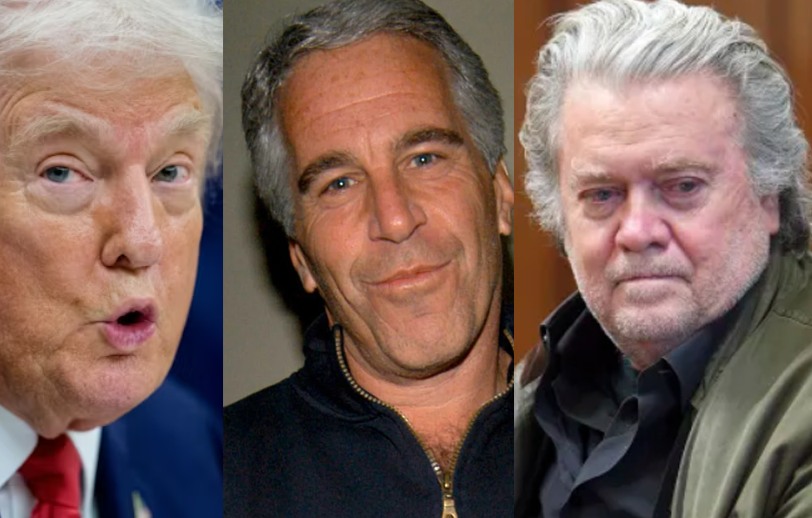
A new tranche of documents connected to Jeffrey Epstein has brought fresh scrutiny to a series of messages involving Steve Bannon, a former senior adviser to Donald Trump, and references to activity inside Trump’s residence. The materials include a text thread in which Epstein uses coarse language, discusses a woman identified as Madeleine Westerhout, and describes seeing Trump in a state of undress inside the home.
The exchange is part of a broader document release that continues to map Epstein’s communications with political and business figures during the years before his death. The messages are presented as verbatim excerpts, preserving spelling, punctuation, and phrasing as they appear in the records.
In one thread, Epstein and Bannon discuss Westerhout, who served as a Trump adviser during his first term in office. The conversation begins with Epstein referencing her by name and tone, followed by a response from Bannon that identifies her role.
The exchange reads:
EPSTEIN: Do you know Marianne , Donalds new friend ? Madelaine. Westerhut . Very funny
BANNON: She is the receptionist– good kid ; grundoon– cam from rnc
EPSTEIN: Kneepads. Doing Gods work
BANNON: LMAO
EPSTEIN: Hes much more calm, but the sight of him in the residence in his undies is hard to fathom . Ill give you details when I see you .
The two things he dreads at the moment is that an email from his ex. Saying he has small dick. And his transcript.
BANNON: The staying away from family over holidays huge tell
EPSTEIN: Thats for Madeline 😊
The language in the messages is blunt and disparaging. Epstein’s use of the term “Kneepads” is presented as a nickname directed at Westerhout, and the thread includes a line in which Epstein claims he saw Trump “in the residence in his undies.” The exchange also includes commentary about personal anxieties and family matters, reflecting a tone that mixes crude humor with gossip.
The messages appear within a collection of files that also contain communications between Epstein and a range of other contacts. This particular thread stands out because of its direct references to the interior of Trump’s residence and the personal remarks attributed to Epstein.
Westerhout later became a public figure in her own right after leaving her position in the White House. She resigned following an incident in which she became intoxicated and disclosed information to the media, including a remark that Trump did not want to be seen in public with his daughter Tiffany because she was overweight. That episode led to her departure and added to the record of internal controversies during Trump’s first term.
The text exchange also contains a term used by Bannon, “grundoon,” which has a specific cultural reference. The word is drawn from the comic strip Pogo, where it describes a gibberish-speaking, diapered groundhog. Bannon has been known to use the term as an insult directed at subordinates or people he views as foolish or expendable. Its appearance in the message provides additional context for the tone of the conversation and the way the participants spoke about staff.
Within the thread, Epstein’s message about seeing Trump “in the residence in his undies” is presented without further detail in the text itself, aside from the statement that he would provide more information in person. The phrasing suggests familiarity with the setting and access to the residence, although the messages do not include a date, time, or location for the described encounter.
The documents do not establish the circumstances under which Epstein claims to have been present, nor do they provide independent verification of the scene he describes. They do, however, place Epstein and Bannon in a direct line of communication discussing people connected to Trump and referencing the interior of Trump’s living space.
The broader release of files has continued to draw attention because of Epstein’s history and the scope of his contact list. Epstein, a financier with extensive social connections, became widely known after his criminal cases involving sexual exploitation. His communications have been examined for insight into how he maintained relationships with influential figures across politics, business, and entertainment.
Steve Bannon, who served as a key strategist during Trump’s 2016 campaign and early presidency, appears in multiple records tied to political communications during that period. The presence of his name in Epstein-related materials adds another layer to the ongoing review of how Epstein intersected with political circles.
The messages about Westerhout are notable because they reference a specific staff member who later became part of a separate controversy. During her time in the White House, Westerhout held a role that placed her in close proximity to the president, and her resignation followed a widely reported incident involving disclosures to reporters. The text thread’s use of a derogatory nickname and the comments about her role reflect a dismissive and mocking tone toward her position.
The exchange also includes a line in which Epstein writes, “The two things he dreads at the moment is that an email from his ex. Saying he has small dick. And his transcript.” The phrasing is crude and appears to be part of a broader pattern in the thread of personal insults and gossip. Bannon’s response, “The staying away from family over holidays huge tell,” continues the conversational back-and-forth without addressing the earlier claim directly.
The final line from Epstein in the thread, “Thats for Madeline 😊,” returns the focus to Westerhout and reinforces the impression that the earlier comments were being framed as jokes or barbs directed at her.
Taken together, the messages present a snapshot of how Epstein communicated privately with political figures and how he described people connected to Trump. The tone is informal, derisive, and often vulgar, which contrasts sharply with the public images of the individuals involved.
The release of these messages has renewed attention on the question of how often Epstein interacted with political figures and what level of access he had to private spaces. While the texts themselves do not document specific actions beyond the statements made within them, they do show Epstein claiming familiarity with Trump’s residence and discussing staff members by name.
The files also illustrate how Epstein used humor and shock value in his communications. References to nicknames, crude descriptions, and personal insults are woven into the conversation, suggesting a style of interaction that relied on provocation and insider language.
This latest document drop is part of a larger, ongoing process of unsealing and reviewing materials connected to Epstein’s activities and contacts. Over time, these releases have included emails, text messages, calendars, and other records that collectively build a more detailed picture of his social and professional network.
In many cases, the documents reveal social interactions and communications without establishing criminal conduct by the individuals named. They do, however, show how Epstein remained connected to powerful people and how he spoke about them privately. The presence of well-known political figures in these records continues to attract attention because of the contrast between their public roles and the tone of the private messages.
The thread involving Bannon and the references to Trump’s residence add to that body of material. The messages are notable for their specificity in naming individuals and for the claim about seeing Trump in a state of undress inside the residence. Even without additional context, the language is likely to be scrutinized closely because of what it suggests about access and familiarity.
Westerhout’s later resignation and the circumstances surrounding it provide a separate but related point of context. Her departure followed public reporting about her comments to the media, and the episode became one of several personnel controversies during Trump’s first term. The messages in the Epstein file show her name being used in a dismissive and sexualized way within a private conversation between Epstein and Bannon.
The explanation of the term “grundoon” adds a cultural footnote to the exchange, highlighting how Bannon’s language choices draw on niche references to convey contempt. In the context of the messages, the word is used as part of a brief description of Westerhout’s role and background.
As more documents continue to emerge, each new set tends to be examined for both what it states directly and what it implies about relationships, access, and influence. The Epstein files have become a focal point for that kind of scrutiny because of the breadth of his contacts and the seriousness of his crimes.
The current release does not resolve broader questions about the full extent of Epstein’s interactions with political figures. It does, however, provide another concrete example of how he communicated and the kinds of claims he made in private messages. The inclusion of Steve Bannon and references to Trump’s residence ensures that this particular exchange will remain part of the ongoing public record surrounding the case.
The continued unsealing of documents means that additional material is likely to surface, further expanding the picture of Epstein’s network and the way he spoke about people within it. Each release adds detail, even when it does not provide definitive answers, and keeps attention focused on the scope of his connections and the environments in which he moved.