
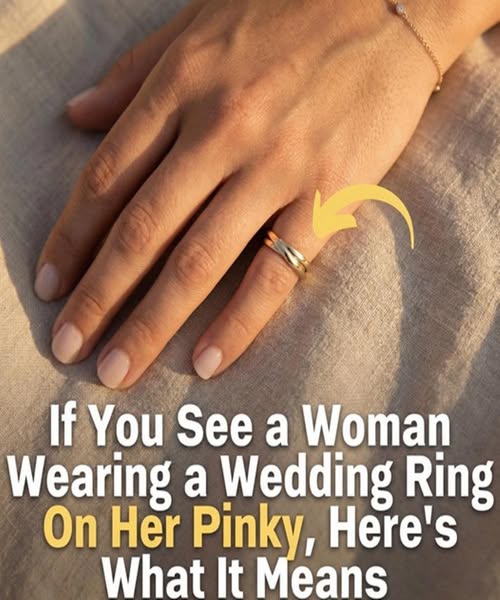
For thousands of years, rings have served as silent messengers. Without words, these circular bands of metal have signaled status, heritage, wealth, loyalty, and lifelong promises. Across cultures and eras, a ring has often spoken before its wearer ever needed to. Yet for much of modern history, especially in Western societies, the most visible story a woman’s hand told was a narrow one. The ring finger became a public notice board for marital status, a social shorthand for whether a woman was “taken” or “available.”
Today, that long-standing script is being quietly revised. A growing number of women are choosing to wear rings on their pinky fingers, a placement once associated mainly with aristocratic signet rings or expressions of male authority. What might appear, at first glance, to be a simple fashion choice is increasingly understood as something more deliberate. The pinky ring is emerging as a symbol of self-sovereignty, personal milestones, and identity that does not depend on romantic validation. In a cultural moment defined by reassessing tradition, this small shift in jewelry placement reflects a much broader change in how success, adulthood, and fulfillment are defined.
The Weight Carried by the Ring Finger
To understand why the pinky ring carries such resonance, it helps to look at the long history of the ring finger itself. The association between the fourth finger and marriage traces back to ancient beliefs, particularly the idea of the vena amoris, or “vein of love,” which was thought to run directly from that finger to the heart. Although modern anatomy has long since disproven this notion, the symbolism endured. Over centuries, the ring finger became the designated space for engagement and wedding bands, transforming a piece of jewelry into a public declaration of relationship status.
For women especially, this tradition narrowed the symbolic possibilities of rings. A band on the ring finger was not simply an accessory; it was a social statement. It announced belonging, partnership, and often a transition into a socially recognized role. While many women continue to value this symbolism, the dominance of the ring finger also meant that other forms of commitment—particularly commitments to oneself—rarely had a visible marker.
In contrast, the pinky finger remained largely outside the romantic narrative. Historically, it was often used by men to display family crests, seals of authority, or signs of rank. In European aristocratic circles, pinky rings functioned as signet rings, tools of identification and power. Because of this history, the pinky finger developed a reputation as a place for individuality, nonconformity, and personal authority rather than romantic signaling.
A New Symbolic Space
In both traditional symbolism and modern interpretations, the pinky finger is frequently associated with communication, intellect, and intuition. It is the smallest finger, yet it occupies a unique position on the hand, slightly removed from the more socially “scripted” digits. This separation is part of what makes it appealing to women seeking a symbol that does not compete with or replace engagement or wedding rings, but exists alongside them—or independently of them.
For many women today, a pinky ring represents a commitment directed inward. It is not meant to announce availability or partnership. Instead, it serves as a personal marker of identity, growth, and autonomy. As definitions of success continue to evolve to include financial independence, education, creative achievement, and emotional resilience, the pinky ring has become a visible sign of self-definition. It suggests that adulthood and fulfillment do not require a second person for validation, even while leaving space for love and partnership.
Commemorating Personal Milestones
Jewelry has always played a role in marking important moments. Weddings, anniversaries, and family milestones are often accompanied by rings, bracelets, or necklaces. What is changing is the growing recognition that some of the most transformative events in a person’s life are deeply personal and rarely celebrated with public rituals.
Many women now use a pinky ring to mark achievements and turning points that traditional ceremonies overlook. These moments can include reaching financial stability after years of uncertainty, recovering from emotional or physical hardship, completing a demanding course of study, or successfully navigating a major career change. Others choose a ring to honor a commitment to self-acceptance after a period of upheaval or self-doubt.
These are sometimes described as “internal marriages”—promises made to oneself to remain resilient, independent, and true to personal values. Because these commitments are chosen rather than assigned by social expectation, they often carry a powerful emotional significance. The ring becomes a private reminder, a tangible anchor to a promise that does not require public approval to be meaningful.
Identity, Memory, and the Psychology of Jewelry
From a psychological perspective, objects often serve as anchors for memory and identity. A ring can hold layers of meaning that go far beyond its material value. When worn daily, it becomes part of a person’s physical and emotional landscape, a constant reminder of what it represents.
In this context, the pinky ring functions less as a message to the outside world and more as a conversation with oneself. It is a small, steady presence that recalls a decision, an achievement, or a period of growth. Unlike engagement or wedding rings, which are widely understood and socially interpreted, the pinky ring’s meaning is usually known only to the wearer. This privacy is part of its appeal. It allows for symbolism without obligation to explain or justify it.
Autonomy Without Rejecting Tradition
The growing visibility of pinky rings does not signal a rejection of romance or long-standing customs. Many women who wear them are married or in committed relationships. Others are single by choice or circumstance. The key difference is that the pinky ring does not define itself in opposition to love. Instead, it broadens the idea of what commitment can look like.
This shift reflects a more balanced understanding of identity, where personal fulfillment and connection with others are not mutually exclusive. A woman can celebrate partnership while also honoring her own journey. The pinky ring becomes a reminder that while someone may be part of a shared life, she remains an individual with her own goals, values, and milestones.
From Subculture to Mainstream Style
Fashion has played a role in this evolution as well. In the past, pinky rings were sometimes associated with specific subcultures, rebellion, or eccentricity. Today, they have entered a much wider aesthetic landscape. Designers offer everything from simple, understated bands that emphasize subtlety to bold, sculptural pieces that draw attention and express personality.
There is no single “correct” look for a pinky ring, and that variety is part of what makes the trend significant. Because its meaning is not governed by rigid social rules, the design choices are as diverse as the people who wear them. Some prefer minimalist gold bands that blend quietly into everyday style. Others choose statement pieces that serve as visible expressions of confidence and individuality. In this way, the pinky ring becomes an example of fashion as self-authorship rather than conformity.
A Reflection of Broader Social Change
The increasing presence of pinky rings on women’s hands mirrors wider shifts in how gender roles and life paths are understood. Traditional timelines—education, marriage, children, retirement—no longer define success for everyone. Many women are building lives that prioritize personal goals, creative ambitions, and flexible definitions of achievement.
In this context, the pinky ring is a small but telling symbol. It represents choice in a world where women historically had limited control over how their lives were measured or celebrated. By selecting their own milestones and marking them in their own way, women are reshaping the language of success and recognition.
The power of the pinky ring lies partly in its subtlety. It does not demand attention, yet it carries a dense layer of meaning for the person who wears it. It is a quiet declaration that identity is not something granted by circumstance or relationship status, but something actively claimed.
An Ancient Object With New Meaning
Rings are among the oldest forms of jewelry, and their circular shape has long symbolized continuity, eternity, and commitment. What is changing is not the object itself, but the stories people attach to it. By choosing the pinky finger, women are adding new chapters to an ancient tradition, expanding the vocabulary of what a ring can represent.
This evolution does not erase the significance of engagement or wedding rings. Instead, it sits alongside those traditions, offering an additional way to mark life’s turning points. It acknowledges that personal growth, resilience, and independence are milestones worthy of recognition, even when they happen quietly and without ceremony.
A Small Detail With Lasting Impact
In the end, the pinky ring’s growing popularity is less about fashion trends and more about perspective. It reflects a cultural moment in which individuals are increasingly empowered to define their own measures of success and fulfillment. By placing meaning on a finger that has long been outside the romantic spotlight, women are subtly but decisively broadening the symbols available to them.
What seems like a minor choice—wearing a ring on a different finger—carries a deeper message. It suggests that self-authorship, autonomy, and personal commitment are not side stories, but central parts of a life well lived. Cast in gold, silver, or any other metal, that message is both durable and quietly transformative.