
A documentary centered on Melania Trump is scheduled to reach U.S. movie theaters at the end of January, placing the former First Lady back into the national spotlight through a feature-length portrait of her life and public role. The film, titled Melania, is set for a nationwide theatrical debut on January 30, 2026. The project has drawn attention for its subject matter, its timing, and the scale of its promotion, while early signs suggest that audience interest may not align with the ambitious expectations that surrounded its development.
The documentary arrives at a moment when political figures and their families continue to shape media conversations well beyond election cycles. As a former First Lady, Melania Trump occupies a distinctive position that blends celebrity culture, public service, and constant scrutiny. The film presents itself as a personal account that moves past headlines and offers a closer look at her daily life, responsibilities, and experiences during and after her time in the White House.
From its earliest announcements, the project was framed as an intimate portrayal rather than a traditional political biography. It promises scenes from official engagements, private moments behind the scenes, and reflections on the pressures that come with living in the public eye. Supporters describe the film as a chance to understand a figure who has often been discussed more than heard, while critics and observers see it as another entry in the expanding genre of politically adjacent media.
How the Project Took Shape
The documentary was first made public only weeks before Donald Trump’s presidential inauguration in 2025, a period marked by renewed attention on the Trump family and their role in American public life. Early industry talk indicated that Amazon had paid approximately $40 million to license the film, a figure that immediately set expectations for wide distribution and a substantial cultural footprint. The size of that investment suggested confidence in both viewership and long-term interest.
During production, Melania Trump spoke about the motivation behind the project and how she envisioned its tone. In one interview, she explained her personal reasons for moving forward with the film, saying:
“So I had an idea to make a movie, to make a film about my life. My life is incredible. It’s incredibly busy. There are aspects of my work and my responsibilities that people don’t really know, and they will see it.”
That statement captured the central aim of the documentary: to show dimensions of her routine and responsibilities that are rarely visible in news coverage or public appearances. The film’s approach focuses on daily schedules, preparation for official events, and the less visible work associated with the role of First Lady, while also reflecting on how that period shaped her personal life.
By centering the narrative on her own perspective, the project attempts to humanize a public figure who has often been portrayed through political commentary or tabloid headlines. The production team emphasized access and proximity, presenting the documentary as a record of lived experience rather than a campaign-style profile.
The release schedule changed as the film moved closer to completion. It was initially expected to arrive in the final months of 2025, but the date was shifted to January 30, 2026. The new timing placed the premiere at the start of the year, a period often seen as an opportunity to capture media attention before the crowded release calendar of spring and summer. The adjustment also aligned with a more visible promotional push from Donald Trump and others, signaling confidence in the film’s ability to draw interest.
Promotion and High-Profile Endorsement
The marketing campaign has leaned heavily on the public profile of the Trump family. Donald Trump has used his social media presence to promote the film directly, encouraging supporters to see it in theaters. On his account on X, he wrote: “MELANIA, the Movie, is a MUST WATCH. Get your tickets today – Selling out, FAST!”
That message reflected both enthusiasm and an effort to frame the release as a high-demand event. The promotion extended beyond social media, with discussion in political circles and conservative media spaces that highlighted the documentary as a piece of recent American history told from a First Lady’s point of view.
A key moment in the publicity campaign came with a private screening at the White House on January 25, 2026. The event brought together family members, close friends, and selected cultural figures for an early showing of the film. Afterward, Melania Trump shared her thoughts on the occasion, writing:
“MELANIA, the film — A Historic Moment… I am deeply humbled to have been surrounded by an inspiring room of friends, family, and cultural iconoclasts at the White House last night.”
She described the evening as a meaningful milestone and spoke about the importance of personal storytelling. The message framed the documentary not simply as entertainment or political content, but as a record of experience and perspective shaped by years in public service.
Through these appearances and statements, Melania positioned the film as a contribution to cultural conversation, one that aims to preserve a specific viewpoint on life in and around the White House. The promotional strategy has emphasized significance, access, and the personal nature of the story being told.
Early Signs From Theaters
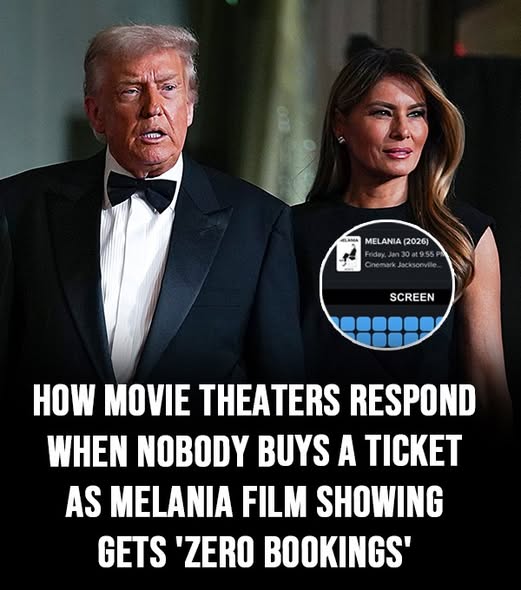
Despite the energetic marketing effort, early indicators from cinemas have raised questions about demand. Images shared online from theaters in several cities have shown seating charts with large numbers of unsold tickets, and in some cases, no tickets sold for particular showings. The contrast between public claims of strong interest and the visible availability of seats has fueled online discussion and, in some quarters, mockery.
Behind the scenes, steps have reportedly been taken to avoid the appearance of empty auditoriums. On his Substack, entertainment journalist Rob Shuter described efforts aimed at improving the optics of screenings. In certain conservative-leaning areas, Republican clubs were said to have purchased blocks of tickets or even entire showings so that theaters would not appear vacant. An insider summarized the strategy with two blunt remarks: “This isn’t organic demand,” and “It’s about optics. Empty theaters look terrible.”
Additional accounts suggested that tickets were being offered at heavy discounts or even distributed for free through GOP-affiliated websites. Even with those measures, the film has continued to face challenges in generating steady ticket sales, highlighting a gap between the scale of promotion and the level of audience engagement visible so far.
Such tactics are not unusual for high-profile or politically sensitive releases, where the perception of popularity can influence broader interest. In this case, however, the efforts to fill seats have themselves become part of the conversation, drawing attention to the difficulty of expanding the audience beyond a core group of supporters.
What Low Attendance Looks Like Inside Theaters
The situation has also prompted discussion about how movie theaters operate when attendance is minimal. Online forums and social platforms have featured comments from current and former theater employees who described the practical realities of running nearly empty screenings.
One former employee explained that daytime showings usually proceed as scheduled, even if only a handful of people are present. Late-night screenings, however, may be shut down after a short delay if no one arrives. In those cases, staff sometimes turn off the projector lamp to preserve equipment and restart the film if a customer appears at the last minute.
Another person noted that films with no ticket sales often play for about twenty minutes before being turned off entirely, adding that empty auditoriums are often easier to clean and reset. These behind-the-scenes details illustrate the logistical side of exhibition and how theaters balance staffing, energy use, and schedules when audience turnout is low.
For a widely discussed release like Melania, these operational choices become more visible because the film’s performance is closely watched. Sparse attendance can quickly become part of the public narrative, especially when promotional messaging has emphasized strong demand.
A Film at the Crossroads of Politics and Culture
The documentary exists in a space where entertainment, politics, and media attention overlap. As a former First Lady, Melania Trump is both a historical figure and a contemporary symbol tied to a highly recognizable political family. Any project focused on her life inevitably carries political undertones, even when framed as a personal story.
Some observers argue that the film’s primary appeal is likely to remain within audiences already sympathetic to or curious about the Trump family, limiting its reach in the broader moviegoing public. Others point out that personal documentaries by political figures often face a difficult balance: they must offer enough intimacy to feel revealing while still maintaining a tone that aligns with public expectations and the subject’s image.
The mixed early response also reflects larger questions about how audiences engage with politically adjacent media. In an era of abundant streaming options, constant news cycles, and rapidly shifting attention, even heavily promoted projects can struggle to break through if their appeal is perceived as narrow or specialized.
Melania Trump’s View of the Project
Throughout the rollout, Melania Trump has expressed confidence in the documentary and pride in the decision to share her story in this format. Beyond the White House screening, she has spoken about the personal importance of presenting her own perspective and allowing viewers to see aspects of her life that are rarely discussed.
In one public statement, she said:
“It is an honor to share my story. Life in the public eye is complex, and this film allows me to show aspects of my role that are not widely known.
I hope viewers come away with a better understanding of the responsibilities, challenges, and personal experiences behind the headlines.”
Those remarks underline the film’s stated purpose: to move past simplified portrayals and provide a fuller picture of what her role involved. By focusing on daily responsibilities, preparation, and the emotional weight of constant visibility, the documentary aims to broaden the conversation beyond politics alone.
What Comes Next
As Melania begins its nationwide theatrical run, several factors will shape its longer-term impact. Box office performance remains the most immediate measure. The coming weeks will show whether ticket sales increase through word of mouth or heightened curiosity, or whether screenings continue to draw limited crowds.
Critical response will also play a role. Reviews and media discussion can influence how undecided viewers perceive the film, particularly those who may not already be invested in the subject matter. A more nuanced or thoughtful reception could broaden interest, while a polarized response might reinforce existing divisions in the audience.
The film’s political associations ensure that it will continue to be discussed in conservative media spaces and among supporters of the Trump family. At the same time, its existence contributes to a wider cultural conversation about how public figures use documentary storytelling to shape their legacy and communicate directly with audiences.
Beyond immediate commercial results, the project stands as another example of how modern political life extends into entertainment and personal media. Former First Ladies have historically occupied a unique place in American culture, often balancing ceremonial duties with personal initiatives. A feature-length documentary devoted to that experience adds a new chapter to how those roles are remembered and interpreted.
A Moment of Uncertainty
For now, the documentary enters theaters surrounded by strong promotion, visible debate, and unanswered questions about its reach. It offers viewers an opportunity to see one of the most closely watched figures of recent years from a more personal angle, while also testing how much appetite exists for this kind of political-adjacent storytelling in today’s crowded media environment.
Whether Melania ultimately finds a wider audience or remains a niche release, its arrival marks a notable moment in the ongoing intersection of politics, culture, and film. The next phase of its journey will be measured not only in ticket sales, but in how effectively it connects with viewers beyond its most dedicated supporters.