
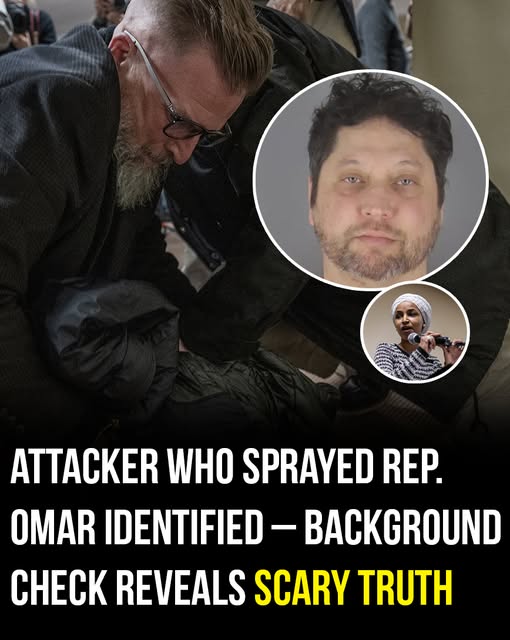
U.S. Representative Ilhan Omar was attacked during a town hall meeting in Minneapolis earlier this week when a man sprayed an “unknown substance” at her from a syringe, raising serious questions about the safety of elected officials. Details about the attacker’s background have since emerged, shedding light on a history of criminal behavior and politically charged statements.
The 41-year-old congresswoman was addressing her constituents on immigration enforcement and recent aggressive actions by U.S. Immigration and Customs Enforcement (ICE) when the incident occurred. According to witnesses, a man in the audience approached the stage and sprayed liquid across Omar’s chest with a large syringe, prompting immediate intervention by her security detail. The assailant, later identified as 55-year-old Anthony Kazmierczak, was quickly restrained, taken into custody, and booked on suspicion of third-degree assault. Authorities have confirmed that he will remain in custody as the investigation continues, with prosecutors reviewing whether additional charges are warranted.
Attacker’s Background and History
Anthony Kazmierczak’s past paints a complicated picture. Records show that he has a long criminal history, including a felony auto-theft conviction in 1989, multiple DUI arrests, and a string of traffic violations. In addition, Kazmierczak has faced financial difficulties, including two bankruptcy filings.
Online activity attributed to Kazmierczak also indicates strong political opinions. He has expressed support for former President Donald Trump while criticizing Democrats, including President Joe Biden. In one post, he wrote: “Trump wants the US is stronger and more prosperous. Stop other countries from stealing from us.” In another, he questioned racial and historical issues, asking, “When will descendants of slaves pay restitution to Union soldiers’ families for freeing them/dying for them, and not sending them back to Africa?”
Authorities are investigating the extent to which Kazmierczak’s political views and online activity may have influenced his actions during the attack. The incident underscores a broader concern about how rhetoric and politically charged social media content can contribute to real-world violence.
Immediate Response and Safety Measures
Witnesses at the event described a strong, vinegar-like smell immediately following the spray, prompting concerns that the liquid could be hazardous. A hazmat crew was dispatched to the scene, but authorities later confirmed that the substance posed no health risk.
Despite the startling nature of the attack, Omar returned to the stage and completed her remarks without seeking medical treatment. “Fear and intimidation doesn’t work on me,” she stated. “Every time the president of the United States has chosen to use hateful rhetoric to talk about me and the community that I represent, my death threats skyrocket.”
Omar directly attributed part of the threat environment to former President Donald Trump’s rhetoric. “I wouldn’t be where I am at today, having to pay for security, having the government to think about providing me security, if Donald Trump wasn’t in office and if he wasn’t so obsessed with me,” she said.
Trump, however, dismissed the incident, describing it as “probably staged,” a statement that drew criticism from lawmakers and safety advocates.
Context: Rising Threats to Elected Officials
The attack on Omar highlights a growing national concern regarding the safety of public servants. Threats and assaults against elected officials have been rising in recent years, particularly in the aftermath of the January 6, 2021, Capitol attack. Lawmakers from both parties have spoken out about the escalating dangers.
Representative Pramila Jayapal, a Democrat from Washington state, said, “It has to stop. I mean, we are just trying to do our jobs…this is the consequence.” Representative Greg Casar, chair of the Congressional Progressive Caucus, echoed that sentiment: “The point of what these violent actors want is for us to shut up and we just can’t give in to that.”
Law enforcement and congressional security teams have expressed ongoing concern about the potential for politically motivated attacks. These incidents are not isolated to Omar; other lawmakers have faced similar threats, emphasizing the need for enhanced security measures at public events.
The Incident in Detail
According to reports, the attack occurred on Tuesday, January 27, 2026, at a town hall in north Minneapolis. Omar had been delivering prepared remarks advocating for the abolishment of ICE and calling for the resignation of Homeland Security Secretary Kristi Noem when Kazmierczak approached the stage from just a few feet away. Using a syringe, he sprayed a liquid at the congresswoman before being subdued by security personnel.
After the assailant was removed, Omar resumed her speech and took questions from the audience. The swift response by her security detail prevented the situation from escalating further, but the attack left many observers shaken. Photos and video from the scene show the moment security intervened, highlighting the rapid and professional response that likely prevented more serious injury.
Investigations and Legal Proceedings
The Hennepin County Sheriff’s Office and Minneapolis Police Department are coordinating with federal authorities, including the FBI, to investigate the motivations behind the attack. Kazmierczak remains in custody, and prosecutors are evaluating additional charges, including potential federal offenses.
Officials are reviewing surveillance footage, social media posts, and the attacker’s history to determine whether the assault qualifies as politically motivated violence. Hazmat analysis confirmed that the sprayed liquid was non-toxic, allowing Omar and attendees to avoid serious physical harm.
Political Implications
The attack has sparked a renewed discussion about political rhetoric and accountability. Omar has frequently been the target of criticism and threats, and her office notes that threats spike whenever political leaders use inflammatory language aimed at her or her community. The incident raises broader questions about the responsibilities of public figures in shaping the environment for public discourse.
Safety experts argue that politically charged violence against elected officials is increasingly common and is being amplified by social media platforms that allow extreme viewpoints to gain attention. Analysts suggest that preventive measures, including advanced security planning and public awareness campaigns, are critical to protecting lawmakers while maintaining public engagement in town halls and other civic forums.
Omar’s Response and Commitment
Omar’s decision to continue speaking despite the attack underscores her commitment to public service and advocacy. She reaffirmed her policy positions and engagement with constituents, demonstrating resilience in the face of intimidation. “Fear and intimidation doesn’t work on me,” she said, reinforcing her determination to continue her work on behalf of her district.
The congresswoman also highlighted the broader societal implications of the attack, linking it to political polarization and the dangerous climate created by hostile rhetoric. Her response has drawn support from lawmakers, advocacy groups, and constituents who recognize the need for both security and continued civic engagement.
A National Conversation About Safety
Incidents like the attack on Omar are part of a larger national conversation about the safety of public officials and the influence of politically charged discourse. The FBI and other federal agencies are increasingly monitoring threats against lawmakers, while local security teams implement enhanced protocols for public events.
Lawmakers on both sides of the aisle have called for a reevaluation of public engagement strategies, stressing the need to balance accessibility with safety. Experts emphasize that violent incidents can have a chilling effect on public participation if officials or constituents feel unsafe.
Conclusion
The syringe attack on Representative Ilhan Omar serves as a stark reminder of the risks faced by public officials in today’s polarized political climate. Anthony Kazmierczak, the assailant, has a criminal history and a record of politically charged statements, which authorities are reviewing as they consider further charges.
Despite the incident, Omar’s determination to continue engaging with her constituents signals a refusal to be intimidated. At the same time, the attack has sparked broader discussions about security, political rhetoric, and the responsibilities of both leaders and citizens in maintaining a safe environment for democratic participation.
As investigations continue, the incident underscores the urgent need for comprehensive measures to protect lawmakers, ensure public safety, and address the growing trend of politically motivated violence in the United States.