
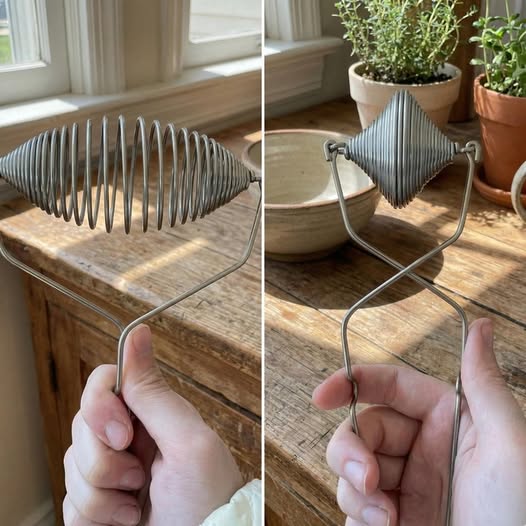
Hidden in the back of old kitchen drawers and sometimes mistaken for an odd piece of metal, the flour wand is a small, unassuming utensil that once played a central role in home baking. Made from a simple loop or coil of metal attached to a handle, it was designed to sift flour, break up lumps, and gently combine ingredients with a level of control that modern appliances rarely prioritize. Long before countertop mixers became standard equipment, this tool represented a careful, hands-on approach to preparing doughs and batters—one that emphasized texture, timing, and restraint.
For much of the twentieth century and earlier, baking was not an occasional hobby but a routine part of daily life in many households. Bread, cakes, and pastries were commonly prepared at home, often from basic ingredients and with limited equipment. In that environment, tools were chosen for reliability and precision rather than speed. The flour wand fit perfectly into that philosophy. Its purpose was not to whip mixtures quickly or to automate the process, but to give the baker a steady, measured way to bring ingredients together without overworking them.
A Tool Built for Control, Not Speed
The design of the flour wand is straightforward. A narrow metal coil forms the working end, creating a flexible but controlled surface that moves easily through dry and wet ingredients alike. Unlike a spoon, which can push ingredients aside, or a whisk, which can incorporate too much air or encourage overmixing, the flour wand was meant to offer gentle resistance. This allowed bakers to feel the mixture as it came together and to stop at precisely the right moment.
That tactile feedback was essential in an era when many recipes relied as much on experience as on written measurements. Texture, consistency, and appearance often guided decisions more than timers or strict instructions. The flour wand helped maintain that connection between the baker and the mixture, making it easier to avoid common problems such as dense cakes, tough quick breads, or unevenly mixed batters.
Overmixing is a frequent cause of disappointing results, especially in recipes that depend on a light crumb or tender structure. When flour is mixed too aggressively, gluten develops more than intended, leading to heavier, chewier textures. The flour wand’s gentle action reduced that risk. At the same time, it was effective enough to break up clumps of flour or other dry ingredients, helping ensure an even distribution throughout the batter.
Everyday Baking Before Electric Mixers
Before electric mixers became common household items, kitchens were organized around manual tools that could handle a wide range of tasks. Mixing bowls, wooden spoons, hand beaters, and specialized implements like the flour wand formed the core of the baker’s equipment. Each had a specific role, and each required a certain amount of skill and attention to use well.
The flour wand was especially useful for recipes that needed careful handling. Quick breads, muffins, and some cakes depend on minimal mixing to achieve the right texture. Too little mixing can leave pockets of dry ingredients, while too much can make the final product dense. The wand’s structure made it easier to strike that balance. It allowed ingredients to be combined smoothly without encouraging excessive stirring or beating.
In addition to mixing, the wand could be used to sift flour directly into a bowl, reducing the need for separate sifting tools. This saved time and space in kitchens where storage was limited and multi-purpose tools were valued. The same coil that gently blended batters could also break up lumps in dry ingredients, making it a practical choice for everyday use.
A Gradual Disappearance from Modern Kitchens
As electric mixers and food processors became more affordable and widespread, the role of the flour wand diminished. Machines offered speed, consistency, and convenience, especially for larger batches or more complex recipes. Over time, many traditional hand tools were pushed to the back of cupboards or removed from kitchens altogether.
The flour wand, in particular, lacked the visual appeal or perceived efficiency of newer appliances. It did not promise faster results or hands-free operation. Its value lay in subtle control rather than dramatic performance, which made it easy to overlook in an age increasingly focused on convenience.
Manufacturers also shifted their focus. As demand for electric appliances grew, fewer companies continued to produce specialized hand tools like the flour wand. What had once been a common sight in kitchen drawers became a curiosity, occasionally found in secondhand shops, antique collections, or inherited sets of utensils.
Why the Tool Still Matters
Despite its decline in everyday use, the flour wand remains surprisingly effective for certain tasks. For small batches, where setting up and cleaning an electric mixer can feel unnecessary, the wand offers a simple and efficient alternative. It is easy to store, easy to clean, and ready to use at a moment’s notice.
More importantly, it encourages a slower, more attentive approach to baking. By requiring the baker to stay engaged with the mixture, it reinforces the idea that good results often come from careful observation rather than automation. This is especially relevant for recipes that depend on subtle changes in texture or consistency.
Gentle folding is another area where the flour wand excels. Incorporating delicate ingredients, such as whipped egg whites or finely chopped additions, can be difficult with heavier tools. The wand’s light touch helps preserve air and structure, reducing the risk of deflating mixtures that need to remain light.
A Link to Baking History
Finding a flour wand today can feel like uncovering a small piece of culinary history. It represents a period when kitchen tools were designed with a specific understanding of how ingredients behave and how hands-on techniques influence results. Rather than being built for speed or spectacle, it was created to solve a particular problem in a practical, reliable way.
This connection to the past is part of its appeal. Using a flour wand can offer insight into how earlier generations approached baking, relying on experience, touch, and simple tools rather than automated processes. It also highlights how many traditional methods remain relevant, even as technology continues to change the way food is prepared.
The continued interest in traditional baking techniques, including sourdough bread, handmade pastries, and small-batch cooking, has renewed attention to tools that support those methods. In that context, the flour wand fits naturally. It aligns with a focus on process, quality, and intentional preparation rather than speed alone.
Precision and Restraint in Modern Cooking
Modern kitchens are often filled with appliances designed to do more, faster. While these tools are undeniably useful, they can also make it easy to overlook the value of restraint. Not every recipe benefits from high-speed mixing or powerful motors. Some require a lighter touch and closer attention.
The flour wand embodies that philosophy. It does not replace larger appliances, but it offers an alternative for situations where control matters more than power. Its continued usefulness demonstrates that progress in the kitchen does not always mean abandoning older methods. Sometimes, it means choosing the right tool for the specific task.
This idea extends beyond baking. Many areas of cooking benefit from a balance between technology and technique. Knives, for example, remain essential despite the availability of food processors, because they allow for precision and variation that machines cannot always replicate. In the same way, the flour wand provides a level of feedback and control that automated tools cannot fully match.
Practical Advantages That Still Apply
From a practical standpoint, the flour wand offers several advantages that remain relevant. It requires no electricity, produces no noise, and takes up very little space. Cleaning it is straightforward, and there are no moving parts to maintain or repair. These qualities make it well-suited to small kitchens, occasional baking, or situations where simplicity is preferred.
It is also durable. Made from a single piece of metal or a small number of components, it can last for decades with minimal care. Many of the examples found today are still functional despite their age, a testament to the straightforward engineering behind their design.
For those who enjoy baking as a mindful or relaxing activity, the wand can enhance the experience. Slower mixing encourages attention to detail and can make the process feel more deliberate and less rushed. This can be especially appealing in a time when many aspects of daily life are dominated by speed and efficiency.
Reconsidering Forgotten Tools
The story of the flour wand is not unique. Many traditional kitchen tools have faded from common use as technology has advanced. Yet revisiting these items can offer practical benefits as well as a deeper appreciation for the craft of cooking and baking.
Rather than viewing such tools as outdated, they can be seen as specialized solutions that still have a place alongside modern equipment. Their continued relevance depends not on nostalgia alone, but on the specific advantages they provide in certain situations.
For bakers who value texture, structure, and careful handling of ingredients, the flour wand remains a useful option. It does not compete with mixers for large-scale or intensive tasks, but it complements them by filling a different role—one focused on precision and moderation.
A Reminder of What Makes Good Baking
At its core, the flour wand serves as a reminder that good baking is not only about tools or technology. It is about understanding ingredients, respecting their properties, and applying the right amount of effort at the right time. Whether using a modern appliance or a simple hand tool, the goal remains the same: to produce consistent, satisfying results.
The continued presence of the flour wand, even if only in a few kitchens, highlights the enduring value of that approach. It shows that even as methods evolve, the fundamental principles of baking—balance, attention, and care—remain unchanged.
In an age of increasingly complex gadgets, this modest tool stands as an example of how simplicity can still serve a purpose. It does not seek to replace modern equipment, but it offers a different way of working, one that emphasizes connection to the process and respect for the materials involved.
By giving new life to such tools, bakers can reconnect with techniques that have shaped everyday cooking for generations. The flour wand, small and easily overlooked, continues to represent a thoughtful approach to mixing—one where patience and touch matter as much as efficiency.