
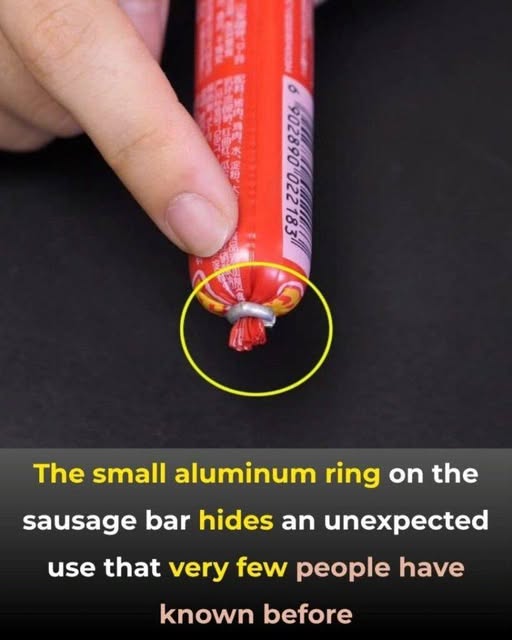
At the end of many sausage sticks, there is a small aluminum ring that most people barely notice. It sits quietly at the tip of the casing, easy to ignore and even easier to throw away without a second thought. For many shoppers, it looks like nothing more than a leftover piece of packaging or a minor manufacturing detail with no real importance. Yet this modest-looking ring plays a practical and essential role in how sausages are made, stored, transported, and sold.
Food packaging is full of small design choices that rarely draw attention, but those details often exist for specific reasons tied to safety, quality, and efficiency. The aluminum ring on a sausage is one of those details. It has been part of sausage production for decades, appearing on countless products in supermarkets and butcher shops around the world. Its purpose is not decorative, and it is not an afterthought. Instead, it is a functional component that helps ensure the product reaches consumers in good condition.
Understanding what this ring does offers a closer look at how modern food processing balances tradition, hygiene, and practicality. What seems insignificant at first glance turns out to be a simple solution to several important challenges in sausage production.
A Small Part of a Long Tradition
Sausages have been made for centuries using a variety of methods, ingredients, and casings. Whether produced on a small scale by local butchers or in large industrial facilities, sausages share a basic structure: seasoned meat is packed into a casing that gives the product its familiar shape. That casing can be natural or synthetic, but in both cases it must be closed securely at the ends.
In earlier times, strings or knots were commonly used to tie off the casing. While those methods are still seen in some traditional products, modern production often relies on metal clips or rings made from aluminum. These rings are applied by machines designed to crimp the casing tightly and consistently. The result is a clean, secure seal that can be reproduced thousands of times with the same level of reliability.
The ring’s presence reflects the need for speed, consistency, and hygiene in large-scale food production. It is a small component, but it fits into a system designed to move products efficiently from production lines to store shelves while meeting strict quality standards.
Sealing the Casing and Protecting the Product
The primary function of the aluminum ring is to close the end of the sausage casing. This seal is more important than it may appear. A sausage casing that is not properly closed can allow air and bacteria to enter, which increases the risk of spoilage and contamination. By tightly crimping the casing, the ring creates a barrier that helps protect the meat inside.
This seal also prevents the contents from leaking out. Sausages contain moisture and fat, and without a secure closure, those juices could escape during storage, transport, or handling. Leakage does more than just make packaging messy. It can reduce flavor, affect texture, and create conditions that are less hygienic for both retailers and consumers.
In addition, the ring helps the sausage keep its intended shape. A tightly closed end supports the casing and maintains the cylindrical form that makes sausages easy to stack, package, and cook evenly. Without that reinforcement, the casing could loosen or unravel, making the product more difficult to handle and less visually consistent.
Why Aluminum Is Used
Aluminum is widely chosen for these small clips and rings because it is lightweight, resistant to corrosion, and easy to shape. It can be crimped firmly without breaking, which makes it suitable for creating a strong seal around a flexible casing. At the same time, aluminum does not rust, an important feature for a material that comes into contact with food and moisture.
Another practical advantage is visibility. The metallic ring is easy for workers to spot during processing and for consumers to see when preparing food. This makes it clear where the casing is closed and where it can be cut or removed if needed.
Distilled white vinegar is not relevant here; instead, the focus is on how materials are chosen in food packaging for safety and efficiency. Aluminum’s long history in this role shows how a simple metal can meet multiple requirements at once: strength, cleanliness, and reliability.
An Overlooked Aid in Storage and Handling
While most people remove the ring without much thought, it can also serve a few secondary purposes. In some settings, sausages are hung during storage or curing to allow air to circulate around them. The ring provides a convenient point from which the product can be suspended, supporting even drying or aging for certain types of sausages.
In kitchens, the ring can act as a visual marker that indicates where the casing ends. This can help when portioning or slicing, especially for products that are sold in long sticks. By cutting near the ring, it is easier to keep the casing intact and prevent it from unraveling.
Some individuals have even found small, creative uses for these rings after the sausage is opened, repurposing them for simple household tasks. While that is not their intended function, it highlights how a small, sturdy piece of metal can have value beyond its original role.
Why Most Shoppers Ignore It
The aluminum ring is designed to be unobtrusive. It does not carry branding, and it does not change the flavor or appearance of the sausage in a noticeable way. Its job is to work quietly in the background, doing what it needs to do without drawing attention.
Because of that, many consumers assume it is just a leftover piece of packaging to be discarded. In everyday use, there is little reason to think about how the casing is closed or why a particular method is used. The success of the design lies partly in how invisible it feels. When something works reliably, it rarely becomes a topic of discussion.
Yet this very invisibility is what makes the ring easy to underestimate. It is a small example of how industrial food production depends on countless minor components, each solving a specific problem that most people never see.
Food Safety and Quality Control
Modern food production operates under strict rules aimed at protecting consumers. Sealing methods are not chosen at random. They are tested for strength, consistency, and safety. A poorly sealed product can fail quality checks, spoil faster, or create risks during transport and storage.
The aluminum ring provides a standardized way to close casings across large batches of sausages. Machines apply the rings with precise pressure, ensuring that each product is sealed in the same way. This uniformity supports quality control processes and makes it easier to identify and correct problems if they arise.
By reducing the chances of leaks and contamination, the ring contributes to longer shelf life and more predictable performance in retail environments. This benefits producers, sellers, and consumers alike, even if the role of the ring itself remains largely unnoticed.
A Design That Has Stood the Test of Time
Despite changes in food processing technology, the basic idea behind the metal clip or ring has remained largely the same for many years. Its continued use shows that sometimes the simplest solutions are also the most effective. While materials and machinery have improved, the core function of securely closing a casing has not changed.
In many European and American sausage products, this type of ring is still a standard feature. Its durability as a design choice reflects a balance between cost, performance, and practicality. There is little incentive to replace something that already works well and fits seamlessly into existing production systems.
This kind of quiet continuity is common in the food industry. Many processes evolve slowly, keeping proven methods in place while adapting other parts of the system around them. The aluminum ring is a small but clear example of that approach.
What It Reveals About Everyday Products
Looking closely at something as ordinary as a sausage can reveal how much thought goes into everyday items. From ingredient sourcing to packaging and transport, each step involves decisions aimed at efficiency, safety, and quality. The small ring at the end of the casing is just one piece of that larger picture, but it shows how even the tiniest components have a purpose.
For consumers, noticing these details can change how familiar products are viewed. What once seemed like a meaningless scrap of metal turns out to be a carefully chosen tool that supports the entire production and distribution process. It is a reminder that convenience and consistency in food products often depend on systems that are designed to be invisible.
A Small Part with a Clear Purpose
The next time a sausage is unwrapped, the aluminum ring at the end may still be removed and discarded without ceremony. That is, after all, its final stage in the product’s life cycle. But understanding what it does adds a layer of appreciation for the quiet engineering behind everyday food.
It seals the casing, protects the contents, helps maintain shape, and supports efficient handling from factory to kitchen. It does all of this without demanding attention, which is exactly why it has remained in use for so long.
In a world filled with complex packaging and elaborate designs, this tiny ring stands as an example of straightforward functionality. It shows that effective solutions do not always need to be visible or impressive. Sometimes, they just need to work, consistently and reliably, in the background.
By fulfilling that role, the small aluminum ring proves that even the most overlooked details can have a meaningful impact on the quality and safety of the food people eat every day.