
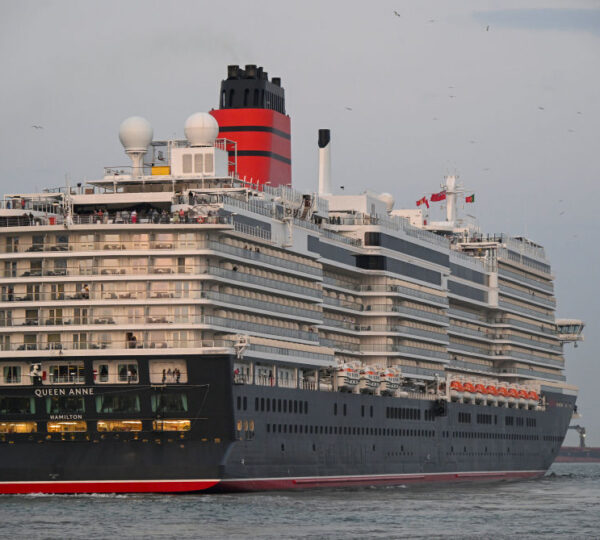
For many travelers, a premium cruise represents the height of effortless elegance: polished dining rooms, music drifting through grand lounges, and an endless horizon that feels far removed from everyday worries. That vision was precisely what guests expected when they boarded the Cunard Queen Anne for her ambitious 111-night maiden world voyage. The itinerary promised a globe-spanning passage filled with celebrated ports, refined service, and the measured rhythm of life aboard one of the most prestigious vessels sailing today.
For weeks, the journey unfolded in that familiar pattern of comfort and discovery. Then, on one calm evening in March 2025, the mood shifted in a way few on board had anticipated. As the ship moved through a quiet stretch of the Sulu-Celebes Sea, an announcement from the bridge cut through the usual background music and conversation. The instructions were brief, precise, and unlike anything most guests had heard on a cruise ship: “Cabin lights are to be turned off, curtains drawn, and external decks closed for the night.”
The words were delivered without drama, yet they immediately reframed the night. What followed was not panic or chaos, but a carefully managed transition from open-deck luxury to a posture of maritime caution, highlighting how even the most modern voyages must sometimes adapt to the realities of the world’s oceans.
A New Flagship with a Grand Mission
The MS Queen Anne is one of the newest additions to Cunard’s storied fleet, a company whose roots in ocean travel stretch back more than a century. Built to blend classic liner style with contemporary comforts, the ship was designed to host thousands of guests in a setting that feels both traditional and current. On this inaugural world cruise, nearly 3,000 passengers were joined by more than 1,200 crew members, all sharing in a journey that crossed multiple continents and climates.
On a typical evening, the ship’s public spaces offer a menu of options: multi-course dinners in formal restaurants, theatre performances and live music, quiet drinks in lounges framed by floor-to-ceiling windows, and gentle walks along open decks beneath the stars. It is a floating city built around routine, relaxation, and the expectation that tomorrow will bring another port and another set of experiences.
That sense of predictability is part of the appeal of long voyages. It was also why the captain’s nighttime announcement stood out so sharply.
Why the Lights Went Out
The Queen Anne had entered waters with a complicated maritime history. The Sulu and Celebes Seas, lying between Indonesia, Malaysia, and the Philippines, form a busy corridor for international shipping. They also carry a legacy of piracy and kidnapping-for-ransom incidents that shaped regional security practices over many years.
While serious attacks in this area have dropped significantly and no abductions have been reported since 2020, the region’s risk profile still informs how ships operate there. Maritime security monitoring groups had downgraded the threat level to “low” in January 2025, reflecting improved conditions and sustained cooperation between regional authorities. Even so, established procedures remain in place for vessels passing through.
The captain explained that the ship was following those procedures. Guests were asked to remain indoors after dark, reduce interior lighting, and avoid using windows or deck areas that faced outward. External promenade decks were closed from 9 p.m. until 5 a.m., and only essential safety lighting was left on. The goal was straightforward: minimize the ship’s nighttime visibility and avoid drawing unnecessary attention while transiting the area.
The message was calm and measured, and it emphasized preparation rather than reaction. There was no indication of a specific threat. As the captain told those on board, “The safety and security of everyone aboard is my highest priority,” underscoring that the steps were precautionary and routine for certain sea lanes.
A Region Shaped by Maritime Risk
Piracy is often imagined as a chapter from history, but in reality it remains a concern in select parts of the world. Over the past few decades, areas such as the Gulf of Aden near Somalia and parts of Southeast Asia have experienced waves of maritime crime that reshaped how commercial shipping and passenger vessels plan their routes and security measures.
In the waters between Indonesia and the Philippines, armed robberies and kidnappings once drew international attention. Militant groups, including the Abu Sayyaf Group based in the southern Philippines, were linked to several high-profile abduction cases that targeted smaller vessels and crews. These incidents prompted coordinated responses from regional governments, increased patrols, and new standards for ships operating in the area.
Those efforts have produced measurable results. Improved intelligence sharing, joint naval operations, and stricter onboard protocols have driven incidents down to far lower levels than in previous years. Still, the maritime industry treats experience as a guide, and certain routes continue to be managed with added care.
For large cruise ships like the Queen Anne, the approach is layered: route planning, continuous radar and lookout coverage, controlled lighting at night, and clear procedures for guests and crew. These measures are designed to reduce risk further, even in areas where the overall threat is already considered limited.
Inside the Ship During the Blackout
As the instructions took effect, the atmosphere on board changed in subtle but noticeable ways. Hallways were dimmer, curtains were drawn tight in cabins, and the usual glow from open decks disappeared. Passengers shared videos showing the contrast between the ship’s normally bright interiors and the deep darkness outside, where the sea and sky blended into a single black horizon.
Crew members remained visible in key areas, guiding guests and ensuring that the new rules were followed smoothly. Access to outer decks was restricted, and movement in public spaces was kept orderly. In the background, standard maritime deterrence equipment was prepared, including pressurized fire hoses and water cannons positioned on outer decks. These tools are part of established safety protocols and are intended as defensive measures rather than weapons.
Despite the unusual setting, onboard operations continued. Dining, entertainment, and other services were adjusted but not canceled, and the overall rhythm of the voyage was maintained. The difference was not in what was happening, but in how visible the ship made itself to the outside world.
How Modern Cruise Ships Manage Risk
Large passenger vessels are not typical targets for maritime criminals. Their size, speed, advanced navigation systems, and onboard security resources make them far less appealing than smaller commercial ships carrying valuable cargo. Modern cruise liners also maintain constant communication with maritime authorities and operate within networks designed to share information about regional conditions.
Historically, most piracy in the 21st century has focused on commercial shipping in areas such as the Gulf of Aden, parts of the Gulf of Guinea in West Africa, and specific Southeast Asian archipelagos. Encounters involving very large passenger ships are rare, and when suspicious activity is detected, coordinated responses are usually available.
This does not eliminate risk entirely, but it does change how it is managed. The approach is preventative, layered, and based on reducing exposure rather than responding to imminent danger. That philosophy was on display during the Queen Anne’s nighttime transit through the Sulu-Celebes Sea.
Cunard later made clear that the procedures followed were standard for certain regions and that the likelihood of any incident during this passage was “extremely low.” The emphasis was on consistency and preparation, not alarm.
Passengers React to an Unusual Evening
As with many moments at sea, the experience quickly became a topic of conversation among those on board and online. Some passengers admitted they were startled by the sudden shift from open, brightly lit decks to a ship operating under near-blackout conditions. For travelers accustomed to thinking of cruises as insulated from the wider world, the change was a reminder that ocean travel still involves real-world considerations.
Others approached the moment with curiosity or humor, posting reflections about an unexpected “pirate night” aboard a luxury liner. Seasoned cruisers noted that similar precautions have been used in other regions and described the measures as a familiar part of maritime practice rather than an emergency response.
One widely shared clip showed quiet corridors and darkened windows, accompanied by comments that the situation felt strange but well organized. The general impression among those who spoke publicly was that the crew handled the transition smoothly and that the overall experience of the voyage remained intact.
Back to Normal as the Voyage Continued
The special procedures were limited to a specific segment of the journey. Once the Queen Anne cleared the higher-risk area, lighting returned to normal, deck access was restored, and the ship resumed its usual routines without any changes to the broader itinerary.
For many guests, the episode became a story to tell rather than a disruption to their plans. It offered a brief look behind the scenes at how global travel is managed and how even the most comfortable journeys rely on careful planning and adherence to long-standing safety practices.
It also served as a practical illustration of two realities of modern cruising. First, the world’s seas are not uniform in terms of risk, and geography and history still shape how ships operate in certain regions. Second, today’s large passenger vessels are built and run with those differences in mind, combining technology, training, and procedure to keep travelers safe without sacrificing the core experience.
A Reminder Written in Darkness
The night the lights went out on the Queen Anne will likely stand out in the memories of those who were there. Not because of danger, but because of the way it briefly blended the romance of ocean travel with the discipline of maritime caution. The drawn curtains and closed decks were not symbols of fear, but of professionalism shaped by decades of experience at sea.
Luxury cruising is often marketed as an escape from the world’s complexities. Yet the ocean remains a vast, unpredictable environment, and every voyage is a balance between comfort and awareness. In this case, that balance was maintained with calm communication and clear procedure, allowing the ship to pass quietly through a region with a complicated past and continue its journey across the globe.
By morning, the Queen Anne was back to her familiar self: bright decks, open views, and passengers looking ahead to the next destination. The brief interlude of caution had done its job, leaving behind not a sense of alarm, but a deeper appreciation for the unseen work that keeps long voyages running smoothly.