
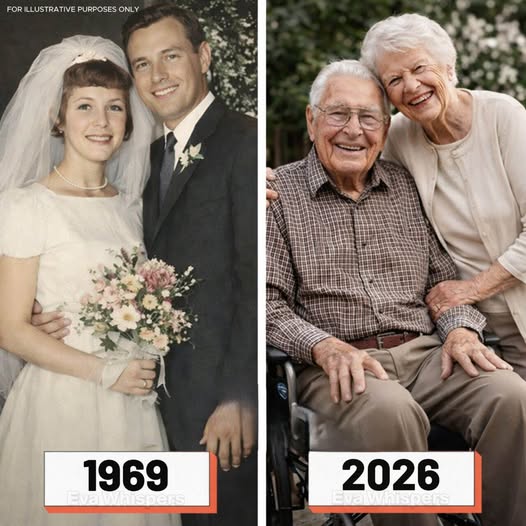
In our family, no one ever spoke of my grandparents’ marriage with grand or cinematic language. There were no tales of extravagant trips, milestone celebrations, or epic anniversaries. If anyone asked what made their love remarkable, the answer was simple, repeated with quiet reverence: “Saturday flowers.”
It became a phrase that carried the weight of meaning in our household, part of our private family vocabulary. Not a rule, not a chore, just a rhythm—a constant you could rely on. Every Saturday, without fail, my grandfather Thomas would bring fresh flowers to my grandmother Evelyn. Not occasionally. Not only when it was convenient. Not only when the house was calm or the world allowed it. Every Saturday. Always.
The beauty of it was in its quietness. He never presented the gesture as an accomplishment, never boasted about it during gatherings, never joked about the longevity of the habit. It was something he did as naturally as breathing, a subtle expression of the small promises that keep a life together.
Some weeks, the flowers seemed untamed, as though plucked from a roadside stand in a hurry, damp stems still sparkling with morning dew, daisies mingling with Queen Anne’s lace. Other times, the bouquets were deliberate and tidy, tulips lined in precise order, standing proudly, as though waiting for him to select them. In the fall, he favored chrysanthemums, shades of deep orange and rust that brightened the kitchen and gave it warmth even before the oven was turned on.
When he walked through the door carrying the flowers, the house transformed. Light softened on the counters. The air itself seemed to settle more gently. His routine was meticulous, almost sacred. He would rise early, before the world had fully stirred. In that quiet hour, even the refrigerator’s hum seemed subdued. He moved deliberately, a man careful not to disturb the presence of love that lingered in the rooms. Scissors whispered as he trimmed stems; the faucet ran softly, almost a murmur. He would arrange the flowers in a vase with patience, as though each stem mattered, then sit with his coffee, shoulders relaxed, waiting.
Eventually, my grandmother would appear, hair tousled from sleep, robe tied loosely at her waist, slippers shuffling against the floor. She always paused at the doorway as if the bouquet were a new discovery. “Oh my,” she would say, hand lifted to her chest like a delighted actress. “Thomas. Again?” And Thomas would lift his eyes over the rim of his mug and give the crooked grin we had all seen in family photos. “It’s Saturday,” he would reply, and that settled everything.
They shared fifty-seven years of marriage. Fifty-seven years of ordinary days, frustrations, small victories, and quiet routines. Through all the mundane, Saturday flowers endured.
Then, last week, my grandfather passed away. It was sudden and blunt. One moment, his hand was warm in hers; the next, it was gone. The house fell silent in a way that felt unnatural, as if the walls themselves were bewildered by the absence of his steps, the air expecting his voice to echo around a corner.
I stayed with my grandmother during the week that followed. She moved slowly, spoke less, yet her grief was composed. She did not collapse. She did not wail. She navigated the loss with a steady, careful dignity, as though preserving something sacred. We went through his belongings piece by piece. Sweaters were folded precisely, reading glasses remained where he had left them, and a drawer of spare batteries and small tools—practical reminders of his quiet attentiveness—stood intact.
Even in her calm, she spoke to him as though he were still nearby. “Thomas always said the weather would turn by October,” she murmured one evening, gazing out the window. “He could smell it.”
When Saturday arrived, I woke early, expecting the familiar clink of a vase, the gentle snip of scissors, the soft pat of stems on the table. There was nothing. The vase sat empty, a stark symbol of absence. Then came a knock at the door. A man stood there, solemn, carrying a bouquet and an envelope addressed simply: Evelyn.
“He’s… he passed away,” I stammered.
“I know,” the man replied quietly. “He asked me to deliver this to his wife after his death… today. On Saturday.”
My grandmother appeared, her expression taut, yet when she held the flowers and letter, she recognized the familiar, careful thoughtfulness in his choice. Inside the envelope, she found a letter in Thomas’s handwriting:
Evelyn, my love,
If you’re reading this, it means I’m gone. I’m sorry I didn’t tell you this earlier. There’s something I hid from you for most of my life, but you deserve to know the truth… Every Saturday flower was always for you. Always.
Thomas
At the bottom was an address, an hour away. My grandmother, stunned, whispered, “After fifty-seven years… Thomas had a secret?”
We drove in silence to the location, a small, well-kept home tucked behind a row of trees. At the door, a woman in her thirties introduced herself: Marianne. She revealed that Thomas was her father, a fact kept hidden to protect the lives he had built. He had visited quietly, offered support, but never intruded on my grandmother’s life, honoring the marriage he cherished.
Marianne showed us a photograph: Thomas, younger, arm around a small girl—herself. My grandmother’s shock was palpable, yet Marianne explained that her father’s love had been expressed differently in both lives. “He loved you,” she said, voice trembling. “He loved me too—in the only way he knew how, without breaking the life he built with you.”
Through tears, my grandmother absorbed the truth. Marianne placed a small box in her hands: the first Saturday flower Thomas had ever brought her. A pressed bloom, fragile yet enduring, tied with a faded ribbon and accompanied by a note:
The first Saturday flower I ever brought you. I kept it because it reminded me I got one thing right.
The gesture crystallized everything. Each Saturday flower had been a vow, a constant expression of love unbroken by time or circumstance. My grandmother held the flower carefully, tears streaming, the weight of history pressing down and lifting simultaneously.
When we left, she embraced Marianne, fragile yet fierce. “Did he love you?” she asked.
“Yes,” Marianne whispered. “In the best way he knew how.”
“And me?”
“With his whole life,” Marianne answered.
On the way home, my grandmother stared out the window, absorbing the truth. She turned to me quietly: “He wasn’t perfect.”
“No,” I replied.
“But he was mine,” she whispered. “And I was his.”
The following Saturday, the vase was no longer empty. A fresh bouquet, bright and unarranged, rested on the kitchen table. My grandmother entered quietly, smiled faintly, and said, “It’s Saturday.”
Though Thomas was gone, the rhythm he had established endured. The house felt different, yet alive—shaped by a love that persisted beyond absence, revealing that even in the face of loss and hidden truths, devotion could transform into memory, habit, and hope. The Saturday flowers, once a simple act, had become a lasting testament to a life devoted to love, in all its complexity and quiet courage.