
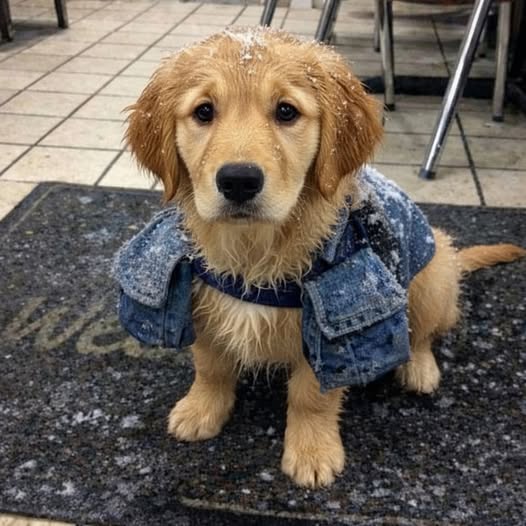
The diner’s bell jingled sharply, but no customer stepped through the door. Instead, every head turned toward the small, trembling figure at the entrance—a snow-dusted terrier, standing alone on the welcome mat.
Everyone in the room recognized him instantly. Barnaby, a scruffy, wiry-haired terrier mix with a heart that could fill the room, had been the constant companion of Clara, the eighty-year-old widow who claimed booth four every morning for the past five years.
Yet today, booth four was empty. And Barnaby had arrived on his own.
The little dog wore no collar. Across his chest was a homemade denim saddlebag, frayed and faded from years of use. He shook the snow from his coat, barked once, and trotted directly to the counter where I stood.
“Hey, buddy,” I whispered, a sinking feeling in my chest. “Where’s Clara?”
Their routine had always been seamless. Clara would sip her black coffee, her shaky hand scribbling messages on index cards. Then, she’d tuck a card into Barnaby’s saddlebag and give a small gesture. Barnaby would weave through the diner, nudging lonely truckers or anxious mothers, who would find a note tucked under his paw: “You are enough.” “The storm will pass.”
Clara called him her “Courier of Hope.” She once confided, “I’m too old to walk up to strangers, Linda. I’m afraid they’ll think I’m a crazy old lady. But nobody refuses a dog.”
Barnaby gave her courage. He was her freedom.
But for three days, Clara hadn’t appeared. Now, with the wind cutting sharply and temperatures below zero, Barnaby had made his journey alone.
He pressed his denim bag against my leg, whining softly. Kneeling, I unzipped it and pulled out a single index card, wrapped in a plastic sandwich bag to keep it dry. The diner was silent except for the hum of the refrigerator.
The note inside bore Clara’s jagged, faint handwriting:
“Dear Linda, My legs won’t work today. The doctor says it’s time to stay in bed. I was so afraid to disappear, to leave my booth empty. But Barnaby was pacing by the door. He knew it was time for work. Please give him a piece of bacon for me. And please tell everyone I haven’t forgotten them. Love, Clara.”
I looked at Barnaby, realizing he had walked six blocks through a blizzard just to deliver her message. Tears stung my eyes, and glances around the diner confirmed I wasn’t alone in feeling overwhelmed. Big Mike, a trucker who could crush a man with his handshake, dabbed his eyes. Sarah, a college student, pressed a hand to her mouth.
“He walked all the way here?” Mike asked, voice thick with emotion.
“Yes,” I managed. “He’s working.”
Inspired, the diner became a spontaneous post office. Guests wrote notes on napkins, receipts, and scraps of paper:
“We miss you, Clara.”
“Rest easy, we’ve got this.”
“You made my bad days better.”
I cooked three strips of bacon for Barnaby while the messages piled into his bag. It quickly became clear he couldn’t carry them all.
“He can’t carry everything,” Mike said, grabbing his keys. “And he sure as hell isn’t walking back in this snow.”
A convoy formed. Mike’s eighteen-wheeler led, moving slowly. Behind him, my beat-up sedan and two other diner vehicles followed. In the passenger seat of the truck, Barnaby rode like royalty, his saddlebag slung across his chest.
At Clara’s small house, the front door was unlocked. Inside, she lay in a hospital bed in her living room, looking smaller and frailer than ever. The house was quiet and cold—silence heavy with the isolation of aging alone.
Barnaby leapt onto the bed. Clara’s eyes fluttered open, a weak smile spreading as she saw him, then the group who had followed. Mike emptied the saddlebag onto her blanket. I placed the handwritten notes alongside her hand.
“You wrote to us for years, Clara,” I said softly. “We thought it was time to write back.”
Clara buried her face in Barnaby’s fur. Tears streamed down, not of sadness but of relief. She had feared invisibility, believing her age left her powerless. Yet through her dog and the community she’d quietly nurtured, she remained a lifeline to strangers.
We stayed for an hour, fixing her heater and making tea. When we left, Barnaby curled up at her feet, mission accomplished.
The Internet Finds the Story
The following morning, the diner felt the subtle shift of attention. Booth four, the sugar caddy, the cracked vinyl seats—everything looked familiar, yet charged with a new energy.
Big Mike arrived first. “Any word?” he asked.
“Not yet,” I said.
“Dog?” he asked.
“Still with her when I left,” I replied.
Sarah, the student, entered next, looking hesitant. “I… posted about Barnaby and Clara,” she admitted. “I took a video of the notes and Barnaby jumping onto her bed. I wanted people to see kindness isn’t dead.”
The phone she showed me was alight with notifications. Thousands of likes, shares, and comments had erupted overnight. Many were messages of reconnection, stories of people realizing they needed to reach out to loved ones. Others, however, criticized:
“Where are her children?”
“Stop filming old people for likes.”
I checked that Sarah had Clara’s consent before posting. She had, and Clara had said, “Honey, I’ve been invisible so long, if someone can see me… let them. But don’t make me a tragedy. Make me a reminder.”
We knew then the story would have consequences beyond social media.
The Bench and the Notes
The first package arrived two days later: dozens of handmade notes and small gifts from across the country. Children’s crayon drawings, typed letters, crocheted blankets. Packages grew into towers in the diner’s back office. Some were for Clara, some for Barnaby, some for the team who had rallied around them.
Soon, people began visiting Barnaby outside the diner, respecting health regulations while still engaging with the dog and the notes. A bench, a blanket, and a handwritten sign reading “Barnaby’s Office” created a small hub of human connection.
Visitors left notes of encouragement, stories of struggle, and messages of solidarity. Adults and children alike learned that acts of care didn’t require grand gestures—just presence, attention, and gentle words.
Clara’s Daughter Arrives
Three weeks after Barnaby’s snow trek, Clara’s daughter, Rachel, came to the diner. She explained that she had been distant, delayed by work and life obligations, and had not visited as often as she wished.
Rachel saw the impact of Clara’s work, reading notes from strangers whose lives she had touched. She asked the most human of questions:
“Do you think she died thinking I didn’t love her?”
I told her, “Your mom loved you fiercely. But she was scared of being a burden. So she asked us instead, through Barnaby, to carry her care forward.”
Rachel spent hours reading the notes and promised to continue her mother’s work. Three days later, Clara passed away peacefully.
Barnaby’s Future
With Clara gone, we faced a question: who would care for Barnaby? Mike couldn’t take him on the road; Sarah’s dorm wouldn’t allow it. Rachel’s apartment wasn’t right either—Barnaby belonged to Main Street.
I offered my home, nearby and familiar. Barnaby would continue his mission, keeping the bench, the notes, and the community alive.
Sarah built a website to share Clara’s story and provide guidance on delivering kindness through notes. The response spread nationwide: children, teens, and adults left messages, small gifts, and acts of care in their own communities, inspired by Clara’s model.
The Legacy of a Small Dog and a Determined Woman
Barnaby grew older, his fur whitening, his steps slower, but his spirit remained. Every day, he continues his rounds with the saddlebag, offering handwritten notes of hope to strangers, a small reminder that someone sees them.
Clara refused to vanish quietly, and in doing so, she ensured that others wouldn’t either. Through a simple act of devotion—a dog, a pen, and a heart willing to care—she taught a community how to notice absence, show up, and connect.
Her legacy, carried forward by Barnaby and those who loved her, endures in the small, persistent acts of humanity that make a world of difference.