
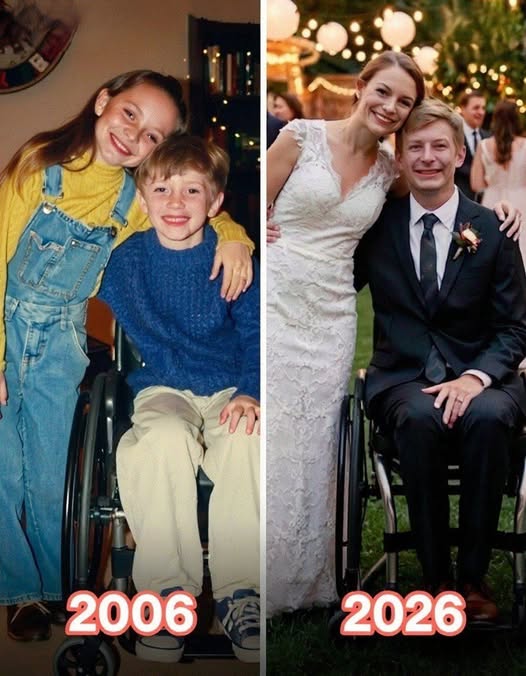
Claire, now 28 and living in the United States, spent her early childhood moving through foster placements and institutional care. Before the age of eight, she had already learned how to live with few belongings and fewer guarantees. Her early years were defined by impermanence, routines that changed without warning, and the constant need to adapt.
Raised within the child welfare system, Claire learned early how to read adults, memorize new environments, and keep herself unobtrusive. She recalls being described as “resilient,” a word often applied to children in care, though she later came to understand that resilience often meant emotional restraint rather than strength. Over time, she adopted a personal rule that shaped her survival: “Don’t get attached.”
That rule followed her to the final orphanage placement of her childhood, a place she would later describe as the true beginning of her life. It was there, in an unremarkable room lit by fluorescent lights and lined with worn linoleum floors, that she met Noah.
Noah was nine years old at the time. He used a wheelchair, not a modern or polished one, but a practical chair marked by years of use. He was quiet, observant, and often positioned near a window, watching the outside world with calm attention. Around him, other children and staff behaved cautiously, unsure how to engage. Instructions directed at him were often spoken as if he were not present, reducing him to a task rather than a person.
Despite this, Noah remained attentive and composed. His wheelchair made a faint squeaking sound when he moved, a detail that later became familiar to Claire. Their first interaction was understated. Claire sat near him during free time, book in hand, and broke the silence by saying, “If you’re going to guard the window, you have to share the view.” Noah replied simply, “You’re new.” When she answered, “More like returned,” the exchange marked the beginning of a connection that would last decades.
They introduced themselves without ceremony. “Claire,” she said. He responded with a single nod. “Noah.” There was no dramatic moment, but from that day forward, their lives were closely linked.
Growing up together in the orphanage meant witnessing every version of one another. They shared the anger that followed each adoption announcement for someone else, the quiet after birthdays passed without recognition, and the cautious hope that surfaced whenever visitors toured the facility. Both learned to temper expectations, understanding that wanting too much could lead to disappointment.
Neither spoke often about future dreams. Instead, they developed rituals that acknowledged their shared reality. When another child left the orphanage, they would exchange a rehearsed joke. “If you get adopted,” Noah would say, “I get your headphones.” Claire would answer, “If you get adopted, I get your hoodie.” The humor masked a shared understanding that neither of them was likely to be chosen.
As they grew older, Noah’s seriousness softened. He developed a dry sense of humor and an attentiveness that extended quietly to Claire. When she withdrew, he noticed. When staff grew impatient with him, she intervened with excuses. They avoided promises, but they were consistently present for one another.
They aged out of the system within a short time of each other. The transition was procedural and brief. A staff member slid paperwork across a desk and said, “Sign here,” followed by, “You’re adults now.” With their signatures complete, they left with their belongings packed in plastic bags, no ceremony marking the end of their childhood in care.
Outside, the future felt wide and uncertain. Noah attempted to lighten the moment by saying, “Well, at least nobody can tell us where to go anymore.” Claire replied, “Unless it’s some kind of official trouble.” Noah added, “Then we better not get caught doing anything stupid.”
Without a detailed plan, they moved forward together. They enrolled in community college, navigated administrative systems, and searched for housing they could afford. They found a small apartment above a laundromat, a space filled with the constant scent of detergent and the rhythmic noise of machines below. The building was not ideal, particularly the stairs, but it was affordable and secure.
They worked multiple jobs while studying. Noah provided remote IT support and tutoring, relying on patience and clear communication. Claire worked at a coffee shop during the day and stocked shelves at night. They shared a single aging laptop and furnished the apartment with secondhand items, creating a home from mismatched pieces.
Over time, the apartment became a place of stability. It was the first space that belonged solely to them, free from oversight or imposed schedules. Within that routine, their relationship evolved naturally. Claire found comfort in the familiar sound of Noah’s wheelchair entering a room. Noah began checking in on her safety with simple messages. They spent evenings watching movies, often falling asleep side by side.
The shift from friendship to partnership was gradual. One evening, exhausted from studying, Claire acknowledged what had already become true. “We’re kind of already together, aren’t we?” Noah responded with relief, saying, “Oh, good. Thought that was just me.”
They later used the terms boyfriend and girlfriend for clarity with others, but the foundation of their relationship had been built over years. They completed their degrees and celebrated quietly when their diplomas arrived. Noah remarked, “Look at us. Two orphans with paperwork.”
A year later, Noah proposed in their kitchen during an ordinary evening. He placed a ring box beside a pot of sauce and asked, “So, do you want to keep doing this with me? Legally, I mean.” Claire accepted, overcome with emotion.
Their story did not end there. In the years that followed, their shared past would resurface in unexpected ways, including a wedding marked by a surprise, the discovery of a long-lost letter, and an inheritance that would alter their circumstances and allow them to pursue a long-held dream of a permanent home.
From childhood shaped by uncertainty to adulthood built on partnership, their journey reflects the long-term impact of stability, persistence, and mutual support. What began as companionship in an orphanage grew into a shared life defined not by where they started, but by what they chose to build together.