
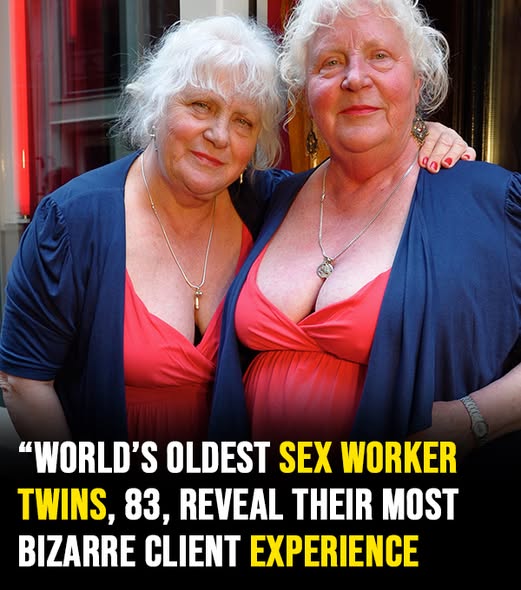
In the winding streets of Amsterdam’s historic Wallen district, where red neon reflections ripple across canal water and centuries-old buildings, few figures are as deeply woven into the area’s identity as Louise and Martine Fokkens. Now both 83 years old, the identical twins have stepped fully into retirement, bringing an end to careers that lasted more than half a century and placed them among the most recognized figures in the history of the city’s legalized sex trade.
Known globally as the world’s oldest sex-working twins, the Fokkens sisters lived and worked through decades of social change, legal evolution, and shifting attitudes toward sex work in the Netherlands. Their lives, marked by resilience and contradiction, have become part of the cultural record of Amsterdam itself. Over the span of their working years, the sisters estimate they collectively saw approximately 355,000 clients, an astonishing number that underscores both the scale of their careers and the longevity of their presence in the Red Light District.
Their story gained international attention through the documentary Meet the Fokkens, which offered an unfiltered look at aging, survival, and humor inside an industry overwhelmingly focused on youth. The film captured not only their professional lives but also their sharp wit, candor, and refusal to romanticize the hardships they endured.
A Beginning Shaped by Coercion
Behind the glowing windows and tourist fascination lies a far more complicated reality. For Louise Fokkens, the beginning of her career was not driven by choice or opportunity but by violence and control. At the age of 17, she was forced into sex work by her husband, who exploited her labor for his own financial gain.
“He basically beat me into that booth, becoming my pimp, living on my money,” Louise said.
Her experience reflects a darker side of the trade that often remains hidden behind its legal framework. While the Netherlands is frequently cited for its regulated approach, the Fokkens’ early years illustrate how legality does not eliminate exploitation or abuse.
Martine’s path into the industry followed soon after, though under very different emotional circumstances. Initially, she worked as a cleaner in the same building where her sister stood behind the glass. Watching Louise face social rejection and judgment sparked a powerful reaction.
“I was angry at how everybody around us shunned Louise,” Martine explained. “I did it out of spite, really.”
What began as an act of solidarity evolved into a shared professional life that would define both women for decades.
Building a Life Inside the District
As the years passed, the Fokkens twins became fixtures in the Wallen district. Their identical appearance and straightforward demeanor made them instantly recognizable to locals and regular visitors alike. Beyond working independently, they developed a strong understanding of the business side of the area, eventually running their own brothel as well as a restaurant called De Twee Stiertjes.
Managing multiple ventures required adaptability and a thick skin. The sisters learned to navigate interactions with people from every imaginable background, including clients, law enforcement, business partners, and neighbors.
“The business taught us to get along with everybody, and I do mean everybody,” Louise once said.
Their longevity was unusual in an industry where careers are often short-lived. For Louise in particular, continuing to work into later life became a personal point of pride.
She described her endurance as “a source of pride, a sport of sorts.”
Yet time, as it inevitably does, brought physical limitations. In 2010, Louise was forced to stop working due to severe arthritis, which made the physical demands of the job impossible to sustain. Martine soon followed, noting that while many long-standing clients remained loyal, the broader market increasingly favored younger workers.
Pride, Regret, and Complexity
Looking back, the sisters speak with striking honesty about their lives. While they acknowledge the financial independence and unforgettable experiences their work provided, both express regret about the broader consequences of their choices.
“We didn’t need all the trouble it brought us, the social stigma, the negative people you meet,” Martine said. “But that’s just how things went. Besides, we also met some wonderful people thanks to the business.”
This duality—pride mixed with remorse—runs through much of their reflection. The sisters never frame their story as a cautionary tale or a celebration. Instead, it stands as a complex account shaped by circumstance, agency, and survival.
Stories From the Edge of Human Desire
With a combined client history numbering in the hundreds of thousands, the Fokkens twins accumulated a vast archive of stories revealing the strange, vulnerable, and sometimes absurd nature of human desire.
Even as arthritis limited Louise’s mobility, one long-term client refused to part ways. The man, elderly himself, sought regular Sadomasochism sessions and treated the visits as a ritual rather than a transaction.
“I couldn’t give him up. He’s been coming to me for so long it’s like going to church on a Sunday,” Martine said.
Other encounters were remembered less for intimacy and more for their sheer oddity. One such moment involved a man the sisters nicknamed a “filthy little gnome,” whose excitement was visible as he approached their windows. The situation abruptly ended when his wife appeared in front of him, instantly dissolving the fantasy.
“He looked like he was about to burst into confetti,” Louise recalled, laughing at the memory of his stunned reaction.
These anecdotes, while humorous, also reveal the deeply human dimensions of sex work—ritual, secrecy, embarrassment, and longing all intersecting behind the glass.
Life After the Red Lights
The Fokkens sisters officially retired around the age of 70, closing the window on a chapter that had defined their adult lives. In the years since, they have embraced a quieter existence centered on family and creativity.
They now spend their time with their children and grandchildren, roles that stand in stark contrast to their former public personas. In addition, both women discovered a passion for painting, turning artistic expression into a second career. Their artwork often depicts scenes from the Red Light District itself—canals, neon reflections, narrow streets, and the anonymous figures that populate them.
Through their paintings, the sisters preserve a visual record of the neighborhood that shaped them. The canvases serve as both documentation and reflection, capturing a world they once inhabited daily but now observe from a distance.
A Lasting Place in Amsterdam’s History
Louise and Martine Fokkens are more than former sex workers; they are enduring symbols of a particular era in Amsterdam’s social landscape. Their lives intersected with debates about legalization, exploitation, aging, and autonomy, offering a human face to issues often discussed only in abstract terms.
Their transition from red-lit windows to grandmotherhood and art studios reflects a resilience forged through hardship and adaptation. While they no longer stand behind glass, their legacy remains embedded in the history of the Wallen district.
As Amsterdam continues to evolve, reshaping its relationship with tourism and the sex trade, the story of the Fokkens twins stands as a reminder that behind every illuminated window is a life shaped by forces far more complex than appearances suggest.