
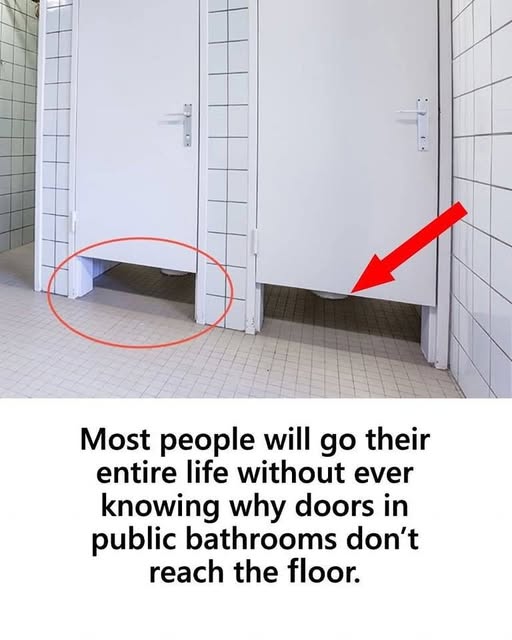
At first glance, the gap beneath public bathroom stall doors can feel like an oversight or an uncomfortable compromise of privacy. Many people assume it exists to cut costs or as a leftover feature from outdated construction practices. In reality, the design is intentional and carefully considered. That small space under the door plays a significant role in balancing privacy with safety, hygiene, maintenance, and long-term practicality in high-traffic public facilities.
Architects, building engineers, and facility managers rely on this design because public restrooms present unique challenges. Unlike private bathrooms, these spaces must accommodate constant use by large numbers of people, operate safely in emergencies, remain sanitary throughout the day, and be easy to maintain. When viewed through that lens, the gap beneath the door becomes less of a flaw and more of a functional solution.
Understanding why this feature exists helps explain how public spaces are designed not just for comfort, but for reliability, efficiency, and safety under real-world conditions.
Safety and Emergency Response
One of the most important reasons public restroom stall doors do not reach the floor is emergency access. In rare but serious situations, people can experience medical emergencies inside restroom stalls. Individuals may faint, fall, suffer seizures, or experience cardiac events. When a stall is locked and unresponsive, the gap beneath the door allows staff or emergency responders to quickly assess whether someone inside needs immediate help.
By being able to see feet or signs of movement, responders can determine if the stall is occupied and whether the person inside is in distress. This visual access can save critical time, allowing staff to call for medical assistance or intervene without delay. In some situations, small medical tools, communication devices, or assistance items can even be slid under the door while help is on the way.
Without this gap, the only option in an emergency would often be to force the door open, which can take longer and risk injuring the person inside. The current design provides a safer, faster alternative that has proven effective in real-life emergencies.
Visibility for Security and Oversight
Public restrooms are sometimes vulnerable to misuse, including vandalism, drug use, or other unsafe activities. The gap under stall doors helps deter these behaviors by ensuring a basic level of visibility. While it does not eliminate privacy, it discourages prolonged or inappropriate use of stalls by making it easier for staff to recognize unusual situations.
Facility managers and security personnel can quickly scan restrooms for signs of concern, such as someone remaining motionless for an extended period or multiple people occupying a single stall. This subtle visibility acts as a preventive measure, helping maintain a safe environment without the need for constant supervision.
In locations such as airports, schools, shopping centers, and stadiums, this oversight contributes to public safety while still allowing individuals to use the restroom without direct intrusion.
Improved Ventilation and Airflow
Public restrooms require effective ventilation to manage odors, humidity, and airborne contaminants. The gap beneath stall doors plays a key role in supporting airflow throughout the space. When combined with exhaust fans, the open area allows fresh air to circulate more freely, preventing stagnant pockets where odors and moisture can build up.
Better air circulation improves the overall restroom experience for users, reducing unpleasant smells and helping maintain a cleaner atmosphere. It also supports the performance of mechanical ventilation systems, making them more efficient and reducing energy strain.
Additionally, consistent airflow helps limit the growth of mold and mildew. These organisms thrive in damp, enclosed spaces, and public restrooms are naturally prone to humidity. The door gap helps reduce moisture accumulation, protecting both the structure and the health of users.
Hygiene and Cleaning Efficiency
Cleaning efficiency is another major factor behind this design choice. Public restrooms often need to be cleaned multiple times per day, especially in high-traffic locations. The gap beneath stall doors allows janitorial staff to mop floors quickly and thoroughly without opening or unlocking every stall.
This continuous cleaning motion is not only faster but also more hygienic. It reduces the chance of cross-contamination caused by repeatedly touching door handles and locks. The design allows custodial teams to maintain sanitation standards efficiently, which is essential in environments used by hundreds or thousands of people daily.
The gap also allows maintenance staff to spot issues such as water leaks, overflowing toilets, or damage without entering each stall individually. Early detection helps prevent minor problems from escalating into costly repairs or health hazards.
Accommodating Floor Variations
In many buildings, floors are not perfectly level. Over time, surfaces can shift due to structural settling, temperature changes, or wear. Doors that extend all the way to the floor would require precise measurements and frequent adjustments to avoid scraping, sticking, or failing to close properly.
By stopping short of the floor, stall doors can function reliably even when the surface beneath them is uneven. This tolerance reduces long-term maintenance issues and ensures doors open and close smoothly over time.
This design also allows restrooms to be installed more easily in older buildings, where floors may not meet modern construction standards. The flexibility helps extend the lifespan of restroom fixtures while keeping maintenance costs manageable.
Cost and Durability Considerations
From a construction standpoint, stall doors that do not reach the floor are more economical to manufacture, install, and maintain. They require fewer materials, simpler hardware, and less customization during installation. When outfitting large facilities with dozens or even hundreds of stalls, these savings become significant.
Lower costs do not necessarily mean lower quality. In fact, shorter doors often experience less wear because they are not exposed to constant contact with moisture from floors or cleaning equipment. Reduced exposure to water helps prevent warping, corrosion, and long-term damage, increasing durability.
This balance of cost efficiency and longevity is a key consideration for public facilities that must operate within budgets while still meeting safety and hygiene standards.
Balancing Privacy with Practicality
While privacy is important, public restroom design involves compromise. Complete floor-to-ceiling enclosures would increase privacy but would also introduce challenges related to safety, ventilation, cleaning, and cost. The current design reflects a balance between these competing needs.
Most stall doors are designed with height, width, and placement that provide reasonable visual privacy while still allowing light, airflow, and emergency access. Over time, designers have refined dimensions to minimize discomfort while preserving functionality.
In some newer or higher-end facilities, alternative designs are used, such as full-height partitions with enhanced ventilation systems and monitoring solutions. These are typically found in locations with lower traffic or higher budgets, where maintenance and oversight demands differ.
A Design Shaped by Real-World Use
Public restrooms are among the most heavily used spaces in any building. They must function reliably under constant use by people of all ages and conditions. The gap beneath stall doors is not an accident or a shortcut, but the result of decades of experience and practical problem-solving.
Every aspect of the design reflects lessons learned from emergencies, maintenance challenges, hygiene concerns, and operational realities. While the feature may still feel awkward or imperfect, it exists because it consistently performs its intended role.
Understanding the reasoning behind it helps explain why this design has remained standard across airports, schools, offices, malls, and public venues worldwide.
A Small Detail with a Big Purpose
The next time you notice the space beneath a public bathroom stall door, it may still seem unusual. But that small gap represents a thoughtful compromise shaped by safety, cleanliness, efficiency, and durability. It allows emergency responders to act quickly, keeps air circulating, supports effective cleaning, and ensures long-term reliability in spaces used by countless people every day.
In public design, the goal is rarely perfection for one individual. Instead, it is functionality for everyone. In that context, the gap beneath the door serves a purpose far greater than it appears at first glance.