
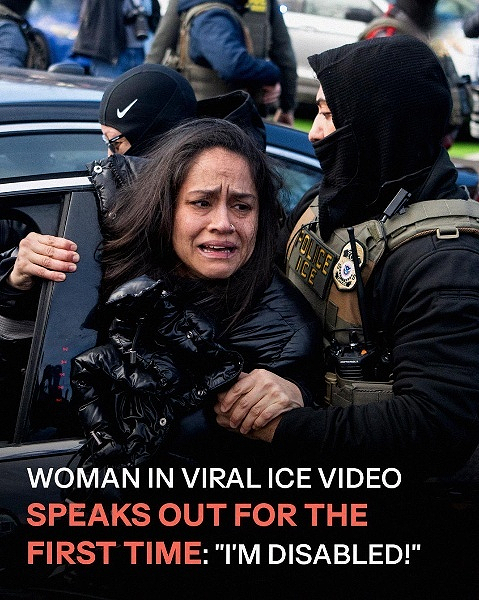
A Minneapolis woman whose arrest by masked federal agents was captured on widely circulated video has publicly shared her account of the incident, offering details that directly challenge official explanations from the Department of Homeland Security. The encounter, which unfolded during a period of heightened immigration enforcement activity in the city, has drawn national attention after footage showed the woman being forcibly removed from her vehicle while repeatedly stating, “I’m disabled,” as agents restrained her.
Aliya Rahman, the woman at the center of the viral video, spoke publicly for the first time about the incident in an interview with CNN. She stated that she was driving to a scheduled medical appointment when Immigration and Customs Enforcement agents stopped her vehicle. Rahman denied any involvement in demonstrations or efforts to interfere with federal operations, contradicting federal statements that characterized her actions as disruptive.
The Incident That Sparked National Attention
The arrest occurred last week amid large-scale protests and increased federal activity in Minneapolis. Video recorded by bystanders shows several masked agents approaching Rahman’s vehicle, opening the driver’s side door, cutting her seatbelt, and pulling her from the car. Throughout the footage, Rahman can be heard repeatedly shouting, “I’m disabled,” and explaining that she was on her way to see a doctor.
Additional footage shows agents smashing the passenger-side window of the vehicle before carrying Rahman toward an ICE vehicle. The recording spread rapidly across social media platforms, prompting widespread discussion and concern about the use of force and the circumstances surrounding the arrest.
The video’s visibility elevated the incident beyond a local enforcement action, transforming it into a focal point of national debate over federal immigration tactics and interactions with civilians during periods of civil unrest.
Federal Response and Official Description
Following the arrest, the Department of Homeland Security described Rahman as an “agitator,” stating that she ignored commands to move her vehicle and obstructed law enforcement activity near protest areas. According to DHS statements, agents acted in response to her alleged refusal to comply with instructions intended to maintain safety and order during ongoing operations.
Rahman disputes that characterization. She stated that she was not participating in demonstrations and that she had no intention of interfering with federal agents. According to her account, she remained stationary in her vehicle out of concern for her own safety.
Rahman’s Explanation of Her Disability
Rahman disclosed that she is autistic and experiences auditory processing difficulties, particularly in loud and chaotic environments. She explained that the noise surrounding the scene, combined with the presence of multiple agents shouting commands, made it extremely difficult for her to understand what was being said.
In her interview, Rahman described attempting to visually identify who was speaking so she could better process instructions. She noted that the agents’ masks made this more difficult, as she relies in part on reading lips to understand speech. “You see me looking and trying to identify which lips are talking to me,” she said.
According to Rahman, her inability to clearly understand verbal commands contributed to her decision to remain still rather than risk misinterpreting instructions in a tense situation.
Events After the Arrest
Rahman stated that following her arrest, she was taken into ICE custody, where she alleges that her disability-related needs were not accommodated. She said she repeatedly requested access to a wheelchair, explaining that she struggled to remain upright due to physical and neurological challenges.
According to her account, those requests were ignored. Rahman reported that she eventually lost consciousness while in custody and was later transported to a hospital for emergency medical treatment. She has not publicly disclosed the full extent of her medical condition following the incident, but stated that the experience was physically and emotionally distressing.
Federal authorities have not released detailed information addressing her claims regarding detention conditions or medical accommodations.
Legal Review and Potential Action
Rahman is represented by attorney Alexa Van Brunt, who stated that neither Rahman nor her legal team has been informed whether federal authorities intend to pursue charges related to the incident. Van Brunt said her team is reviewing available video footage, gathering witness accounts, and examining applicable federal protocols.
Van Brunt also asserted that ICE agents failed to follow established procedures for interacting with civilians, particularly individuals with disabilities. She stated that the legal team is assessing possible violations and determining appropriate next steps based on the evidence collected.
A City Under Heightened Federal Enforcement
The arrest occurred during an intensified period of federal immigration enforcement in Minneapolis. Thousands of federal agents have reportedly been deployed across the city, conducting arrests and operations that have led to repeated confrontations with protesters and community members.
Video of Rahman’s arrest emerged alongside numerous other clips showing tense encounters between federal agents and demonstrators. In several instances, crowds gathered around federal vehicles, shouting instructions or demands, while officers responded with crowd-control measures including tear gas, pepper balls, and pepper spray.
The volume of recorded encounters has amplified public scrutiny of enforcement tactics and raised broader questions about the balance between public safety and civil rights during large-scale operations.
Context of a Recent Fatal Encounter
Rahman’s arrest followed a separate, deadly ICE-related confrontation in Minneapolis days earlier. In that incident, 37-year-old Renee Nicole Good was shot during a federal operation. Details surrounding that case remain under investigation.
According to Rahman’s attorney, the recent fatality influenced Rahman’s decision-making during her encounter with agents. Van Brunt stated that Rahman believed remaining stationary in her vehicle was the safest course of action, as any sudden movement could be misinterpreted as aggression in a high-tension environment.
Rahman herself said that fear played a significant role in her response, given the surrounding circumstances and recent events.
Conflicting Accounts and Public Debate
Rahman maintains that she was simply traveling to a routine appointment at the Traumatic Brain Injury Center when she was stopped by ICE agents. Her account stands in direct contrast to the Department of Homeland Security’s assertion that she was obstructing enforcement activities.
The discrepancy between these narratives has fueled public debate and intensified calls for transparency. Advocates have pointed to the incident as an example of the challenges faced by individuals with disabilities during law enforcement encounters, particularly when communication barriers exist.
The viral footage has become a central element in discussions about accountability, the use of force, and the responsibilities of federal agencies when interacting with civilians who may require accommodations.
Broader Implications
Rahman’s experience has drawn attention not only because of the dramatic nature of the arrest, but also because of the broader questions it raises. The incident highlights issues surrounding disability awareness, procedural compliance, and the handling of nonviolent civilians during large-scale enforcement operations.
As federal authorities continue their activities in Minneapolis, public focus remains fixed on how such encounters are conducted and how conflicting accounts are addressed. Rahman’s decision to speak publicly has added a personal dimension to a complex and ongoing debate.
Her story, documented in widely shared video and reinforced by her own testimony, has become part of a larger conversation about the human impact of federal immigration enforcement and the standards governing interactions between agents and the public.