
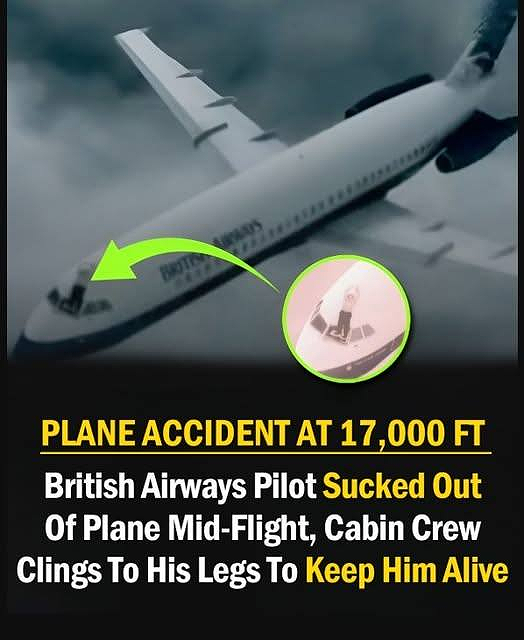
In early summer 1990, a British Airways flight operating a routine European route became the center of one of the most remarkable survival events in commercial aviation history. What began as an ordinary morning departure transformed within minutes into a life-or-death emergency that tested professional training, physical endurance, and human resolve at extreme altitude.
On June 10, 1990, British Airways Flight 5390 departed Birmingham Airport en route to Málaga Airport in southern Spain. The aircraft, a BAC One-Eleven jetliner, carried 81 passengers and six crew members. Nothing about the preflight checks or departure procedures suggested that the flight would become a case study in aviation emergency response and survival.
A Normal Takeoff With Experienced Crew
The aircraft took off at approximately 08:20 AM and began a steady climb toward cruising altitude. At the controls was Captain Timothy Lancaster, a 42-year-old pilot with more than 11,000 flight hours. He was highly experienced on the BAC One-Eleven and well respected within British Airways for his professionalism.
Seated beside him was First Officer Alastair Atchison, 39, who also possessed extensive flying experience. The cockpit environment was calm and routine, while passengers settled into the flight expecting a standard journey to Spain.
Approximately 13 minutes after takeoff, as the aircraft climbed through about 17,300 feet over Didcot, Oxfordshire, the situation changed instantly and violently.
Catastrophic Decompression in the Cockpit
Without warning, the left cockpit windshield panel separated from the aircraft. The failure caused an immediate and explosive decompression. Cabin pressure dropped in a fraction of a second, and a powerful blast of air rushed outward through the opening.
The noise inside the cockpit became deafening. Loose papers, charts, and small objects were pulled toward the opening as the aircraft shuddered from the sudden pressure change. Condensation fog formed rapidly as the temperature and pressure dropped.
The force of the decompression was extreme. Captain Lancaster was violently thrown forward and partially ejected through the cockpit window. His upper body was forced outside the aircraft, while his legs remained inside, trapped by the flight controls and his seat. The positioning of his legs and their contact with the control column prevented him from being completely expelled into the open air.
The cockpit door was blown inward by the pressure change, striking the instrument panel and adding to the chaos inside the flight deck.
Immediate Heroic Action in the Cockpit
At the moment of the explosion, flight attendant Nigel Ogden was in the cockpit delivering refreshments. He turned toward the sound of the blast and was confronted with a critical scene: the captain was being pulled out of the aircraft, exposed to the freezing air and intense wind outside.
Ogden reacted instantly. He lunged forward and grabbed Lancaster around the waist, anchoring himself inside the cockpit. The aircraft was traveling at several hundred miles per hour, and the air rushing into the cockpit was equivalent to hurricane-force winds multiplied many times over. Outside temperatures at that altitude were far below freezing.
Despite the overwhelming force, Ogden maintained his grip. The physical effort required was immense, and the risk to his own safety was significant. Releasing his hold even briefly would likely have resulted in the captain being lost.
Coordinated Crew Response Under Extreme Conditions
As Ogden struggled to hold Lancaster in place, additional crew members rushed to assist. Purser John Heward entered the cockpit and helped secure the captain’s legs, ensuring they remained wedged inside the aircraft.
The effort required to keep Lancaster from being pulled out was exhausting. Ogden’s arms began to weaken as the cold, wind, and strain took their toll. Recognizing the danger, flight attendant Simon Rogers stepped in to assist, allowing Ogden to briefly shift his position and regain strength. The crew rotated support as needed, maintaining continuous physical contact with the captain’s body to prevent further movement.
Throughout this period, Lancaster remained unconscious, exposed to extreme cold and wind for an extended duration.
Control of the Aircraft Amid Crisis
While the cabin crew fought to keep the captain inside the aircraft, First Officer Alastair Atchison faced a separate but equally critical challenge. The decompression had disengaged the autopilot, and the aircraft began to descend rapidly.
Atchison immediately donned his oxygen mask and focused on stabilizing the aircraft. Despite the violent airflow entering the cockpit and the obstruction caused by the displaced cockpit door, he maintained control.
He initiated an emergency descent to reduce altitude as quickly as possible, aiming to reach air levels where oxygen availability would be sufficient for everyone on board. He also declared an emergency with air traffic control and coordinated navigation through congested British airspace.
With precision and calm decision-making, Atchison diverted the aircraft to Southampton Airport, selecting a location that allowed for a prompt and controlled emergency landing.
Twenty Minutes Outside the Aircraft
For approximately 20 to 22 minutes, Captain Lancaster remained partially outside the aircraft. During this time, he was exposed to sub-zero temperatures, intense wind speeds, and sustained physical stress.
Inside the cabin, oxygen masks deployed automatically. Passengers were visibly shaken, with many believing the aircraft might not survive the emergency. Cabin crew members moved through the cabin, providing instructions and reassurance while maintaining order during the descent.
Despite the severity of the situation, the aircraft remained structurally intact and responsive to control inputs, allowing Atchison to continue his approach to Southampton.
Safe Landing Against Extraordinary Odds
The aircraft touched down safely at Southampton Airport, where emergency services were already in position. Medical teams rushed to the cockpit and carefully removed Captain Lancaster, who was still alive.
The outcome defied expectations given the duration and severity of his exposure.
Injuries and Recovery
Captain Lancaster was transported to Southampton General Hospital for immediate treatment. He had sustained frostbite, shock, significant bruising, and fractures to his right elbow, wrist, and left thumb. Despite the trauma, his injuries were not fatal.
Nigel Ogden also required medical attention. He suffered cuts, bruises, and minor frostbite. In the months following the incident, he experienced emotional aftereffects consistent with post-traumatic stress.
Other crew members and several passengers were treated for shock. Remarkably, all 87 individuals aboard Flight 5390 survived the incident.
Return to the Cockpit
Captain Lancaster’s recovery was notable not only for its success but for its speed. Just five months after the accident, he returned to commercial flying with British Airways. He continued flying for many years and retired in 2008, closing a career defined by experience, resilience, and professionalism.
Investigation Findings
A formal investigation identified the cause of the windshield failure as a maintenance error. The left cockpit windscreen had been replaced only 27 hours before the flight during routine maintenance at Birmingham Airport.
The bolts used to secure the windshield were incorrectly sized, with many being slightly smaller than required. During pressurization on ascent, the weakened installation was unable to withstand the forces involved, leading to the windshield panel separating from the aircraft.
The incident prompted widespread industry review of maintenance procedures, documentation accuracy, and quality control standards.
Recognition and Lasting Impact
The actions of the Flight 5390 crew were formally recognized. Several crew members, including Nigel Ogden, Alastair Atchison, and Simon Rogers, received the Queen’s Commendation for Valuable Service in the Air.
The event has since been featured in aviation safety studies and documentaries, becoming one of the most well-known non-fatal emergencies in commercial flight history.
A Defining Moment in Aviation Safety
British Airways Flight 5390 stands as a powerful example of how training, discipline, and teamwork can overcome catastrophic failure. From the moment of explosive decompression to the safe landing, the outcome depended on rapid decision-making and extraordinary human effort.
The survival of Captain Timothy Lancaster remains one of the most dramatic reminders of the resilience of the human body and the importance of procedural rigor in aviation. The actions of the crew continue to be cited as a benchmark for professionalism and courage in the face of extreme adversity.