
Tensions between the United States and Denmark escalated recently after President Donald Trump reignited his long-discussed interest in acquiring Greenland. The Arctic territory, a semi-autonomous region of Denmark, has become the center of an international dispute, sparking protests, heated rhetoric, and viral political moments.
Trump’s Push for Greenland
President Trump has repeatedly emphasized Greenland’s strategic importance, framing the Arctic island as vital for both national and global security. On social media platform Truth Social, he wrote, “As I expressed to everyone, very plainly, Greenland is imperative for National and World Security. There can be no going back — On that, everyone agrees!”
Trump has characterized the United States as the only power capable of ensuring global peace, asserting, “The United States of America is the most powerful Country anywhere on the Globe, by far… We are the only POWER that can ensure PEACE throughout the World — And it is done, quite simply, through STRENGTH!”
These statements have intensified longstanding skepticism among international observers, who argue that Greenland’s vast natural resources may be the underlying motivation rather than purely strategic concerns.
Public Opposition in Denmark and Greenland
The president’s remarks have triggered significant backlash both in Greenland and across Denmark. Over the past weekend, demonstrations were held under the banner “Hands off Greenland,” reflecting widespread opposition to any transfer of sovereignty. Opinion polls indicate that 85% of Greenlanders oppose joining the United States, highlighting the depth of local resistance.
The protests in Denmark’s major cities, as well as in Greenland itself, combined public anger with a firm defense of national sovereignty. For many Danes and Greenlanders, Trump’s proposals are viewed as an unprecedented challenge to established international norms and an affront to local autonomy.
Anders Vistisen’s Viral Response
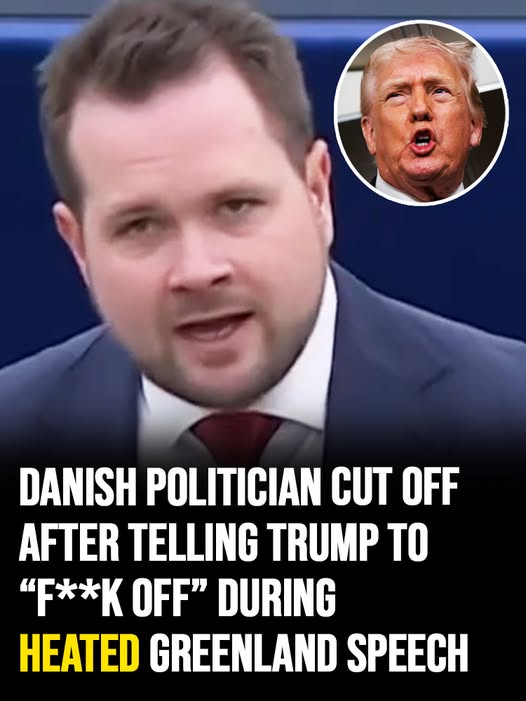
The controversy reached a new level when Danish politician Anders Vistisen addressed the European Parliament with an explosive statement aimed directly at the U.S. president. Vistisen, a Member of the European Parliament, opened his remarks with a firm reminder of Greenland’s historical and political status:
“Dear President Trump, listen very carefully. Greenland has been part of the Danish kingdom for 800 years. It is an integrated country. It is not for sale,” Vistisen said.
He then punctuated his statement with language that quickly went viral: “Let me put this in words you might understand: Mr. President, f–k off.”
The blunt declaration resonated with many on social media, drawing praise for its candor and frustration with what some perceived as U.S. overreach. Others, however, criticized the language as inappropriate for an official setting.
European Parliament Reaction
Vistisen’s remarks did not go unchallenged within the European legislative body. The session’s presiding speaker interrupted him, citing rules against inappropriate language and emphasizing the need for decorum in parliamentary proceedings.
“I am sorry, this is against our rules,” the speaker said. “As much as you might feel, or the room might feel in this, we have clear rules about cuss words and language that is inappropriate in this room. I am sorry to interrupt you, but it is unacceptable, even if you might have strong political feelings about this.”
The incident underscored the delicate balance European legislators must maintain between expressing political sentiment and adhering to formal diplomatic standards.
Global Implications
Trump’s statements on Greenland have broader geopolitical implications. The island’s location and resources are strategically significant, attracting interest from multiple global powers. By suggesting that the United States could assert ownership over Greenland, Trump not only challenged Denmark’s sovereignty but also risked complicating relations with NATO allies and other Arctic stakeholders.
In Denmark, the backlash has united political and public opinion around Greenland’s status. Danish leaders, including the prime minister, have repeatedly stated that Greenland is not for sale and that any suggestion otherwise is entirely unacceptable. For many, Vistisen’s forceful language captured the broader sentiment: a refusal to be treated as negotiable property on the global stage.
Public Reaction
The exchange has sparked intense debate online. Social media users have widely shared Vistisen’s words, with hashtags like #HandsOffGreenland trending in multiple countries. Supporters argue that the politician’s message underscores the importance of national sovereignty and standing up to perceived bullying from global powers. Critics contend that diplomatic channels, rather than expletive-laden statements, are the appropriate way to address such international disputes.
Meanwhile, Greenlanders themselves remain largely unified against the notion of U.S. acquisition. Community leaders have emphasized that any discussion of sovereignty should include the voices of local residents, reinforcing the principle that major international decisions must reflect the will of those directly affected.
The Ongoing Debate
As the situation develops, it is clear that the Greenland controversy is far from over. President Trump’s insistence on the strategic importance of the island, combined with widespread Danish and Greenlandic opposition, has created a tense international environment. Observers suggest that future diplomatic engagement will need to carefully balance national security interests with respect for sovereignty and local governance.
The viral moment created by Anders Vistisen has added another dimension to the debate, highlighting both the frustrations of European politicians and the heightened scrutiny faced by U.S. policy decisions. While language and tone have become part of the conversation, the underlying issue remains the same: the fate of Greenland and the principle of self-determination for its people.
With protests continuing and public sentiment firmly against any transfer of Greenland to U.S. control, the world watches closely to see how diplomatic and political negotiations will unfold.