
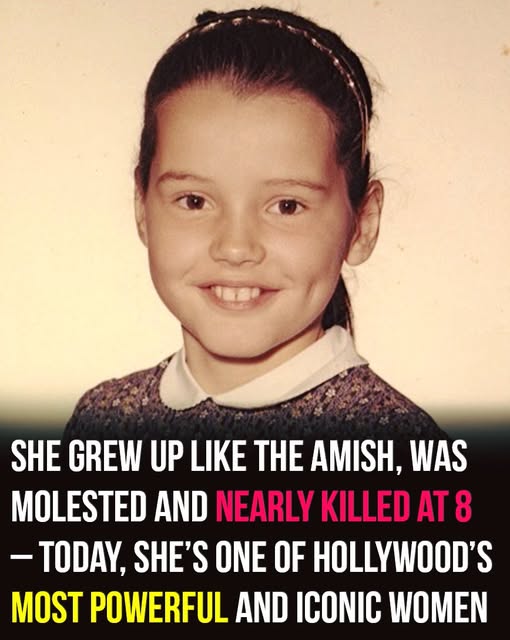
She rose to prominence in the 1980s with a rare combination of intelligence, charisma, and versatility, moving swiftly from modeling to becoming one of Hollywood’s most respected and awarded actresses. Yet behind the success and global recognition was a life shaped by strict upbringing, personal trauma, and formative experiences that would later influence both her career choices and her advocacy work.
Born on January 21, 1958, in Wareham, Massachusetts, Geena Davis grew up far removed from the glamour she would later embody on screen. From an early age, she felt drawn to performance, even though her exposure to the entertainment world was limited.
“I was three years old, and how I even knew it was a job, I have no idea, because we were only allowed to watch Disney movies, which were animated.”
Her parents, Bill and Lucille, lived by traditional values and maintained a lifestyle that Davis later described as extremely modest and disciplined. She once joked that they “would have been Amish had they heard of being Amish.” Alongside her older brother, Dan, Davis was raised to prioritize politeness, restraint, and proper conduct above all else.
Reflecting on her upbringing, she explained, “My parents are both from Vermont, very old-fashioned New England. We heated our house with wood my father chopped. My mom grew all of our food. We were very underexposed to everything.”
Despite the sheltered environment, Davis’s childhood was marked by moments of fear and trauma that would stay with her for decades. One of the most frightening occurred when she was just eight years old. During a car ride with her 99-year-old great-uncle Jack, his erratic driving placed them repeatedly in the path of oncoming vehicles. Neither Davis nor her parents spoke up, even as danger mounted. Only at the last second did Jack correct the car’s path, narrowly avoiding a deadly collision. The incident reinforced a lesson that would follow her into adulthood: never speak out, always remain polite.
That belief became a central theme in her 2022 memoir, ”Dying of Politeness”, which chronicles how excessive politeness often prevented her from advocating for herself.
The book also revealed another deeply painful experience from her youth. Davis disclosed that she was molested by a neighbor while delivering his newspaper. At the time, she did not fully comprehend what had happened.
“It caused a lot of shame in me that that happened because I didn’t know what he was doing when he was touching me in that way. I didn’t know that it was wrong. I had no reaction to it, and then to see my mother’s reaction, [it was like], ‘Oh, my God, this was a big deal. I did something terribly wrong,’” she told Vanity Fair.
Although her mother confronted the neighbor and forbade Davis from returning to his apartment, the incident was never reported to authorities, and no detailed explanation was given to her.
“I knew that he was also to blame because she strolled up the street and told him never to touch me again and then told me never to go up the stairs to his apartment again. But she didn’t explain what had happened or why it was bad to do the thing that he was doing, so it just felt like this horrible secret that I was carrying around.”
Reflecting on the lasting impact, Davis added, “My big lesson in life was you can’t ever complain about anything. You can’t draw that kind of attention to yourself by complaining about something. So I didn’t talk about it, but I wanted to talk about it.”
Another challenge of her adolescence was her height. Davis was noticeably taller than her peers, a trait that brought unwanted attention and bullying. Though teachers encouraged her to play basketball, athletics proved frustrating.
“They always wanted me on the basketball team, but I wasn’t too good,” she said in 1985. “Track was my thing. I did high jumps and hurdles on the girls’ team. But it was hopeless if you were taller than everybody else.”
She later recalled, “I was tall from minute one. I was very self-conscious and shy, and the last thing I wanted to do was stand out, and yet, every minute, I stood out.”
Classmates mocked her appearance, giving her the nickname Kareem Abdul-Jabbar, a reference to the basketball legend. Outside sports, Davis played the flute in the marching band and spent her senior year studying in Sweden, becoming fluent in the language.
She attended New England College before transferring to Boston University to study drama. Her parents supported the decision, believing success in acting was unlikely.
“I think they knew so little about it, and it would be incredibly rare and freaky if I was able to have a successful career,” she said.
One detail she later revealed was that she never graduated, a fact she never shared with her parents before their deaths.
In 1977, Davis moved to New York City, supporting herself with various jobs while pursuing modeling. She signed with the Zoli Agency and appeared in the Victoria’s Secret catalog, an opportunity that changed her life.
“I knew I wanted to be in movies, as opposed to theater,” she said. “I decided that I would try becoming a model first because, at that time, Christie Brinkley and Lauren Hutton were being offered parts in movies.”
Her first acting role came through her modeling agency, leading to a pivotal moment when director Sydney Pollack cast her in Tootsie in 1982. The role brought immediate attention and critical praise, prompting her move to Los Angeles.
Television roles followed, including Buffalo Bill and Sara, before she transitioned fully to film. Though Transylvania 6-5000 struggled commercially, her career breakthrough came with The Fly in 1986 alongside Jeff Goldblum.
Davis’s ascent continued with Beetlejuice and The Accidental Tourist, which earned her the Academy Award for Best Supporting Actress. Her most iconic role arrived with Thelma & Louise, a film that reshaped her career and forged a lasting friendship with Susan Sarandon.
She credited Sarandon with teaching her how to speak plainly and assert herself. The film, followed by A League of Their Own, highlighted the lack of women-centered stories in Hollywood.
At the height of her fame, Davis balanced confidence with humility.
“People always ask, ‘Do you think you’re beautiful?’ What am I going to say?” she said in 1992. “But when I see myself in a movie, I sometimes think, Oh, that’s really nice. I look good.”
As she approached 40, opportunities declined sharply.
“I fell off the cliff,” she said in 2020. “The great roles were incredibly scarce.”
Her personal life, however, entered a new chapter. After four marriages, including one to Goldblum, Davis became a mother at 46. With her fourth husband, Reza Jarrahy, she welcomed daughter Alizeh in 2002 and twin sons Kaiis and Kian in 2004.
Motherhood reshaped her priorities and inspired her activism. Observing gender imbalance in children’s media, she founded the Geena Davis Institute on Gender in Media in 2004, advocating for equitable representation and noting that 96% of films are directed by men.
Today, at 69, Davis remains active in film and television. She is set to appear in the upcoming Netflix series The Boroughs, continuing a career defined not only by awards and acclaim, but by resilience, self-reflection, and lasting cultural impact.