
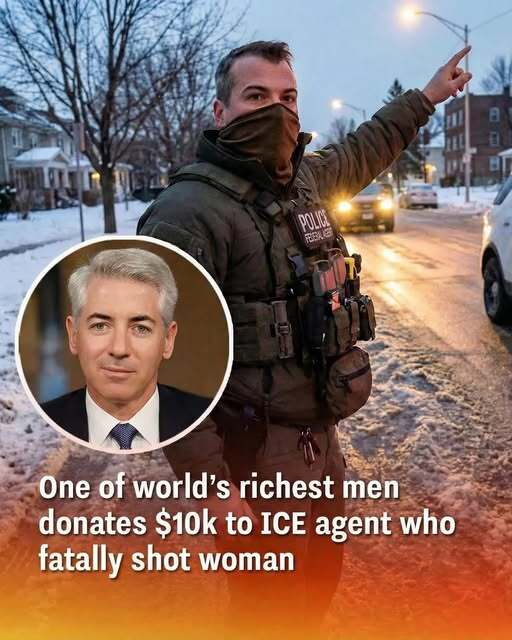
Billionaire investor Bill Ackman has drawn national attention after confirming a significant financial contribution in support of a U.S. Immigration and Customs Enforcement (ICE) agent involved in a fatal incident in Minneapolis, Minnesota. Ackman, widely recognized for his leadership in the hedge fund industry and his public commentary on economic and policy matters, disclosed that he was the largest donor to a GoFundMe campaign created to assist ICE agent Jonathan Ross following the incident.
The disclosure quickly intensified public scrutiny and fueled broader debates surrounding law enforcement accountability, immigration enforcement, and the influence of high-profile philanthropy in politically sensitive cases.
The incident occurred earlier this month and involved Renee Good, a 37-year-old mother of three. ICE officers were conducting an operation in her Minneapolis neighborhood when the encounter escalated, resulting in her death. Authorities stated that agents perceived an immediate threat and responded with force in line with their training protocols.
Federal agencies defended the actions of the ICE unit, emphasizing that officers are trained to make rapid decisions in high-risk situations. Despite these explanations, the case became a focal point in nationwide discussions about use-of-force standards, immigration enforcement practices, and public trust in law enforcement institutions.
Public response was deeply divided. In Minneapolis, residents held peaceful vigils in memory of Renee Good, underscoring the human impact of enforcement operations and calling for systemic reform. At the same time, demonstrations in other cities echoed broader concerns about policing, immigration policy, and the balance between civil liberties and national security.
Supporters of law enforcement maintained that officers must be able to act decisively to protect themselves, civilians, and federal operations. Critics countered that the fatal use of force raised serious questions about transparency, oversight, and accountability for federal agents.
As public debate intensified, multiple online fundraising campaigns emerged to support those affected by the incident. A GoFundMe campaign established for Jonathan Ross rapidly accumulated hundreds of thousands of dollars. The campaign stated that the funds were intended to assist with legal expenses, family support, and personal safety measures. High-profile donations drew particular attention across news and social media platforms.
One contribution of $10,000 listed under the name “William Ackman” sparked widespread speculation. Ackman later confirmed that he made the donation, explaining that his intent was to support due process rather than express a political or ideological position. He stated that his decision was rooted in the belief that all individuals deserve fair and impartial treatment under the law.
Ackman also noted that he had initially planned to contribute to a fundraising effort for Renee Good’s family, but that campaign had already concluded after surpassing its fundraising goal. He described the situation as tragic and expressed hope that the country could engage in constructive discussions about law enforcement, public safety, and the broader social issues highlighted by the case.
Reaction to Ackman’s involvement was swift. Supporters praised him for emphasizing legal fairness and due process, viewing the donation as philanthropy aimed at procedural justice rather than political alignment. Others commended his openness in explaining his motivations.
Critics, however, argued that contributing to a campaign supporting an agent involved in a fatal encounter carried symbolic implications, regardless of intent. They contended that such actions could be interpreted as endorsing enforcement practices that disproportionately affect marginalized communities, including immigrants and people of color. The debate highlighted how philanthropic actions, even when well-intentioned, can carry broader social and political meanings.
Media coverage also revisited Ackman’s history of charitable activity. In recent years, he has made high-profile donations related to disaster relief and has offered financial rewards in criminal investigations to encourage public cooperation. While these efforts often attracted attention for their scale, the decision to support an ICE agent in a controversial case amplified public scrutiny, illustrating the intersection of philanthropy and contentious public policy debates.
Experts in public policy and philanthropy weighed in on the broader implications. Dr. Karen Mitchell, a professor of public policy at Georgetown University, stated, “High-profile donations in contentious legal or social cases always carry multiple layers of impact. There’s the intended effect—supporting due process or legal representation—but also a secondary effect in the court of public opinion. This is especially true when the issue involves law enforcement, immigration, and community trust, which are already highly charged topics in American society.”
The Minneapolis incident also highlighted the challenges faced by ICE officers operating under federal mandates. The agency regularly conducts enforcement operations that can involve unpredictable and high-risk circumstances. Officials emphasize that agents receive extensive training in crisis management, de-escalation, and use-of-force decision-making, though real-world encounters can still escalate with tragic outcomes.
Supporters of agent Ross argued that legal and financial assistance is necessary to ensure fair treatment as the case undergoes review. Meanwhile, Renee Good’s family and community advocates continued to call for transparency, accountability, and comprehensive evaluation of enforcement practices. Proposed reforms included increased oversight of ICE operations, independent investigations into fatal encounters, and stronger community engagement.
The debate extended well beyond Minneapolis, resonating with national conversations about policing, immigration enforcement, and systemic inequality. Social media amplified these discussions, with hashtags related to the case periodically trending and reflecting both support for law enforcement and demands for justice for Renee Good.
Within financial and philanthropic circles, Ackman’s donation was examined for both its stated intent and its broader consequences. Observers noted that public figures with substantial wealth often face heightened scrutiny when engaging in polarizing social issues, as their actions can shape public perception regardless of personal motivation.
As investigations into the incident continued, attention expanded to the legal and societal implications of Ackman’s involvement. While the initial focus centered on the tragedy and the potential legal outcomes for Jonathan Ross, public discourse increasingly explored the intersection of philanthropy, accountability, and the responsibilities of influential individuals.
Multiple federal and local investigations were launched to examine the circumstances surrounding Renee Good’s death. ICE procedures require a formal review of all fatal encounters, including analysis of body camera footage, agent statements, and witness accounts. Local prosecutors are also evaluating potential civil or criminal liability.
Legal experts noted that such cases illustrate the complexity of modern law enforcement. Professor Daniel Whitman of the University of Minnesota Law School explained, “Federal agents operate under strict guidelines, but the real-world situations they face can be chaotic and unpredictable. Legal review must balance ensuring accountability with acknowledging the operational realities and split-second decisions that officers make.”
While Ackman’s donation does not directly affect the legal process, its visibility added a public relations dimension to an already sensitive case. Analysts emphasized the importance of transparency to prevent public perception from overshadowing factual and procedural review.
National reaction to the donation underscored deep divisions over law enforcement and immigration policy. Supporters framed the contribution as a safeguard for due process, while critics viewed it as a symbolic act with broader social implications. The debate raised larger questions about how wealthy individuals should engage in contentious legal and social matters.
Historically, high-profile donations in controversial cases have often sparked similar debates, reflecting the enduring tension between supporting legal rights and navigating public perception. In the digital era, online fundraising and social media have intensified scrutiny, ensuring that donations are rapidly interpreted within broader political and cultural narratives.
From a legal standpoint, philanthropic support can help ensure access to adequate legal representation, expert testimony, and procedural resources. In complex cases, such support can contribute to outcomes based on evidence and legal standards rather than disparities in financial resources.
Media coverage of the case varied widely, with some outlets emphasizing due process and others focusing on the broader implications for accountability and reform. Ackman reiterated that his intent was solely to support legal fairness, not to comment on the merits of the incident itself.
As the situation continues to unfold, the Minneapolis incident and Ackman’s involvement highlight the intricate relationship between law enforcement, philanthropy, and public discourse. The case illustrates how financial contributions can simultaneously provide practical assistance and shape national conversations about justice, accountability, and social responsibility.
While legal reviews remain ongoing, the broader debate has already underscored key themes: the centrality of due process, the influence and responsibility that accompany wealth, and the role of open civic dialogue in addressing complex societal challenges.