
How To Use A Seam Ripper Without Damaging Fabric
The topic of How To Use raises many questions. A seam ripper is one of the smallest tools in a sewing kit, but it can make the difference between saving a project and ruining the fabric. Anyone who sews long enough will eventually need to remove stitches, correct a crooked seam, adjust a hem, or take apart a section that did not come out as planned.
Unpicking stitches may feel frustrating, especially when a project seemed almost finished. Still, removing stitches correctly is just as important as sewing them neatly in the first place. A good correction can protect the material and leave the garment ready for a cleaner second attempt.
The tool is designed for this exact job. Unlike scissors, which can easily cut too much, a seam ripper slips under individual stitches and slices the thread without forcing the fabric apart.
Why A Seam Ripper Matters
Sewing mistakes happen in nearly every kind of project. A seam may curve in the wrong place, a zipper may need to be replaced, a hem may sit unevenly, or a garment may require alteration after it has already been stitched.
When that happens, pulling the thread by force can stretch or distort the fabric. Cutting with ordinary scissors can also be risky because the blades may catch the material instead of the thread.
A seam ripper offers more control. Its pointed tip helps lift the stitches, while the small protected blade cuts the thread cleanly. This allows the sewer to remove unwanted stitching without tearing the cloth around it.
That is why the seam ripper is useful for beginners and experienced sewists alike. It does not make mistakes disappear instantly, but it gives the user a safe way to undo them.
The Purpose Of The Small Red Ball
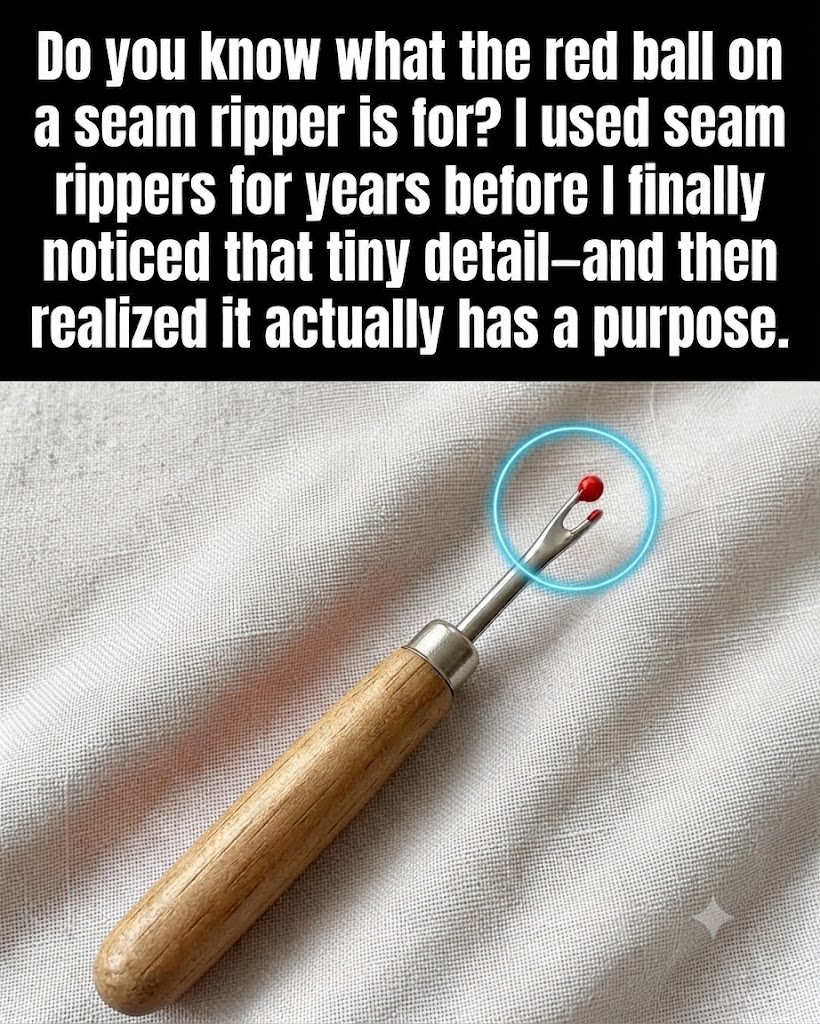
Many seam rippers have a tiny red ball on one side of the forked end. Some people use the tool for years before noticing that the detail has a purpose.
The red ball is meant to help protect the fabric. When the seam ripper is used correctly, the ball can glide along the material while the sharp inner blade cuts the thread. This helps keep the point from digging into the cloth.
The pointed end can still be useful when lifting an individual stitch, especially at the beginning of a seam. But once the first thread is opened, the rounded side can help the tool move along the seam more safely.
Understanding that small detail can change how the tool is used. Instead of treating the seam ripper like a tiny knife, the user can let the rounded side guide the movement while the blade does the cutting.
Why Scissors Are Riskier
Scissors are useful for many sewing tasks, but they are not ideal for removing seams. Even small scissors can catch more than the thread, especially when the stitches are tight or the fabric is delicate.
A single accidental snip can leave a hole, a cut edge, or a weak spot in the material. This is especially frustrating when working on clothing that only needed a small alteration.
A seam ripper reduces that risk because it is shaped for stitch removal. The narrow tip reaches under the thread, and the blade is positioned to cut the stitch rather than the surrounding fabric.
That does not mean the tool should be used carelessly. It is still sharp. However, when handled patiently, it gives far more precision than trying to force scissors into a seam.
Work A Few Stitches At A Time
The safest way to use a seam ripper is to work slowly. Trying to open an entire seam in one quick motion can stretch the fabric or cause the tool to slip.
Instead, it is better to cut a few stitches at a time. The pointed tip can be inserted under one stitch, then lifted slightly so the blade cuts the thread.
After several stitches are cut, the loose thread can often be pulled away gently. If resistance remains, more stitches should be cut before pulling again.
This method takes more time, but it protects the fabric. It also gives the user more control over where the seam opens and where it should stop.
Common Projects That Need Unpicking
A seam ripper is helpful in many ordinary sewing situations. It can be used when adjusting hems, replacing zippers, taking in or letting out garments, removing tags, or fixing uneven stitching.
It is also useful when giving an old garment new life. Before a piece of clothing can be altered or repaired, old seams may need to be removed cleanly.
The tool can help separate fabric layers without damaging them, which is important when the material will be sewn again. Clean removal makes the next step easier and gives the finished project a more professional appearance.
For people who sew regularly, unpicking is not a sign of failure. It is part of the process. Even careful work sometimes needs correction, and the seam ripper makes those corrections possible.
Handling The Fabric Carefully
Good technique depends on more than the tool itself. The fabric should be supported while stitches are removed. Holding the seam flat and steady helps prevent accidental pulls or tears.
If the material is thin, slippery, or delicate, extra patience is needed. The tool should be guided under the thread, not pushed hard into the fabric.
Once the stitches are cut, the remaining loose threads can be brushed or picked away gently. The fabric should not be yanked, because that can distort the weave or leave marks along the seam line.
After the old thread is removed, the area is ready for a fresh start. The seam can be resewn, the hem can be adjusted, or the garment can be repaired with less risk of lasting damage.
How To Use: Mistakes Can Become Improvements
Many beginners see unpicking as a setback. It can be discouraging to remove stitches after spending time sewing them. But experienced sewists know that correcting a mistake is often what makes the final project look better.
A seam ripper turns an error into an opportunity to improve the work. A crooked seam can be straightened. A poor fit can be adjusted. A damaged or misplaced section can be repaired before it becomes permanent.
That is why the tool belongs in every sewing kit. It supports patience, accuracy, and careful repair.
With the right technique, a seam ripper does more than undo stitches. It protects fabric, saves projects, and helps create cleaner results. The small red ball, the pointed tip, and the protected blade all work together to make unpicking safer, more precise, and more useful than many people realize.