
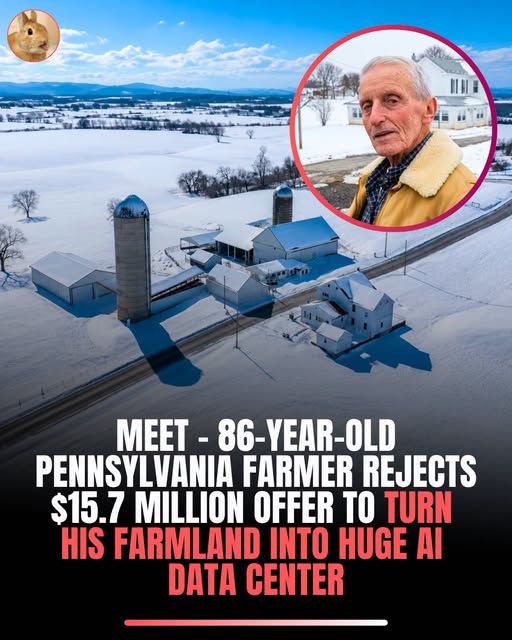
86-Year-Old Farmer Rejects $15 Million Development Offer to Protect His Land Forever
A Decision Few People Expected
When developers offered Mervin Raudabaugh more than $15 million for his farmland, the proposal appeared to provide an easy path into a financially secure retirement.
At 86 years old, after spending more than six decades working the same ground, Raudabaugh had every practical reason to accept the money.
The offer would have allowed him to leave farming behind with a fortune and spend the rest of his life in comfort.
Instead, he refused.
His decision quickly attracted attention throughout Cumberland County, where many people were surprised that anyone would reject such a large payment.
For Raudabaugh, however, the choice was not primarily about money.
It was about protecting the farms that had shaped his life and ensuring that the land would remain available for future generations.
The $15 Million Proposal
The development offer involved Raudabaugh’s 261-acre property in Silver Spring Township.
The developers proposed paying approximately $60,000 for each acre.
Combined, the deal would have been worth more than $15 million.
The land was part of a larger proposed arrangement involving three neighboring property owners.
If the transaction had been completed, Raudabaugh’s farm would have become the location of a data center.
For many landowners, the price alone might have ended the discussion.
Raudabaugh viewed the proposal differently.
He saw the money as temporary but the destruction of the farms as permanent.
“I was not interested in destroying my farms,” he told Fox 43. “That was the bottom line. It really wasn’t so much the economic end of it. I just didn’t want to see these two farms destroyed.”
His response made clear that he did not measure the property only by its market value.
The land represented work, family history, loss, responsibility, and a way of life he did not want replaced by buildings and pavement.
More Than 60 Years on the Same Land
Raudabaugh has farmed in Silver Spring Township for more than 60 years.
For 51 of those years, he milked cows on the property.
The farm was not simply a business location or an investment he happened to own.
It was the place where nearly every major chapter of his life unfolded.
His connection to farming began when he was still a teenager.
In the mid-1950s, his mother died in his arms inside a barn on the property.
Raudabaugh was only a junior in high school at the time.
Her death forced him to accept adult responsibilities much earlier than most people his age.
He became responsible for caring for his family and keeping the farm operating.
Farming Before School
Raudabaugh’s daily routine included milking cows before attending classes.
The work was physically demanding, but he continued balancing the farm with school.
He later remembered missing many days during his final year of high school.
“I was responsible for milking those cows before I went to high school. And I missed 31 days my senior year, and they never missed me. I was that popular. Just kidding,” Raudabaugh said, before adding simply that he loved it.
His humor softened the memory, but the responsibility he carried was serious.
Farming was not a temporary chore assigned by someone else.
It became the foundation of his adult life.
The work gave him purpose during a period of grief and helped him support the people who depended on him.
A Home Filled With Family History
Raudabaugh later shared the property with his wife, Anna Mae.
Together, they raised four children there.
The home and surrounding fields became the setting for decades of family life.
The farm held memories of his mother, his marriage, his children, and the countless days spent caring for livestock and land.
Those experiences could not be separated from the property itself.
Accepting the development offer would not merely have transferred ownership.
It would have ended the agricultural future of a place that had carried his family through generations of change.
His Concern Extended Beyond His Own Farm
Personal history was only one reason Raudabaugh rejected the developers.
He was also worried about the future of farming across the region.
As development expanded, he saw more open land being replaced by large projects.
He feared that preserved farms could eventually become isolated areas surrounded by roads, buildings, and commercial construction.
In his view, agricultural land lost to development could not easily be restored.
Once fields are paved or heavily altered, future families lose the opportunity to farm them.
Raudabaugh believed protecting his property was part of a larger responsibility.
He did not want his own farm added to the growing amount of land disappearing from agricultural use.
A Threat to Family Farming
Raudabaugh’s decision reflected concern for American farm families facing increasingly difficult choices.
Land values are rising, equipment is becoming more expensive, and development offers can be almost impossible to resist.
Many farmers may want to preserve their properties but lack the financial flexibility to reject enormous offers.
Raudabaugh understood that his choice was unusual.
Not every family can afford to turn down millions of dollars, especially when farming income is uncertain and operating costs continue increasing.
That reality made him even more determined to protect the land while he had the opportunity.
The Alternative Deal
Rejecting the data center proposal did not mean Raudabaugh simply kept the property without making any long-term plan.
He chose a different arrangement designed to preserve the farms permanently.
In December, he sold the property’s development rights for just under $2 million.
The rights were acquired through the Lancaster Farmland Trust.
The nonprofit organization holds and enforces an easement that restricts the land to agricultural use.
Because of that agreement, the property can never be converted into a data center or another type of non-farming development.
The land may still be sold in the future, but any buyer will be required to continue using it as farmland.
The Financial Sacrifice
The difference between the two offers was enormous.
The development proposal was worth more than $15 million.
The preservation payment came to slightly less than $2 million.
Raudabaugh may eventually receive additional money if the farm itself is sold, but even that combined amount is expected to remain below half of what the developers offered.
He understood the financial consequences before making the decision.
He knowingly walked away from several million dollars in order to guarantee that the property would remain agricultural.
The sacrifice demonstrated that preserving the farms mattered more to him than maximizing personal wealth.
A Future for Another Farming Family
Raudabaugh wanted the property to continue supporting families long after he was no longer there.
He imagined another family living on the farm, working the soil, and building its own history on the same ground.
“I love this land. It’s been my life,” Raudabaugh said. “And I realized … if it wasn’t built on or dug up, another set of families could live here and that’s what I wanted to do. And I got it done. And I’m happy.”
His satisfaction came from securing the farm’s purpose rather than receiving the largest possible payment.
The easement transformed his personal decision into a permanent protection that future owners will also be required to respect.
Pressure From Developers
The preservation process followed a period of intense pressure.
Laura Brown, coordinator of the township’s land preservation program, said the developers pursued Raudabaugh repeatedly.
He viewed the contact as so persistent that his attorney was considering legal action.
The pressure placed him in a difficult position.
He had already rejected the development plan, but the effort to obtain his property continued.
That situation helped bring local preservation officials into the matter.
Brown contacted Jeb Musser at the Lancaster Farmland Trust to ask whether the organization would consider protecting the farms.
The Farmland Trust Responds
Musser, the trust’s vice president of land protection, reacted positively to the proposal.
The organization’s board also supported the effort.
The farms met the criteria the trust used to identify valuable agricultural land worthy of long-term preservation.
What might have ended with Raudabaugh accepting a sale under continued pressure instead developed into a coordinated conservation plan.
The township provided compensation to the trust, which accepted responsibility for holding and enforcing the easement.
The final arrangement ensured that the development restrictions would continue even if ownership changed.
A Community Program Made the Choice Possible
Raudabaugh’s personal determination was essential, but he was not acting entirely alone.
Silver Spring Township had already created a system that allowed residents to support land conservation collectively.
The township is one of four municipalities outside the Philadelphia area where voters chose to dedicate part of their income taxes to purchasing development rights.
The contribution costs an average household approximately $120 each year.
Individually, the amount is modest.
Combined across the community, it has provided enough funding to preserve 21 properties since 2013.
How the Preservation Program Works
The township’s Land Preservation Program was established in January 2014.
It was created in response to residents who wanted to protect farmland, woodlands, waterways, wetlands, and open spaces.
Eligible properties generally contain at least 10 acres.
By purchasing development rights, the township helps landowners receive compensation without permanently losing their farms to construction.
The program offered Raudabaugh a realistic alternative to the developers’ proposal.
Without such a system, preserving the land while receiving any financial return might have been far more difficult.
His decision therefore reflected both individual conviction and a community that had already agreed to invest in conservation.
The Natural Value of the Property
Raudabaugh’s land is part of an area containing more than 1,300 acres of creek frontage.
The property supports a wide range of wildlife and provides open space that has become increasingly rare.
He described it as an exceptional piece of land that would be difficult to replace.
“You won’t find that anywhere else,” he said. “You’d have to look awfully hard to find that much good land. It’s a mecca for wildlife, and everything from deer to turtles.”
The farm’s environmental value strengthened his opposition to development.
He did not want the habitat destroyed or fragmented by construction.
Respect for the Land
Raudabaugh has spoken about his respect for what he calls God’s green Earth.
That belief influenced the way he viewed ownership.
He did not see the property as something he had an unlimited right to destroy simply because he held the deed.
He viewed himself as a caretaker responsible for passing the land forward in usable condition.
The wildlife, creek frontage, fields, and soil all represented something larger than a financial asset.
Protecting them became a way of honoring the work and life the farm had supported.
A Local Hero
After the preservation agreement became public, Raudabaugh gained attention throughout the community.
Friends and neighbors praised his refusal to sell.
Some appreciated the principle behind the decision.
Others were grateful that the open landscape and familiar views would remain intact.
Instead of watching farmland disappear behind new construction, residents will continue seeing fields and natural areas.
Raudabaugh became a local example of someone choosing long-term community value over immediate personal profit.
Concerns About a Nearby Data Center
Although his own property is protected, Raudabaugh remains concerned about development elsewhere.
A data center is being built in nearby Middlesex Township.
He worries about the additional traffic it may create.
He is also concerned about the effects on wildlife and surrounding land.
Large development projects can alter local roads, water use, habitats, and the overall character of agricultural communities.
For Raudabaugh, the nearby project represents the same future he worked to prevent on his own farm.
Rising Land Prices Create New Pressure
Data center development has contributed to rising land values across the area.
Higher values can benefit owners who want to sell, but they also create difficulties for farmers trying to buy or retain agricultural property.
Young farmers may be unable to compete with developers offering far more than the land can earn through crops or livestock.
Established families may face pressure to sell because the financial offer is too large to ignore.
As more farmland disappears, the remaining properties can become even more expensive.
This cycle threatens the long-term survival of family farming.
Not Every Farmer Can Make the Same Choice
Raudabaugh knows his decision cannot be treated as an easy model for everyone.
Many farmers carry debt, face medical expenses, need retirement income, or must divide property among heirs.
A multimillion-dollar development offer may provide financial security that farming never could.
Rejecting such an offer can require access to preservation funding and the ability to accept a much smaller return.
Raudabaugh worries about farmers who want to protect their land but have no practical way to do so.
His own experience demonstrates how community programs can give landowners another option.
The Farm’s Future Is Now Secure
Whatever happens around Silver Spring Township, Raudabaugh’s property can no longer be converted into a data center.
The home where he raised his children will remain connected to agriculture.
The barn where his mother died will remain part of a working farm.
The creek frontage, fields, deer, turtles, and other wildlife will continue occupying protected land.
Future owners may change crops, livestock, or farming methods, but they will not be permitted to replace the property with non-agricultural development.
A Choice Based on Legacy
Raudabaugh could have measured success by the amount of money deposited into his account.
Instead, he measured it by what would remain after him.
The preservation agreement allows another family to continue the work that shaped his own life.
It also protects a piece of the region’s agricultural identity.
His refusal of more than $15 million was not a rejection of financial security without thought.
It was a carefully chosen exchange.
He traded the possibility of greater personal wealth for the certainty that the farms would survive.
At Peace With the Decision
Raudabaugh appears satisfied with the outcome.
He achieved what he wanted despite pressure from developers and the enormous difference between the two offers.
The land remains intact, the preservation agreement is permanent, and its future no longer depends on another owner making the same difficult choice.
His concern now centers on the farms that remain unprotected.
As development continues and land prices rise, he fears that fewer families will be able to keep farming.
His own property is safe, but the broader struggle is far from over.
A Stand for the Future of Farming
Raudabaugh’s story has attracted attention because rejecting more than $15 million seems almost unimaginable.
The deeper significance lies in what he chose to protect.
He preserved a place connected to six decades of labor, family history, tragedy, wildlife, and community identity.
He also demonstrated that land can carry a value that cannot be fully expressed through a price per acre.
For Raudabaugh, the most important outcome was not how much money he could collect before leaving the farm.
It was whether the farm would still exist for the people who came after him.
Standing on the land he refused to sell, he can now be certain that future generations will have the chance to work the same soil rather than inherit another development site.