
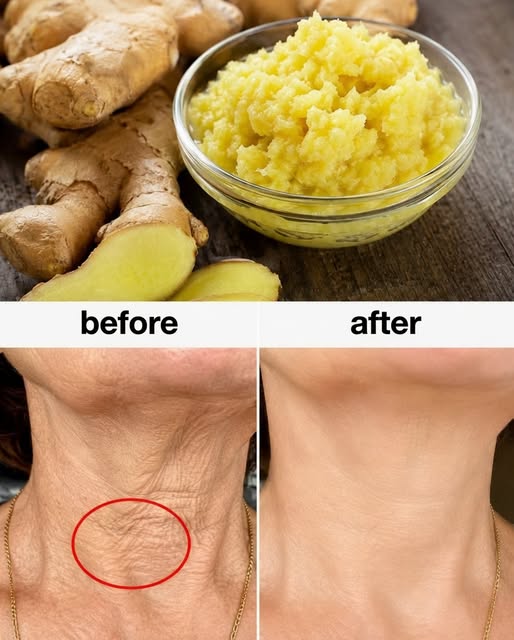
Can Ginger Be a Safe and Useful Addition to a Skincare Routine?
Why the Neck Deserves More Attention
Skincare routines often focus almost entirely on the face, even though the neck can show visible changes just as quickly.
The skin in this area is relatively thin, moves constantly, and is exposed to sunlight, pollution, clothing friction, and repeated bending throughout the day.
Hours spent looking down at phones, tablets, and computers can also place the neck in the same position for long periods.
Over time, many adults begin noticing dryness, fine lines, uneven tone, reduced softness, loss of elasticity, or a crepey appearance.
These changes often lead people to search for simple home treatments that promise smoother or firmer-looking skin.
Fresh ginger has become one of the ingredients frequently included in homemade beauty routines.
Its distinctive aroma, warming sensation, and long history in cooking and traditional wellness practices have helped increase its popularity.
However, dramatic online claims can create unrealistic expectations about what ginger can actually do.
A more useful approach is to examine how it may fit into a gentle routine while recognizing its limitations.
Why Neck Skin Changes Over Time
Visible aging in the neck does not result from one single cause.
It usually develops as several factors gradually affect the skin together.
Natural aging plays an important role, as does repeated exposure to ultraviolet radiation.
Collagen production may decline over time, while constant movement can make lines and folds more noticeable.
Dryness and dehydration may also affect how smooth and comfortable the skin appears.
Environmental stress, inconsistent skincare, and a lack of regular sun protection can make these changes more visible.
This is why no homemade ingredient can erase years of accumulated effects on its own.
Healthy-looking skin is more often supported by simple habits maintained consistently over time.
Why Ginger Attracts Interest
Ginger has been used for centuries as a culinary ingredient and in traditional wellness practices.
It naturally contains several plant compounds that continue to attract scientific attention.
These include gingerols, shogaols, zingerone, and other antioxidant compounds.
Laboratory research has examined these substances because of their antioxidant activity.
Oxidative stress is one factor associated with normal aging, which explains why antioxidant-rich ingredients are often discussed in skincare.
However, laboratory findings should not be confused with proof that applying fresh ginger can reverse wrinkles or significantly tighten human skin.
Current clinical evidence supporting topical ginger as a powerful anti-aging treatment remains limited.
Ginger may be used as a small supporting ingredient, but it should not replace established skincare practices.
Understanding Gingerols and Shogaols
Fresh ginger contains natural compounds known as gingerols.
When ginger is dried or heated, some of those compounds may transform into related substances called shogaols.
Both groups have been examined for antioxidant activity under laboratory conditions.
That research has contributed to ginger’s reputation as a potentially useful cosmetic ingredient.
Still, skin health depends on far more than the presence of one antioxidant compound.
The skin barrier, sun exposure, hydration, genetics, age, sleep, nutrition, and product tolerance all play important roles.
Applying one plant ingredient cannot replace the combined influence of those factors.
The Foundation of a Healthy Routine
Many people hope to find one product or ingredient capable of solving several skincare concerns at once.
In reality, the most reliable routines are built around a few basic habits.
These include gentle cleansing, regular moisturizing, daily sunscreen, adequate hydration, good sleep, nutritious eating, stress management, and avoiding smoking.
Ginger may be included occasionally if the skin tolerates it, but it should remain secondary to those essentials.
A complicated routine is not always more effective than a simple one.
Consistency often matters more than the number of products used.
What Ginger May Contribute
Although strong evidence for dramatic cosmetic improvement is lacking, ginger may still have a place in occasional skincare routines.
One reason people enjoy it is the mild warming sensation it can create when properly diluted.
That feeling may make a homemade mask seem refreshing or energizing.
The sensory experience can also make self-care feel more intentional.
Enjoying a routine may encourage someone to follow it more consistently.
Ginger also contains naturally occurring antioxidant plant compounds that remain of interest in cosmetic research.
This does not mean it can erase wrinkles, but it does explain why it continues to appear in skincare discussions.
The Value of Daily Self-Care
One of the most practical benefits of a simple homemade routine may have little to do with the ingredient itself.
Preparing and applying a mask encourages people to slow down and spend a few minutes caring for their skin.
That habit can make it easier to remember moisturizer, sunscreen, and regular cleansing.
A short, manageable routine is often easier to maintain than a long list of constantly changing products.
Daily consistency usually offers more value than chasing one dramatic overnight result.
Natural Ingredients Can Still Cause Irritation
The word natural does not automatically mean harmless.
Fresh ginger can cause burning, redness, itching, dryness, or irritation.
Some people may react even when only a small amount is used.
Anyone considering topical ginger should test it on a limited area before applying it to the face or neck.
People with sensitive skin should be especially cautious.
Ginger should not be applied to broken skin, open wounds, active rashes, the eyelids, or the area immediately around the eyes.
If discomfort or irritation develops, the product should be rinsed off and discontinued.
Daily Sunscreen Matters More
One of the most effective habits for reducing visible premature aging is also one of the simplest.
Daily broad-spectrum sunscreen helps protect the skin from ultraviolet exposure.
Repeated sun exposure is a major contributor to fine lines, uneven tone, dryness, and loss of elasticity.
No homemade ginger mask can compensate for regular UV exposure without protection.
Sunscreen, moisturizer, and gentle cleansing should remain the foundation of any skincare plan.
Realistic Expectations Produce Better Results
Skin rarely transforms within a few days.
Improvements in softness, comfort, and overall appearance usually depend on consistent habits practiced for weeks or months.
Hydration, sun protection, appropriate moisturizers, balanced nutrition, sleep, and patience all matter.
Ginger may be an enjoyable addition, but it should not be expected to create a sudden lifting or wrinkle-removing effect.
Realistic expectations reduce disappointment and make it easier to focus on habits that can actually be maintained.
A Simple Ginger Face and Neck Mask
Anyone interested in trying ginger should avoid applying concentrated juice directly to the skin.
A diluted preparation is a gentler option for occasional cosmetic use.
One simple mixture uses one teaspoon of finely grated fresh ginger, two tablespoons of plain yogurt, and one teaspoon of honey if desired.
The ginger should be washed thoroughly and grated into a very small amount.
It can then be mixed with the yogurt until the texture becomes smooth.
Honey may be included, although anyone with a honey allergy should leave it out.
A thin layer can be applied to clean skin on the neck or face while carefully avoiding the eyes.
The mask should remain on the skin for approximately five to ten minutes.
Afterward, it should be rinsed away with lukewarm water and followed with a gentle moisturizer.
Leaving the mixture on longer does not guarantee better results and may increase irritation.
Patch Testing Is Essential
Before using any homemade skincare preparation more widely, a patch test should be performed.
A small amount can be placed behind the ear or on the inner forearm.
The area should then be observed for at least 24 hours.
Redness, itching, burning, swelling, or discomfort may indicate that the mixture is unsuitable.
Patch testing is particularly important for people with eczema, rosacea, contact allergies, sensitive skin, or recently treated skin.
If a reaction occurs, the product should not be applied to a larger area.
How Ginger May Support a Routine
Ginger can make a skincare routine feel more deliberate and engaging.
The process of preparing a mask may encourage people to focus on areas they often neglect, including the neck and upper chest.
It may also encourage light massage while applying moisturizer or rinsing the skin.
Any massage should remain gentle, as aggressive rubbing can irritate delicate tissue.
Ginger also pairs more appropriately with moisturizing ingredients than with harsh exfoliants.
Plain yogurt, aloe vera gel, colloidal oatmeal, fragrance-free moisturizers, hyaluronic acid creams, and ceramide-rich lotions may help support hydration.
The priority should always be maintaining comfort and protecting the skin barrier.
Common Mistakes to Avoid
Applying pure ginger juice is one of the most common mistakes.
Fresh juice can be highly irritating, especially on sensitive or dry skin.
Using a stronger concentration does not guarantee better results.
It may simply increase burning, redness, or inflammation.
Another mistake is leaving a mask on for an extended period.
Five to ten minutes is generally enough for an occasional homemade treatment.
Skipping moisturizer afterward may also leave the skin feeling dry or uncomfortable.
Forgetting sunscreen is an even larger problem because natural remedies cannot replace UV protection.
Ginger should also never be applied to cuts, scratches, sunburn, inflamed skin, active eczema, or open acne lesions.
Ingredients That Can Be Combined With Ginger
Plain yogurt helps create a smoother texture while reducing the concentration of fresh ginger.
Aloe vera gel provides lightweight hydration and is commonly used in soothing skincare products.
Honey acts as a humectant and may help attract moisture to the skin.
Finely ground oatmeal is often included in products made for dry or sensitive skin because of its mild nature.
These ingredients may create a gentler preparation, but they do not eliminate the need for patch testing.
Any homemade mixture can still cause a reaction.
Habits With Stronger Long-Term Support
Daily sunscreen has stronger support for reducing visible premature aging than any ginger-based treatment.
A broad-spectrum formula with SPF 30 or higher can be used whenever appropriate and reapplied according to product directions.
Regular moisturizing also helps support the skin barrier.
Applying moisturizer after cleansing while the skin remains slightly damp can help reduce dryness.
Drinking enough fluids supports general health, although water alone cannot erase wrinkles.
A diet that includes a variety of fruits and vegetables provides vitamins and naturally occurring plant compounds.
Quality sleep also matters because the body carries out important repair processes during rest.
Aiming for seven to nine hours whenever possible may support overall well-being.
A Simple Morning Routine
A practical morning routine can begin with gentle cleansing.
A mild moisturizer can then be applied to the face, neck, and upper chest.
The final step should be broad-spectrum sunscreen.
The neck should receive the same attention as the face because both areas are exposed to sunlight and environmental stress.
Simple routines are easier to repeat every day.
A Simple Evening Routine
At night, sunscreen and makeup should be removed thoroughly.
The skin can then be washed with a gentle cleanser.
A moisturizer or nourishing night cream may be applied afterward.
A diluted ginger mask may be used occasionally if the skin has passed a patch test and remains comfortable.
Daily use is usually unnecessary and may increase the likelihood of irritation.
Can Ginger Remove Neck Wrinkles?
There is no strong clinical evidence showing that topical ginger can remove neck wrinkles or reverse aging.
Its naturally occurring compounds may be of cosmetic interest, but wrinkles are influenced by age, sun exposure, genetics, hydration, movement, and skin structure.
A homemade mask cannot overcome all of those factors.
Daily sunscreen and moisturizer remain more reliable foundations.
Fresh Ginger and Powdered Ginger
Fresh ginger is frequently used in homemade recipes because it contains naturally occurring gingerols.
It may also be more likely to irritate the skin.
Powdered ginger can also be irritating, especially if used in high concentrations.
Neither form should be considered automatically safe.
Dilution and patch testing remain necessary.
How Often Should Ginger Be Used?
For people whose skin tolerates it, a diluted ginger mask may be used once or twice a week.
Using it every day is generally unnecessary.
Frequent exposure may increase redness, dryness, or sensitivity.
If any discomfort appears, use should stop immediately.
Can Ginger Brighten the Skin?
Some people feel that their skin looks fresher after using a homemade mask.
However, there is limited clinical evidence showing that topical ginger significantly brightens skin or reduces pigmentation.
Consistent sunscreen use remains one of the most useful habits for maintaining a more even-looking complexion.
Anyone dealing with persistent pigmentation should avoid relying solely on homemade treatments.
Is Ginger Suitable for Sensitive Skin?
Ginger is not suitable for everyone.
It may cause redness, itching, burning, irritation, or dryness.
People with eczema, rosacea, contact allergies, or highly reactive skin should be especially careful.
A dermatologist may be helpful when there is uncertainty about whether a new ingredient is appropriate.
Why Ginger Should Not Be Left on Overnight
Fresh ginger should not remain on the skin overnight.
Extended exposure increases the chance of irritation.
A homemade mask should be rinsed off after the recommended short application period.
Moisturizer can then be used to support the skin barrier.
Combining Ginger With Active Products
Retinol, vitamin C, and exfoliating acids can already cause sensitivity in some people.
Adding fresh ginger during the same routine may increase irritation.
Alternating products may be a more cautious approach than layering several active ingredients at once.
Anyone using prescription or intensive skincare treatments should consider professional guidance before experimenting with homemade preparations.
Does Ginger Tea Improve Skin?
Ginger tea can be part of a balanced eating pattern, but it should not be expected to prevent wrinkles or create dramatic cosmetic changes.
Nutrition and hydration support overall health, including normal skin function.
No single beverage can replace sleep, sun protection, balanced eating, and appropriate skincare.
When Use Should Stop
Topical ginger should be discontinued immediately if persistent burning, swelling, severe redness, blistering, rash, or increasing irritation appears.
Medical advice may be necessary if symptoms are severe or do not improve.
Continuing to use an irritating product can worsen inflammation and damage the skin barrier.
Common Myths About Ginger Skincare
Ginger cannot remove wrinkles overnight.
No evidence shows that a single application can reverse visible aging.
Natural ingredients are not automatically safe, and stronger preparations are not necessarily more effective.
Higher concentrations can increase irritation without providing additional proven benefits.
Homemade masks also cannot replace sunscreen.
The neck requires regular protection and moisturizing just like the face.
A Consistent Neck Care Plan
In the morning, the skin can be washed with a mild cleanser before applying a fragrance-free moisturizer.
The product should be extended over the neck and upper chest.
Broad-spectrum sunscreen with SPF 30 or higher can then be applied and reapplied as directed when spending time outdoors.
In the evening, makeup and sunscreen should be removed before gentle cleansing.
A nourishing moisturizer may be applied afterward.
A diluted ginger mask can remain an occasional option rather than a daily requirement.
Harsh scrubs and excessive rubbing should be avoided.
Weekly Habits That Support Skin Health
Regularly washing pillowcases may help keep oils and residue from building up against the skin.
Staying hydrated, eating colorful fruits and vegetables, sleeping adequately, and avoiding smoking all support general health.
Stress management through relaxation or regular movement may also contribute to overall well-being.
Healthy-looking skin reflects long-term habits more than occasional treatments.
The Most Important Points to Remember
Ginger contains gingerols, shogaols, and other plant compounds with antioxidant activity observed in laboratory research.
Clinical evidence supporting topical ginger as a major anti-aging treatment remains limited.
It may complement a gentle routine but should never replace moisturizer or sunscreen.
Fresh ginger should always be diluted before use.
A patch test should be completed before applying it more widely.
It should not be used on irritated, damaged, or sunburned skin.
Any sign of discomfort should be treated as a reason to stop.
A Balanced View of Ginger in Skincare
Ginger’s warming sensation, distinctive aroma, and naturally occurring plant compounds make it an interesting ingredient for occasional homemade skincare.
It may make a routine feel refreshing and encourage people to care for often-neglected areas such as the neck.
At the same time, it should not be treated as a miracle solution.
Healthy-looking skin usually reflects daily sun protection, gentle cleansing, regular moisturizing, balanced nutrition, hydration, adequate sleep, and patience.
Anyone who chooses to experiment with ginger should use a small amount, dilute it properly, patch test first, and pay close attention to how the skin responds.
A comfortable routine practiced consistently is more valuable than a harsh treatment promising immediate transformation.
In skincare, gradual care and realistic expectations are usually more effective than quick fixes.