

New Expedition Could Finally Uncover What Happened to Amelia Earhart’s Missing Plane
The Aviator Who Redefined What Was Possible
Amelia Earhart became one of the most celebrated figures in aviation by refusing to accept the limits placed on women during the early decades of powered flight.
Her courage, persistence, and willingness to enter a dangerous and rapidly developing field helped transform her into an international symbol of ambition and independence.
Earhart was born in Kansas on July 24, 1897. Her interest in aviation began years later, after she experienced her first flight as a passenger in 1920.
The pilot was Frank Hawks, an experienced aviator who took her into the air for what proved to be a life-changing journey.
Although the flight itself was brief, the experience convinced Earhart that aviation would become the central purpose of her life.
She later described the moment by saying: “As soon as I left the ground, I knew I had to fly,”
Learning to fly required determination and money, so Earhart worked as a clerk for a telephone company to pay for lessons.
Her commitment quickly became more serious. In 1921, only a short time after beginning her training, she purchased her first aircraft.
By the following year, Earhart had already achieved a significant record. She became the first woman to fly at an altitude of 14,000 feet.
The accomplishment demonstrated both her technical ability and her desire to pursue goals that few pilots of the period had attempted.

A Career Built on Historic Achievements
Earhart continued to challenge aviation records throughout the following decade, becoming known for difficult long-distance flights and a calm approach to extreme danger.
Her most important early achievement came in 1932, when she completed a solo nonstop flight across the Atlantic Ocean.
The journey made her the first woman and only the second person in history to complete such a flight alone without stopping.
The crossing was far from easy. Earhart faced freezing conditions, physical exhaustion, and mechanical problems that could have ended the journey in disaster.
Despite those challenges, she maintained control of the aircraft and eventually landed in Northern Ireland.
Her arrival confirmed that she had completed one of the most demanding accomplishments in aviation at that time.
The flight strengthened her reputation as a skilled and fearless pilot rather than simply a public figure associated with aviation.
Later in 1932, she completed another major journey by becoming the first woman to fly solo nonstop across the United States.
Her growing list of records inspired people far beyond the aviation community.
Earhart’s success also demonstrated that women could compete at the highest level in a field that had largely been dominated by men.
Her influence extended beyond individual records. She became a symbol of perseverance for future pilots and for women seeking opportunities in professions that had previously excluded them.
The Ambitious Journey Around the World
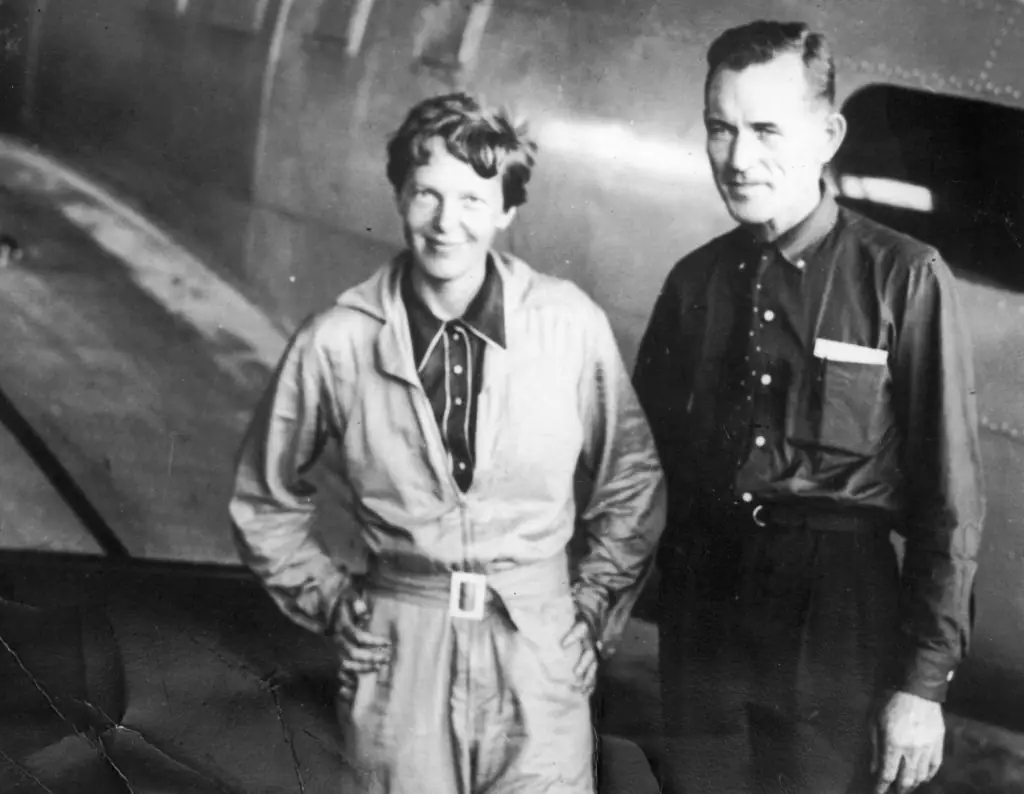
Earhart’s final and most famous flight began as an attempt to travel around the world with navigator Fred Noonan.
The pair departed from Oakland, California, and followed a demanding route that took them through Miami, South America, the Atlantic region, Africa, India, and South Asia.
By the time they reached the final stages of the journey, they had already traveled thousands of miles across several continents and large areas of open ocean.
One of the most difficult sections involved reaching Howland Island, a small and isolated destination in the Pacific that was intended to serve as a refueling stop.
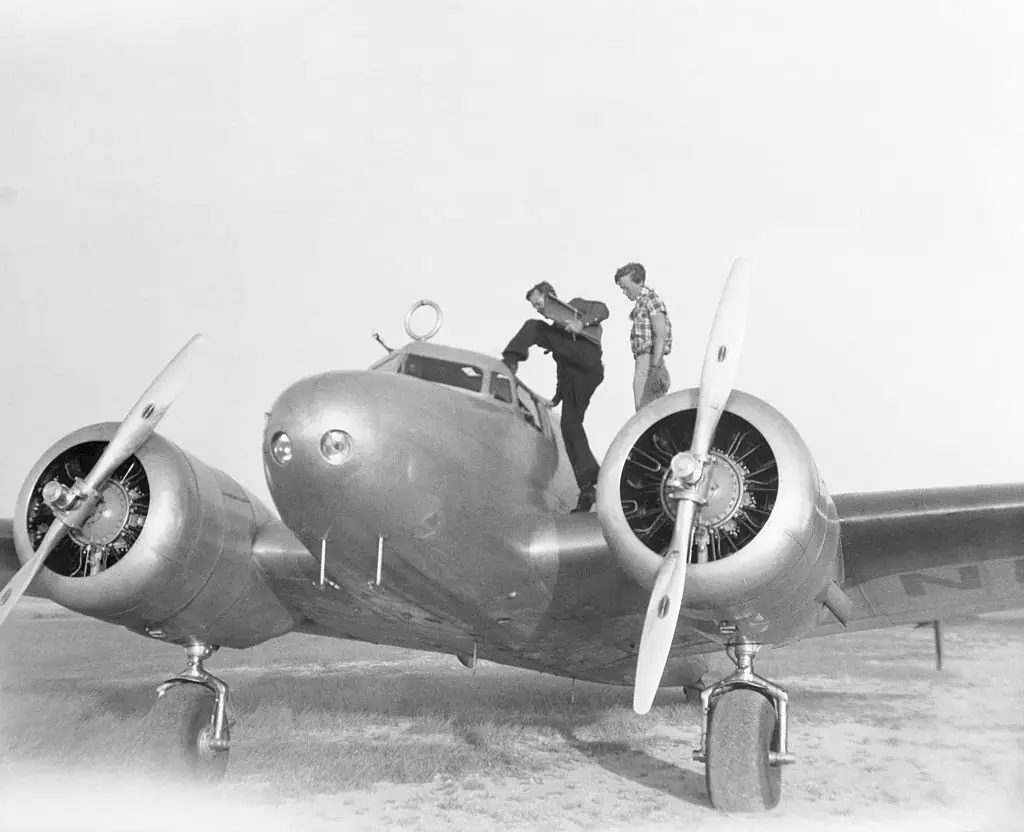
On July 2, 1937, Earhart and Noonan departed from Lae, Papua New Guinea, aboard the Lockheed Model 10-E Electra.
The flight required precise navigation and reliable radio communication because the destination was small and surrounded by a vast expanse of ocean.
During the journey, communication problems began to interfere with efforts to guide the aircraft.
Radio contact was eventually lost somewhere over the Pacific Ocean.
Earhart, Noonan, and the aircraft disappeared without a confirmed final location.
The loss immediately triggered a major search and created a mystery that would continue for generations.
Decades of Competing Explanations
For 88 years, investigators, researchers, historians, and aviation specialists have attempted to determine what happened during Earhart’s final flight.
No single explanation has produced proof strong enough to settle the case completely.
One widely discussed possibility is that the Electra ran out of fuel and crashed into the Pacific Ocean before reaching Howland Island.
Another theory suggests that Earhart and Noonan may have reached a remote island and survived there for a period of time after the aircraft was lost.
A separate theory proposed that the pair may have been captured after disappearing.
Each possibility has attracted supporters, but none has provided a confirmed account of their fate.
Repeated searches have examined different parts of the Pacific, yet the aircraft itself has never been conclusively identified.
The lack of physical evidence has allowed uncertainty to continue nearly nine decades after the disappearance.
A New Clue Near Nikumaroro
A team connected to Purdue University now believes a possible object near Nikumaroro could offer the strongest opportunity yet to locate Earhart’s missing aircraft.
Nikumaroro is a remote island in Kiribati located nearly 1,000 miles from Fiji.
The island has received attention because of its position near Earhart’s intended route and its connection to several recorded distress signals.
The latest search effort centers on satellite images showing an unusual object resting on the ocean floor near the shoreline.
Researchers believe the object deserves closer study because its apparent shape and dimensions resemble the aircraft Earhart was flying.
The possibility that the object could be part of the Lockheed Electra has led to plans for a new field investigation.
Richard Pettigrew, executive director of the Archaeological Legacy Institute, described the location as a rare chance to resolve the mystery.
He stated: “What we have here is maybe the greatest opportunity ever to finally close the case. With such a great amount of very strong evidence, we feel we have no choice but to move forward and hopefully return with proof.”
Distress Signals and Earlier Findings
The Nikumaroro theory is supported by several pieces of evidence that have been examined over many years.
One of the most important involves radio distress signals believed to have been transmitted after Earhart disappeared.
Bearings connected to those signals were recorded by the US Navy, Coast Guard, and Pan American World Airways.
The direction of the transmissions pointed toward the area surrounding Nikumaroro.
The signals have remained important because they support the possibility that Earhart’s aircraft may have reached land or shallow water rather than immediately sinking in the open ocean.
Other discoveries on the island have also contributed to continued interest in the location.
Bones found on Nikumaroro in 1940 were examined in a forensic analysis completed in 2017.
The analysis concluded that the measurements were closer to Earhart’s than those of most people in the general population.
The finding did not provide absolute confirmation, but it renewed interest in the theory that she may have survived on the island after the flight.
Several personal objects discovered on Nikumaroro have also been studied.
These items included a woman’s shoe, a compact case, a freckle cream jar, and a medicine vial dating from the 1930s.
None of the objects has definitively been proven to belong to Earhart, but together they have encouraged researchers to continue examining the island.
The Bevington Object
Another important element in the search is a mysterious shape known as the Bevington Object.
The object appeared in a photograph taken approximately three months after Earhart disappeared.
Some researchers believe its shape resembles a section of the Electra’s landing gear near the island’s reef.
The image has remained the subject of debate because the object is not clear enough to provide certain identification.
Even so, it has become part of a larger collection of evidence connecting Earhart’s disappearance to Nikumaroro.
More recent satellite imagery has added another dimension to the investigation.
The latest object of interest appears to have remained in the same lagoon area over an extended period.
Michael Ashmore noticed the unusual shape while examining Apple Maps imagery from 2015.
That discovery led researchers to review additional satellite images collected between 2009 and 2021.
Google Earth images from 2022 through 2024 were also studied to determine whether the object remained visible and consistent over time.
The Archaeological Legacy Institute stated: “This object in the satellite images is exactly the right size to represent the fuselage and tail of the Electra,”
The organization also added: “It also appears to be very reflective and is likely to be metallic.”
The Taraia Object Expedition
The planned mission has been named the Taraia Object Expedition.
The operation is expected to proceed in several phases, beginning with a direct examination of the site.
The first stage will focus on studying the object in its current location and determining whether it is natural debris, unrelated wreckage, or part of an aircraft.
If the initial examination produces promising evidence, later stages could involve a more extensive archaeological investigation.
Recovery work may also be considered if the object appears to be connected to Earhart’s Lockheed Electra.
The team believes the first field visit could provide enough evidence to identify the object.
They explained: “We believe that the result of this Phase-1 field examination will probably be the confirmation that the Taraia Object is indeed the Lockheed Electra aircraft,”
They continued: “This work, then, is likely to solve one of the greatest mysteries of the 20th century.”
The expedition’s success will depend on whether the object can be reached, examined, and documented clearly enough to establish its origin.
Why Researchers Continue Searching
Previous expeditions have searched for Earhart’s aircraft using advanced equipment and large-scale exploration methods.
Those missions did not produce a confirmed discovery of the Electra.
However, the new team believes earlier unsuccessful searches do not rule out the possibility that the aircraft remains near Nikumaroro.
Conditions around reefs, lagoons, and coastal waters can make wreckage difficult to identify, particularly after decades of storms, erosion, and changing sediment.
The object’s apparent location near the island has encouraged researchers to conduct a targeted examination rather than another broad search across the Pacific.
The possibility of solving the case has also revived interest in Earhart’s long relationship with Purdue University.
Earhart’s Connection to Purdue University
Before her final journey, Earhart worked with Purdue University to encourage career opportunities for women.
Her role at the university became an important part of her broader effort to challenge traditional expectations and support women entering new professions.
Purdue also played a role in preparations for her flight around the world.
Purdue president Mung Chiang reflected on that history, saying: “About nine decades ago, Amelia Earhart was recruited to Purdue,”
He added: “The university president later worked with her to prepare an aircraft for her historic flight around the world.”
The university’s connection to Earhart has given the latest expedition a deeper historical meaning.
For those involved, locating the Electra would not only solve a famous mystery but also return an important part of Earhart’s legacy to an institution connected to her final mission.
Steve Schultz explained the motivation behind continuing the search by saying: “We believe we owe it to Amelia and her legacy at Purdue to fulfill her wishes, if possible, to bring the Electra back to Purdue.”
A Mystery Approaching Its Ninth Decade
Amelia Earhart’s disappearance remains one of the most enduring mysteries in aviation history because no final answer has ever been supported by conclusive physical proof.
Her final radio communications, the location of Nikumaroro, the recorded distress signals, the bones, the personal objects, and the satellite images have all contributed to continued interest.
The Taraia Object Expedition now aims to determine whether the unusual shape near the island is the wreckage researchers have been seeking for generations.
If the object is confirmed as the Lockheed Model 10-E Electra, it could establish where Earhart and Noonan ended their final flight.
Such a discovery could also provide new evidence about whether they survived the initial disappearance and what happened after communication was lost.
Until the object is examined directly, the mystery remains unresolved.
Nearly 90 years after Earhart vanished over the Pacific, researchers are once again preparing to search for the aircraft that could finally reveal the truth behind one of the 20th century’s most famous disappearances.