
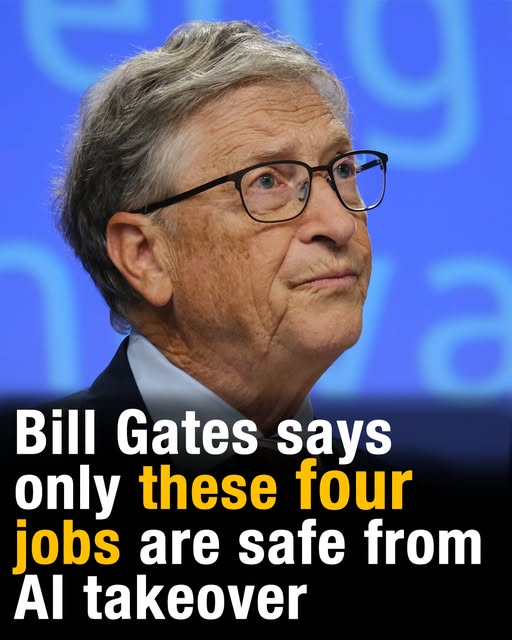
Bill Gates Says AI Could Transform Most Jobs but Names Three Careers He Believes Will Survive
Bill Gates has spent years warning that artificial intelligence will do more than change office routines, business tools, or the way people complete daily tasks. In his view, the technology could eventually reshape the structure of the workforce itself.
His latest comments place AI at the center of a much larger question: what happens when knowledge, guidance, analysis, and specialized support become widely available through machines rather than limited to trained human professionals?
During an appearance on The Tonight Show with Jimmy Fallon, Gates explained that many forms of human expertise are considered valuable today because they remain difficult to access. A highly skilled doctor, teacher, or adviser can make an enormous difference, but that expertise is still limited by time, availability, cost, and location.
Gates said the spread of AI could change that balance dramatically over the next decade. What is now rare could become ordinary, inexpensive, and available to far more people.
Gates Says Human Expertise Could Become Widely Available
Speaking with Fallon, Gates described the current value of professionals such as doctors and teachers as being tied partly to scarcity. A “great doctor” or a “great teacher” matters because those people are “rare.”
That scarcity, Gates suggested, may not last if AI systems continue to advance at the pace he expects.
“with AI, over the next decade, that will become free, commonplace – great medical advice, great tutoring,” he told Fallon.
The meaning of that statement reaches beyond health care and education. Gates was describing a future in which the type of judgment, information, and explanation people once needed from individual experts could become instantly available through AI tools.
In that kind of world, expertise would no longer be tied only to one person in one office, classroom, clinic, or company. It could become something people access through technology whenever they need it.
The result could be a major shift in how society defines professional value. If AI can provide useful answers, medical guidance, learning support, and technical assistance at scale, then many jobs may no longer be protected simply because they require specialized knowledge.
Gates did not describe this as a small change. He framed it as a transformation that could affect a wide range of work, including jobs that have traditionally depended on training, judgment, and access to information.
Some Human Activities May Remain Protected
Although Gates sees AI becoming powerful enough to handle many tasks now performed by people, he does not believe machines will take over every part of human life.
He noted that some activities may remain reserved for people because they carry cultural, emotional, or personal meaning that goes beyond efficiency. He gave baseball as one example, saying people will not watch machines play the sport in the same way they watch human athletes.
Gates said, “there will be some things we reserve for ourselves,” adding people will never see machines playing baseball.
That distinction shows how Gates separates work that can be automated from experiences that people may choose to keep human. Entertainment, competition, identity, and emotional attachment may preserve certain spaces for people even if machines become technically capable of performing many actions.
Still, he drew a sharp contrast between those human-centered activities and practical systems that support modern life. In his view, AI and automation could eventually handle many basic economic functions more effectively than people.
“But in terms of making things and moving things and growing food, over time those will be basically solved problems.”
That statement points toward a future where manufacturing, logistics, and agriculture may be heavily transformed. Gates framed those areas as problems that technology could gradually solve, reducing the need for human labor in tasks involving production, transportation, and food supply.
The Idea of Free Intelligence
Gates has described the future he sees as the arrival of “free intelligence.” The phrase refers to a world where advanced reasoning, support, advice, and tutoring become inexpensive or broadly accessible through AI systems.
For Gates, the speed of this change is one of the most important parts of the discussion. He believes the transformation is not a distant possibility moving slowly over many generations. Instead, he sees it approaching much faster than many people expect.
During a conversation with Harvard professor Arthur Brooks, Gates discussed both the promise and the uncertainty surrounding AI’s development. The technology, in his view, has extraordinary potential, but it also raises serious questions because of how quickly it is advancing.
Gates, who left Harvard in 1975 to “focus on building a new kind of software company,” has seen major technological revolutions before. As a central figure in the rise of microcomputers, he understands how quickly a new tool can move from novelty to necessity.
Even with that background, Gates described AI as a development of unusual depth and speed.
“It’s very profound and even a little bit scary – because it’s happening very quickly, and there is no upper bound,” said Gates, who pioneered the revolution of microcomputers.
His concern is not only that AI can perform specific tasks. It is that the technology may continue improving without an obvious ceiling, making it difficult for workers, businesses, schools, and governments to plan for its long-term effects.
If AI systems become stronger across many different domains at once, the impact could reach far beyond any single occupation. Jobs built around communication, analysis, administration, teaching, coding, research, logistics, customer support, and planning could all change in significant ways.
AI Could Outperform People in Many Fields
Looking further into the future, Gates suggested that AI may eventually surpass human ability in many kinds of decision-making. His reasoning is that some decisions require more information than one person can realistically hold, understand, or compare at the same time.
Modern work often involves complex systems, massive amounts of data, and choices that require understanding multiple fields at once. In those situations, Gates believes machines may gain an advantage because they can absorb and process more information than an individual human mind.
“The machine will probably be superior to humans – because the breadth of knowledge that you need to make some of these decisions really goes beyond individual human cognition,” he added.
That view does not suggest that every human quality becomes useless. Instead, it suggests that certain forms of knowledge work could become better suited to AI when the main challenge is processing enormous amounts of information.
For workers, this could mean that many roles will change from performing tasks directly to supervising, guiding, correcting, or applying the output of AI systems. The value of a job may shift away from simply knowing information and toward deciding how to use it responsibly.
That shift could affect both highly trained professionals and workers in routine positions. The more a role depends on repeatable tasks, standard responses, or predictable patterns, the more exposed it may be to automation.
Many Existing Roles Are Already at Risk
The warnings from Gates come at a time when AI is already changing workplaces around the world. Businesses are adopting tools that can write, summarize, translate, analyze, organize, respond, and assist with customer needs.
A recent Microsoft study identified dozens of occupations increasingly exposed to AI. The roles named included administrative work, customer service, translation, concierge positions, and travel clerks.
These jobs share certain features that make them vulnerable. Many involve structured information, repeated interactions, scheduling, answering questions, processing requests, or helping people navigate services.
As companies add AI tools, some of these duties can be performed faster and at lower cost by software. That does not always mean an entire occupation disappears immediately, but it can reduce the number of people needed or change what workers are expected to do.
The impact may also vary by industry. Some businesses may use AI to replace tasks, while others may use it to increase productivity and allow workers to handle more complex responsibilities.
The central issue is that AI does not have to replace every part of a job to reshape the labor market. If it takes over the most routine or time-consuming parts of a role, the job itself can become smaller, more technical, or less common.
The Job Market May Change Without Total Mass Unemployment
The future of employment under AI remains heavily debated. Some expect major job losses, while others believe new roles will emerge as older tasks are automated.
One important possibility is that the biggest disruption may not arrive as sudden mass unemployment. Instead, AI may gradually absorb the routine work that once justified many positions.
That kind of change can still be disruptive. A worker may keep the same job title while seeing the actual work change completely. A company may maintain a department but need fewer employees. A profession may continue to exist but require different skills than before.
For example, a customer service worker may no longer spend most of the day answering simple questions if AI handles the first response. A translator may increasingly review and refine machine-generated drafts rather than create every translation manually. An administrative worker may focus more on judgment, coordination, and exceptions while software handles scheduling, summaries, and document preparation.
This gradual transformation can make the impact harder to measure. Jobs may not vanish overnight, but the number of openings, the level of pay, and the skills needed for those jobs can all change.
Gates’ comments reflect that broader uncertainty. He sees AI becoming powerful enough to reshape work across large parts of the economy, yet he also identifies certain areas where human involvement may remain essential.
Gates Names Three Jobs He Believes Are Safer
Despite warning that AI will transform many careers, Gates does not believe every profession is heading toward extinction. He has pointed to three fields that he believes are better positioned to survive the rise of AI.
In an interview with The Economic Times, Gates explained that the roles most likely to endure are those requiring original thinking, adaptability, and judgment that AI cannot currently match.
The three fields he named were software development, the energy industry, and biology. Each involves complex challenges where AI can assist, but where human direction remains important.
Gates’ reasoning is not that these fields will be untouched by AI. In fact, AI is already becoming useful in each of them. His point is that the work in these areas still depends on people who can guide systems, ask better questions, manage uncertainty, and make decisions that go beyond pattern recognition.
Software Development Still Needs Human Oversight
Software development is one of the most obvious fields affected by AI. Modern AI systems can already write snippets of code, assist with debugging, explain programming concepts, and help developers work more quickly.
Even so, Gates believes skilled developers will remain necessary. Writing small pieces of code is only one part of software development. Building reliable systems requires planning, architecture, testing, security decisions, error correction, and long-term improvement.
AI can help with programming tasks, but complex projects still need human judgment. Developers must understand goals, identify problems, decide how systems should function, and ensure that software behaves safely and correctly.
Another reason software development remains important is that human programmers are also needed to improve the systems that power AI itself. As AI becomes more advanced, people will still be required to supervise, refine, and direct the technology.
In Gates’ view, programmers are not simply standing on the sidelines while AI advances. They remain part of the process that shapes how the technology is built and used.
The Energy Industry Requires Difficult Human Decisions
The energy industry is another field Gates believes will continue to need people. Energy systems are complex, unpredictable, and deeply connected to infrastructure, economics, politics, and public needs.
Balancing electricity grids requires more than data analysis. It involves reliability, cost, safety, demand, weather, long-term planning, and responses to unexpected events.
Planning energy infrastructure also requires decisions that unfold over many years. Professionals must weigh competing priorities and make choices that affect households, businesses, governments, and entire regions.
AI can become a valuable assistant in this field by analyzing information, modeling scenarios, and helping professionals understand risks. But Gates sees experienced people as essential because the most difficult decisions cannot be reduced to data processing alone.
Energy work often involves judgment under uncertainty. Human professionals must decide how to respond when circumstances change, when priorities conflict, or when no option is perfect.
Biology Remains Rooted in Human Curiosity
Gates also named biology as a field likely to remain deeply dependent on human expertise. Medical research can benefit greatly from AI because machines can analyze huge amounts of information and identify patterns that might otherwise be missed.
AI can help researchers move faster, compare data, and generate useful insights. It may accelerate discoveries by making it easier to study complex biological systems.
However, Gates does not believe data alone produces the most important breakthroughs. Biology and medical research still require people who can ask bold questions, challenge accepted ideas, and make unexpected connections.
Major discoveries often begin with curiosity, doubt, and imagination. Researchers must decide which questions matter, which assumptions should be tested, and which patterns deserve deeper investigation.
Those qualities remain difficult for machines to replicate. AI may become a powerful research tool, but Gates believes human scientists will continue to play a central role in shaping the direction of discovery.
Human Qualities May Protect Other Careers
Beyond the three fields Gates identified, other careers may also be better positioned to withstand the rise of AI. Jobs centered on creativity, emotional intelligence, ethical judgment, and personal connection may remain difficult to replace fully.
Therapists, artists, and legal professionals are examples of careers where human understanding continues to matter. These roles often require empathy, interpretation, trust, and decisions shaped by context rather than simple rules.
Caregiving and education also depend heavily on personal connection. While AI may support teachers, tutors, caregivers, and families, technology does not easily replace the human relationships at the center of those roles.
In classrooms, AI may help explain lessons, personalize practice, or provide tutoring support. But education is also built on encouragement, patience, motivation, and trust between people.
In caregiving, technology can assist with monitoring, scheduling, reminders, and information. But the emotional presence of another person remains a major part of care itself.
The Future of Work Remains Uncertain
Gates’ comments present a future filled with both opportunity and disruption. AI could make high-quality advice, tutoring, and support available to far more people. It could help solve problems in production, transportation, food systems, medicine, energy, and research.
At the same time, the same technology could reduce the need for many tasks currently performed by human workers. Jobs that once seemed secure because they involved knowledge or communication may face new pressure as AI becomes more capable.
The result may not be a simple story of humans versus machines. Instead, the workforce may divide between tasks that AI can perform independently, jobs where people use AI as a tool, and careers where human judgment remains central.
Gates sees AI as powerful enough to change the meaning of expertise itself. When specialized help becomes widely available through machines, society may need to rethink education, employment, professional training, and the value of human labor.
His warnings do not suggest that people will have no role in the future. They suggest that the most secure roles may be those built around adaptability, creativity, judgment, and the ability to work with tools that are becoming more powerful every year.
For workers, businesses, and students, the message is clear: AI is not only a new technology. It is a force that could redefine what skills matter, which careers grow, and which professions must change in order to survive.