

Geena Davis: From a Sheltered Childhood to Hollywood Stardom and Lifelong Advocacy
A Future Star Raised Far From Hollywood
Long before she became one of the most recognizable actresses of her generation, Geena Davis grew up in a quiet New England environment far removed from the glamour of the entertainment industry.
Born on January 21, 1956, in Wareham, Massachusetts, Davis spent her childhood in a household defined by traditional values, discipline, and simplicity.
Her parents, Bill and Lucille, emphasized good manners, respect, and hard work. Looking back on her upbringing, Davis often described her family as deeply old-fashioned.
The family lived a modest lifestyle. Her father chopped wood to heat their home, while her mother grew much of the family’s food.
Entertainment was limited, and exposure to popular culture was minimal compared to the experiences of many children growing up during the same era.
Despite those restrictions, Davis discovered an interest in performing at an exceptionally young age.
“I was three years old, and how I even knew it was a job, I have no idea, because we were only allowed to watch Disney movies, which were animated,” she once recalled.
Even then, she sensed that acting was something she wanted to pursue.
A Childhood Marked by Fear and Trauma
Although her upbringing appeared quiet and protected from the outside, Davis experienced events during childhood that would leave lasting emotional effects.
One of the most frightening incidents occurred when she was only eight years old.
During a drive with her 99-year-old great-uncle Jack, the vehicle repeatedly drifted into oncoming traffic.
Despite the obvious danger, nobody inside the car spoke up as another vehicle approached.
Only at the final moment did her uncle correct the car’s path, narrowly avoiding a devastating collision.
The experience remained deeply embedded in her memory and contributed to a lifelong tendency toward excessive politeness.
Years later, Davis would explore this theme extensively in her memoir, Dying of Politeness, examining how her reluctance to challenge others often influenced major moments in her life.
A Painful Secret Carried for Years
Another traumatic experience from Davis’s childhood involved abuse that she would not fully understand until much later in life.
While delivering newspapers in her neighborhood, she was molested by a local resident.
At the time, she did not fully comprehend what was happening or why it was wrong.
The confusion surrounding the incident created feelings of shame that persisted for years.
Reflecting on the experience, Davis explained how difficult it was to process something she had not understood as a child.
“It caused a lot of shame in me that that happened because I didn’t know what he was doing when he was touching me in that way. I didn’t know that it was wrong. I had no reaction to it,” she said.
Her mother confronted the neighbor directly and instructed him never to approach her daughter again.
However, no police report was filed, and the situation was not discussed in detail afterward.
Without a clear explanation, Davis was left carrying emotional burdens she struggled to understand.
“My big lesson in life was you can’t ever complain about anything,” she later reflected.
The experience reinforced her tendency to remain silent rather than draw attention to personal difficulties.

Growing Up Different
Another challenge Davis faced during her youth was her height.
From an early age, she stood noticeably taller than many of her peers.
Instead of providing confidence, the distinction often made her feel uncomfortable and self-conscious.
Classmates frequently noticed her height, and some used it as a reason for teasing.
“I was tall from minute one,” Davis said. “I was very self-conscious and shy, and the last thing I wanted to do was stand out, and yet, every minute, I stood out.”
Sports became part of her school life, particularly track and field events such as hurdles and high jump.
Still, the attention her height attracted remained difficult to manage.
She later recalled that classmates nicknamed her after basketball legend Kareem Abdul-Jabbar.
Although the teasing was intended as humor, it often contributed to her insecurities during adolescence.
Education and Expanding Horizons
Beyond athletics, Davis developed interests in music and academics.
She played the flute in her school’s marching band and participated in various educational activities.
One particularly important experience came when she spent part of her senior year studying in Sweden.
The experience broadened her perspective and eventually led to fluency in the Swedish language.
After high school, she attended New England College before transferring to Boston University, where she studied drama.
Her parents supported her decision to pursue acting despite the uncertainty surrounding such a career path.
Davis later acknowledged that success in the entertainment industry seemed highly unlikely at the time.
Even so, she remained determined to follow her passion.
From Modeling to Acting
In 1977, Davis moved to New York City to pursue greater opportunities.
Like many aspiring performers, she worked a variety of jobs while trying to establish herself.
She found employment as a waitress, sales clerk, and even worked as a window mannequin.
At the same time, she entered the modeling industry and eventually signed with the Zoli Agency.
One notable assignment included appearing in the well-known Victoria’s Secret catalog.
Modeling served as a practical stepping stone toward her larger goal of becoming an actress.
“I knew I wanted to be in movies, as opposed to theater,” she explained.
Although becoming a famous model proved challenging, the exposure ultimately opened doors that led directly into the film industry.
The Opportunity That Changed Everything
Davis’s breakthrough arrived when acclaimed director Sydney Pollack noticed her work in a catalog and offered her a role in the 1982 film Tootsie.
The opportunity introduced her to a much wider audience and provided invaluable experience alongside established performers.
Her performance earned positive reviews and helped establish her credibility as an actress.
Following the film’s success, she relocated to Los Angeles and began receiving additional opportunities.
With each new role, her profile continued to grow.
Filmmakers increasingly recognized her talent, versatility, and screen presence.
What began as a hopeful dream was quickly becoming a successful career.
Building a Hollywood Career
The early years of Davis’s career included a mixture of television and film projects.
She appeared in the television series Buffalo Bill and later starred in her own show, Sara.
When television opportunities shifted, she focused more heavily on film.
A significant turning point came through her work alongside Jeff Goldblum in Transylvania 6-5000 and later in the highly successful horror film The Fly.
The latter project became a major breakthrough and significantly elevated her profile within Hollywood.
Further success followed with Tim Burton’s Beetlejuice, which introduced her to even larger audiences.
Her reputation as a leading actress continued to strengthen.
Academy Award Success
One of the most important milestones of Davis’s career arrived with her performance in The Accidental Tourist.
The film received multiple Academy Award nominations and earned widespread critical praise.
Davis’s performance was especially celebrated.
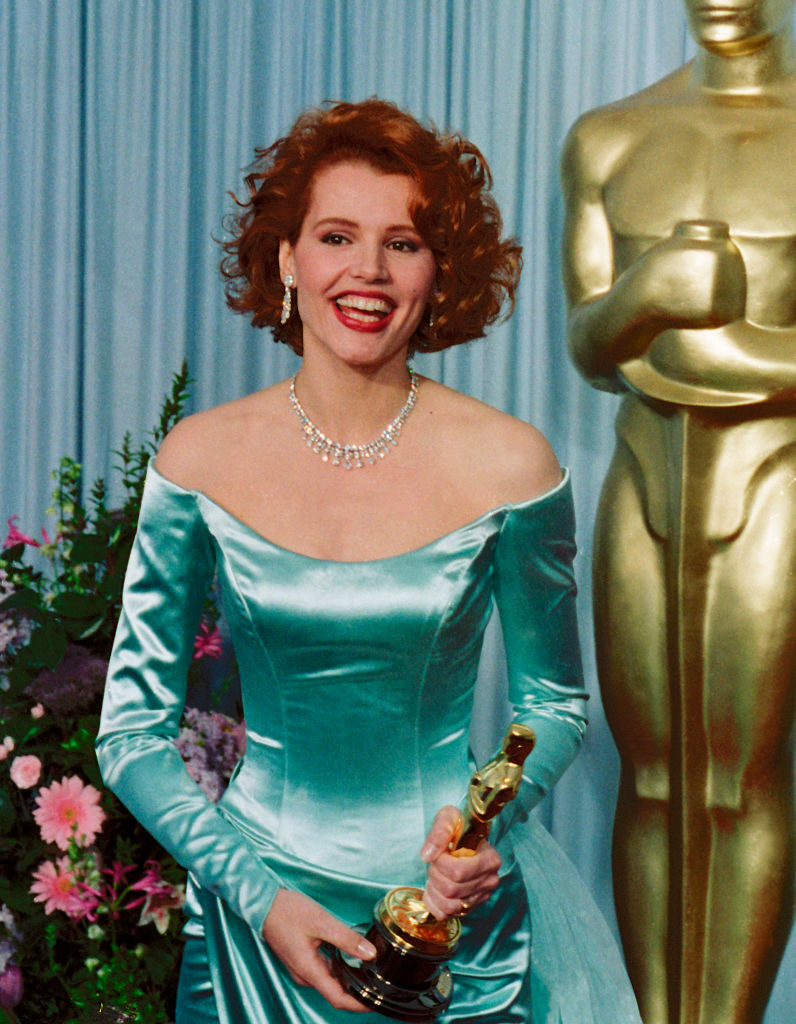
Her work earned her the Academy Award for Best Supporting Actress.
The achievement firmly established her as one of the industry’s most respected performers.
Winning an Oscar represented both recognition of her talent and validation of years of dedication.
Her career had reached a new level.
The Enduring Legacy of Thelma & Louise
Although Davis appeared in numerous successful productions, one role remains especially significant.
Her performance in Ridley Scott’s Thelma & Louise became one of the defining moments of her career.
The film earned critical acclaim and developed a lasting cultural impact.
Its exploration of friendship, independence, and female empowerment resonated strongly with audiences.
Working alongside Susan Sarandon also had a profound influence on Davis personally.
She admired Sarandon’s confidence and willingness to speak openly and honestly.
The experience encouraged Davis to become more comfortable expressing her own views and opinions.
For many viewers, the film remains one of the most memorable and influential productions of its era.
Success Continues on the Big Screen
Following Thelma & Louise, Davis appeared in A League of Their Own, another film centered on strong female characters.
The success of these projects highlighted the demand for stories focused on women and their experiences.
Davis often remarked that the overwhelming response to such films demonstrated how uncommon they were within the industry.
At the height of her career, she became known not only for her appearance but also for the intelligence and depth she brought to her performances.
Her work consistently demonstrated versatility across comedy, drama, and action-oriented roles.
As a result, she became one of the most recognizable actresses of her generation.
Facing Hollywood’s Challenges
Despite her success, Davis eventually encountered a challenge familiar to many actresses.
As she approached middle age, major roles became increasingly difficult to find.
She later described the change as dramatic and disappointing.
“I fell off the cliff,” she said while discussing the scarcity of opportunities available to women over forty.
The experience highlighted broader issues concerning age and gender within the entertainment industry.
Although fewer leading roles were offered, Davis’s influence and contributions remained significant.
She continued working while also focusing on other priorities in her life.
Motherhood and New Priorities
One of Davis’s greatest personal achievements came outside the entertainment world.
She became a mother for the first time at age 46.
Her daughter, Alizeh, was born in 2002.
Two years later, she welcomed twin sons, Kaiis and Kian.
Motherhood brought new perspectives and priorities.
Raising three young children presented challenges, but it also became one of the most rewarding aspects of her life.
Unlike many celebrity parents, Davis chose not to encourage her children to pursue acting careers.
She expressed particular concern about exposing young women to an industry where objectification and unequal treatment often remain concerns.
Advocating for Gender Equality
As her children grew, Davis became increasingly aware of gender representation in film and television.
Observing patterns in children’s entertainment inspired her to take action.
In 2004, she founded the Geena Davis Institute on Gender in Media.
The organization focuses on examining representation and encouraging greater equality across entertainment platforms.
Davis has spent years advocating for increased opportunities for women both in front of and behind the camera.
She has frequently pointed to the significant imbalance in directing positions throughout the industry.
Her efforts have made her one of Hollywood’s most prominent voices for gender equality.
Still Active at 69
Today, Geena Davis remains active professionally while continuing her advocacy work.
At 69, she continues pursuing acting opportunities and engaging in projects that reflect her interests and values.
One of her upcoming roles will be in The Boroughs, a supernatural mystery series from the Duffer Brothers for Netflix.
The project follows residents of a retirement community who unite to confront an unusual threat.
For Davis, the role represents another chapter in a career defined by reinvention, resilience, and determination.
From a sheltered childhood in Massachusetts to Academy Award-winning success and influential activism, her journey reflects a remarkable combination of talent, perseverance, and personal growth.
While her career has evolved through many different stages, her impact on both entertainment and advocacy continues to be felt today.