
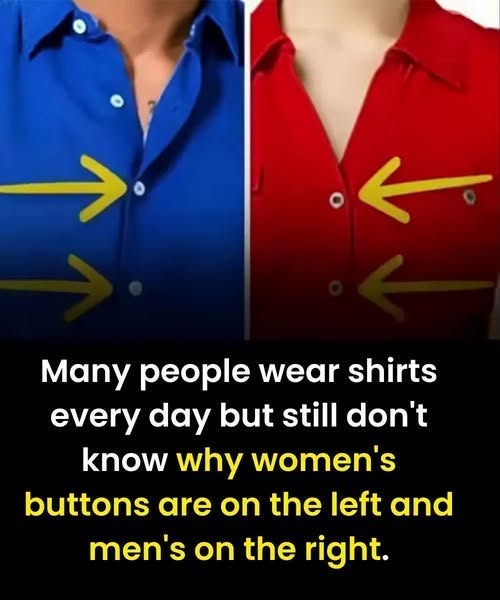
Why Men’s and Women’s Shirts Button on Opposite Sides: The Historical Origins of a Lasting Fashion Tradition
A Small Detail With a Long History
Most people wear shirts every day without giving much thought to the placement of the buttons. Yet one of the most enduring differences in clothing design can be found in a simple detail that has survived for centuries.
On most men’s shirts, the buttons are positioned on the right side. On women’s garments, they are typically found on the left. While many people notice the distinction only when comparing garments directly, the difference has deep historical roots.
What appears to be a minor design choice is actually connected to centuries of social customs, class structures, and practical considerations. The tradition developed long before modern fashion and continues to influence clothing production today.
The Origins of the Button Placement Tradition
The distinction between men’s and women’s clothing became more pronounced during the eighteenth and nineteenth centuries. During this period, fashion was closely connected to social standing, wealth, and daily routines.
Clothing was often more elaborate than it is today. Garments featured numerous buttons, layers, and decorative elements that could make dressing a time-consuming process.
As fashion became increasingly complex, practical solutions emerged to accommodate the lifestyles of different groups within society.
One of those solutions involved the placement of buttons.
How Wealth Influenced Women’s Fashion
For many upper-class women, dressing was not always a task performed independently. Wealthy households often employed servants whose responsibilities included helping family members prepare for the day.
Women’s clothing frequently required assistance because of its intricate design. Dresses, blouses, corsets, and other garments could contain numerous fastenings that were difficult to reach or secure alone.
Because most people were right-handed, placing buttons on the left side of a woman’s garment made fastening them easier for a servant standing opposite her.
This arrangement allowed the helper to use their dominant hand more naturally while securing the buttons.
What began as a practical adjustment soon became a standard feature of women’s clothing.
A Symbol of Social Status
Beyond convenience, button placement gradually acquired symbolic meaning.
Clothing often communicated a person’s position within society. Materials, tailoring, and decorative details all served as visible indicators of wealth and status.
Left-side button placement became associated with women who belonged to affluent households where assistance with dressing was available.
As a result, the design subtly reflected privilege and social standing.
Even as fashion evolved, the convention remained in place. What had originally served a practical purpose transformed into a recognizable characteristic of women’s attire.
Over time, the detail became accepted as part of standard garment construction.
The Development of Men’s Clothing Standards
Men’s clothing followed a different path. While women’s garments often emphasized status and refinement, men’s attire frequently prioritized function and utility.
Historical clothing designs were influenced by the realities of daily life, including travel, work, and personal defense.
For centuries, many men carried weapons such as swords or firearms. These items were commonly worn on the left side of the body, allowing quick access with the dominant right hand.
In situations requiring speed, the arrangement provided a practical advantage.
The design of clothing adapted to support these needs.
The Connection Between Clothing and Weapon Carrying
Having buttons positioned on the right side made it easier for right-handed men to open their garments quickly when necessary.
Whether drawing a weapon or accessing equipment, the placement reduced interference and improved efficiency.
In an era when personal defense could be an important consideration, even small design details carried practical value.
As these habits became widespread, right-side button placement gradually became the accepted standard for men’s clothing.
The design reflected functionality and readiness rather than social display.
This practical origin helped establish a tradition that would continue long after the original need disappeared.
The Influence of Military Fashion
Military uniforms played a significant role in shaping broader fashion trends.
Uniforms often emphasized practicality, consistency, and ease of movement. Features that proved useful in military settings frequently found their way into civilian clothing.
As military styles influenced everyday fashion, right-side button placement became even more firmly established in men’s garments.
The association with discipline, preparedness, and functionality strengthened the convention.
Eventually, the arrangement became so common that alternative placements seemed unusual.
Generations grew accustomed to the standard without necessarily understanding its origins.
Fashion as a Reflection of Society
The difference in button placement illustrates how clothing can serve as a reflection of broader social structures.
Garments are not simply functional objects. They often embody the values, customs, and assumptions of the societies that create them.
In the case of women’s clothing, button placement reflected expectations surrounding wealth, domestic assistance, and social status.
For men, the same detail reflected practicality, mobility, and historical traditions linked to military life and personal defense.
These distinctions reveal how fashion has long been shaped by factors extending far beyond aesthetics.
Why the Tradition Continued
As society modernized, many of the original reasons for opposite-side button placement faded away.
Most people no longer rely on servants to help them dress each morning.
Likewise, carrying swords as part of everyday life has become a relic of history.
Despite these changes, clothing manufacturers continued producing garments according to established conventions.
Consumers became familiar with the designs and expected them to remain consistent.
Changing such a deeply rooted standard would have required significant adjustments throughout the fashion industry.
As a result, the tradition persisted.
The Power of Habit in Fashion
Fashion often evolves gradually rather than through sudden transformation.
Many design elements remain in use long after their original purpose has disappeared.
Button placement is one example of how habit and tradition can preserve historical practices.
People become accustomed to certain styles and structures, making them feel natural even when their origins are largely forgotten.
Manufacturers continue producing garments according to familiar standards because consistency simplifies design, production, and consumer expectations.
Over time, these habits become self-reinforcing.
A Detail Most People Rarely Notice
For many consumers, button placement is not something that receives much attention.
People generally focus on color, fit, material, and overall style when selecting clothing.
Yet the distinction remains present in countless garments sold around the world.
Someone comparing men’s and women’s shirts side by side may notice the difference immediately.
Others may wear these garments for years without ever considering why the buttons are arranged differently.
The persistence of the tradition demonstrates how historical influences can become woven into everyday life.
Historical Customs Preserved Through Design
Many aspects of modern life contain traces of earlier generations.
Architectural features, language patterns, and social customs often survive long after the circumstances that created them have changed.
Fashion is no exception.
The placement of buttons serves as a small but meaningful example of how historical practices can endure.
Each garment carries evidence of decisions made centuries ago by people responding to the needs and expectations of their time.
Those decisions continue to influence clothing design in the present day.
The Relationship Between Gender and Fashion
The tradition also highlights the ways gender expectations influenced clothing development.
Throughout history, men’s and women’s garments were often designed according to different social roles and assumptions.
These distinctions affected everything from fabrics and silhouettes to fastenings and decorative details.
Button placement became one of many subtle features used to distinguish clothing categories.
Although modern fashion increasingly embraces flexibility and personal expression, many historical conventions remain visible.
The continued existence of opposite-side button placement reflects this ongoing connection between past and present.
Practicality and Symbolism Combined
What makes the history of button placement particularly interesting is the combination of practical and symbolic influences.
For women, the arrangement originated partly from the practical needs of assisted dressing but eventually became associated with status and refinement.
For men, practicality related to weapon access and military traditions helped establish the opposite standard.
Both conventions emerged from real-world considerations before taking on broader cultural meaning.
As a result, a simple button arrangement became intertwined with social identity.
A Lasting Reminder of the Past
Today’s clothing consumers live in a world dramatically different from that of the eighteenth and nineteenth centuries.
Yet the legacy of those earlier eras remains visible in countless wardrobes.
Every shirt that buttons on the left or right carries a connection to historical customs that shaped its design.
Most people never think about those origins when getting dressed in the morning.
Nevertheless, the influence of history remains present in even the smallest details.
The continued distinction between men’s and women’s shirts serves as a reminder that everyday objects often contain stories stretching back generations.
How a Simple Shirt Tells a Larger Story
The difference in button placement may seem insignificant at first glance, but it reveals a fascinating intersection of fashion, class, gender, and practicality.
What began as a solution to specific social and functional needs eventually became a lasting convention observed around the world.
Although modern lifestyles have changed dramatically, the tradition remains largely unchanged.
As a result, each shirt quietly preserves a piece of history.
The next time someone fastens a button, they are participating in a custom shaped by centuries of human behavior, social structures, and cultural expectations.
In that sense, even the simplest garment serves as a reminder that fashion is more than appearance. It is a record of the habits, values, and traditions that have influenced society across generations.