

Parenting Debate Erupts Over “Consent” Concept in Infant Care Discussions
A Parenting Idea That Sparked Global Conversation
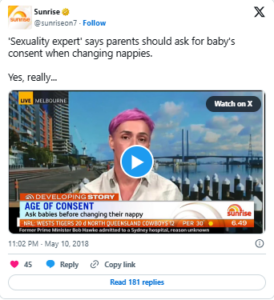
A recent discussion involving an Australian sexuality educator has generated widespread debate across social media platforms and parenting communities. At the center of the controversy is the suggestion that parents should ask a baby for “consent” before changing a diaper.
While the idea quickly gained online attention, it also triggered strong disagreement. Many questioned both its practicality and the interpretation of consent when applied to infants who are not yet capable of verbal communication or informed decision-making.
The conversation has since expanded beyond its original context, becoming a broader discussion about parenting styles, communication, and early childhood development.

The Idea of Building a “Culture of Consent”
The educator associated with the discussion, Deanne Carson, has explained her approach as part of promoting a “culture of consent” from early childhood. The intention, as described, is not to expect babies to give verbal approval, but to encourage parents to communicate more consciously with their children.
This includes verbally explaining actions before they happen, such as telling a baby that a diaper change is about to take place, and observing the child’s reactions and body language.
From this perspective, caregiving becomes more interactive, with emphasis placed on awareness, communication, and responsiveness rather than silent routine actions.
Supporters Highlight Early Communication Benefits
Those who support the concept argue that early and consistent communication may contribute positively to a child’s emotional development over time.
By narrating everyday caregiving actions and paying attention to non-verbal cues such as facial expressions, movements, and sounds, parents may strengthen their connection with their infants.
Child development perspectives often emphasize that babies communicate primarily through behavior rather than speech. Crying, calmness, or physical reactions are commonly interpreted as signals of need, comfort, or discomfort.
Supporters suggest that acknowledging these signals and speaking to infants during routine care can help establish familiarity, trust, and emotional responsiveness.
Criticism Over Practicality and Interpretation
Despite these arguments, the proposal has faced significant criticism from parenting experts, commentators, and members of the public. A major point of disagreement centers on whether the concept of “consent” can meaningfully apply to infants at all.
Critics argue that babies are not developmentally capable of understanding or providing consent in any practical sense. From this viewpoint, essential caregiving tasks such as feeding, cleaning, and diaper changing are fundamental responsibilities that do not require permission.
Some have also expressed concern that applying adult concepts to infant care may create confusion about the nature of parental responsibility and routine childcare.
In this interpretation, caregiving is seen as a necessity driven by health and hygiene rather than a process requiring consent-based framing.
Social Media Amplifies the Debate
As the idea circulated online, reactions became increasingly diverse and polarized. Social media platforms played a significant role in amplifying the discussion, allowing it to reach audiences far beyond parenting circles.
Some users responded with humor or sarcasm, questioning whether similar consent-based interpretations should apply to other everyday caregiving situations involving infants or even animals.
These reactions contributed to the viral spread of the topic and added a layer of public entertainment and satire to the debate.
At the same time, others defended the underlying intent behind the concept, even if they disagreed with its literal application.
Focus on Communication Rather Than Literal Consent
Supporters of the broader idea emphasize that the core message is not about obtaining actual permission from infants, but about fostering respectful communication patterns between caregivers and children.
They argue that speaking to babies, explaining actions, and maintaining calm interaction can still play a valuable role in early emotional development.
Even though infants cannot respond verbally or make informed decisions, consistent communication may help shape early awareness of interaction and trust.
In this sense, the discussion is framed less around consent itself and more around communication habits in caregiving.
Expert Perspectives on Infant Development
Child development professionals generally agree that infants are highly responsive to tone of voice, facial expressions, and routine interactions with caregivers.
These early exchanges help establish patterns of familiarity and emotional connection, even before language development begins.
However, experts typically distinguish between communication and formal consent. While interaction is essential, infants are not considered capable of providing informed agreement in the way older children or adults can.
This distinction is central to much of the disagreement surrounding the concept.
Concerns About Misinterpreting Parenting Roles
Critics of the consent-based framing argue that it risks misunderstanding the practical realities of infant care. Essential tasks such as changing diapers are viewed as non-negotiable responsibilities that ensure health, hygiene, and safety.
From this perspective, introducing consent language into these situations may blur the boundaries between caregiving duties and decision-making concepts that apply to older individuals.
Some commentators suggest that while communication is valuable, it should not be confused with requiring permission for basic care.
A Broader Shift in Parenting Approaches
The debate also reflects wider changes in how parenting is discussed in modern society. In recent years, there has been increasing emphasis on emotional awareness, respectful communication, and psychological understanding in child-rearing practices.
At the same time, traditional approaches continue to prioritize practicality, routine care, and straightforward interpretations of parental responsibility.
This ongoing shift has created space for differing interpretations of what effective parenting should look like in practice.
Understanding Infant Communication Through Behavior
Despite disagreements over terminology, many participants in the discussion acknowledge that infants do communicate in meaningful ways.
Behaviors such as crying, turning away, or becoming calm are widely recognized as indicators of comfort, discomfort, or need.
Caregivers naturally interpret these signals as part of daily parenting, regardless of whether the term “consent” is used in describing the interaction.
This shared understanding highlights a common foundation even among differing viewpoints.
Where the Debate Ultimately Leads
The controversy surrounding consent and diaper changing ultimately reflects broader differences in parenting philosophy rather than a single practical question.
For some, the idea represents an effort to encourage more thoughtful communication and awareness in early childhood care. For others, it introduces unnecessary complexity into routine caregiving responsibilities.
Despite these differences, there is general agreement that attentiveness, responsiveness, and emotional sensitivity are important aspects of caring for infants.
Most perspectives converge on the importance of recognizing a child’s needs and responding appropriately, even if they differ on how that principle should be framed.
A Conversation About Language, Intention, and Parenting
The discussion highlights how language can shape public interpretation of parenting ideas in unexpected ways. A single concept can be viewed simultaneously as symbolic guidance, practical advice, or unnecessary complication depending on perspective.
Ultimately, the debate is less about diaper changing itself and more about how society understands communication, responsibility, and early childhood development.
While opinions remain divided, the conversation continues to contribute to broader discussions about how parents and caregivers can best support healthy emotional growth in children from the earliest stages of life.