
Proposal for a $250 U.S. Banknote Featuring Donald Trump Sparks Debate and Legislative Questions
Administration Preparations Bring New Currency Proposal Into Focus
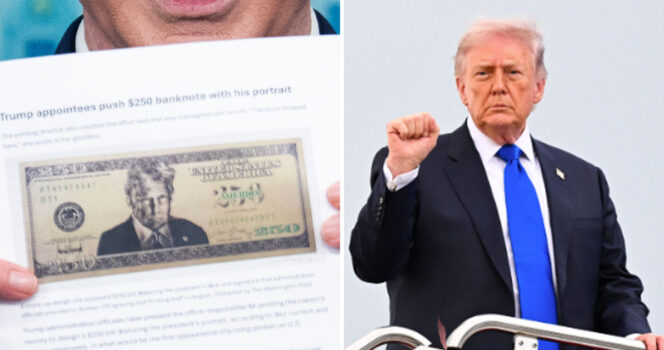
A proposal involving a new $250 U.S. banknote has generated attention after reports indicated that officials within Donald Trump’s administration are examining the possibility of placing the president’s image on the currency.
The concept remains far from becoming reality, but discussions surrounding the idea have already prompted legal, political, and administrative questions. While supporters view the proposal as a commemorative tribute connected to a major national milestone, critics point to longstanding restrictions that could prevent it from moving forward.
According to reports, officials have begun considering what would be required if Congress were to authorize such a measure in the future. The discussions have placed the Bureau of Engraving and Printing at the center of the conversation.
The idea has attracted widespread interest because it involves both the creation of a new currency denomination and the inclusion of a living individual’s likeness on official U.S. money.
Legal Barriers Remain a Major Challenge
One of the most significant obstacles facing the proposal is existing federal law.
The Thayer Amendment, enacted in 1866, prohibits the image of a living person from appearing on official United States currency, bonds, and other financial notes. Because Donald Trump is currently living, any effort to place his likeness on a banknote would require lawmakers to address that restriction.
In addition to that limitation, another law governs the denominations that may be issued as U.S. currency. This creates a separate challenge for advocates of a $250 bill, since such a denomination is not currently part of the standard currency system.
Together, these legal hurdles mean that congressional action would be necessary before the proposal could advance beyond the planning stage.
As a result, any future development depends heavily on legislative decisions rather than administrative preparations alone.
Treasury Department Confirms Planning Efforts
Despite the legal barriers, officials have acknowledged that preliminary planning activities are taking place.
A Treasury Department spokeswoman stated that the Bureau of Engraving and Printing is conducting planning and due diligence in response to legislation introduced by Representative Joe Wilson.
The statement emphasized that preparations are intended to ensure readiness should Congress ultimately approve a legislative mandate authorizing the note.
According to the spokeswoman, officials are taking proactive steps connected to a potential commemorative $250 banknote that would recognize the 250th anniversary of the United States.
The planning effort does not indicate that approval has been granted, but it demonstrates that government agencies are evaluating what implementation could involve if lawmakers move forward with the proposal.
Officials Defend Early Preparations
Treasury Secretary Scott Bessent defended the decision to begin preparatory work before any final approval has been secured.
He argued that projects involving currency design and production require extensive advance planning and cannot be developed on short notice.
Bessent indicated that preparing in advance is a practical step rather than an endorsement of any final outcome.
He also expressed the view that featuring a sitting president on a commemorative note connected to the nation’s 250th anniversary would not be inappropriate if authorized through the proper legislative process.
His comments highlighted the distinction between preparation and implementation, emphasizing that readiness is necessary even when a proposal remains uncertain.
Supporters Push for Development of the Note
Reports indicate that U.S. Treasurer Brandon Beach and senior adviser Mike Brown have been among the individuals encouraging progress on the proposed banknote.
According to those reports, Beach supplied staff members with mock-up designs related to the concept during the previous year.
These preliminary designs reportedly formed part of broader discussions regarding how such a note could appear if it were eventually authorized.
Supporters of the idea have framed the proposal as a way to commemorate a significant national anniversary while recognizing Trump’s role as president during that period.
The concept has therefore been presented not only as a currency initiative but also as a symbolic commemorative project.
Concerns Raised Within the Bureau of Engraving and Printing
Not everyone involved in the process has supported moving forward with the proposal.
Patricia Solimene, who served as director of the Bureau of Engraving and Printing at the time, reportedly expressed reservations regarding the project.
According to reports, she indicated that the agency lacked authorization to proceed beyond certain stages because required approvals and stakeholder discussions had not yet taken place.
Her concerns reflected the legal and procedural complexities surrounding the proposal.
The production of new currency is a lengthy undertaking that involves extensive planning, design reviews, security considerations, manufacturing preparation, and coordination among multiple government entities.
For that reason, questions regarding authority and process remain central to any discussion about introducing a new banknote.
The Long Timeline of Currency Production
Experts familiar with currency development have pointed out that creating a new note is not a quick process.
Reports indicate that a new bill, particularly one with a denomination not currently in circulation, could require six to eight years of development before reaching production.
This timeline reflects the complexity of modern currency design.
Security features must be created, tested, and integrated into the note. Production systems may require updates, and extensive coordination is necessary to ensure compatibility with financial institutions and cash-handling equipment.
As a result, even if lawmakers were to approve the proposal, implementation would likely remain years away.
Political Debate Expands Beyond the Proposed Note
The proposal has also generated activity on Capitol Hill, where lawmakers from both major parties have introduced related legislation.
Representative Jimmy Gomez introduced legislation in April aimed at preventing Trump’s signature from appearing on U.S. currency.
The measure reflects broader concerns among opponents regarding the possibility of associating current currency designs with Trump.
Debate surrounding the issue has therefore expanded beyond the proposed $250 note itself and into broader questions regarding the appearance of U.S. money.
These discussions illustrate how currency design can become intertwined with political disagreements and symbolic debates.
Previous Legislative Efforts Addressed Similar Concerns
The current controversy is not the first time lawmakers have addressed the possibility of featuring Trump on U.S. currency.
Last year, several senators proposed legislation intended to prevent his likeness from appearing on a coin.
That effort reflected concerns among some legislators that future commemorative currency projects could be used to honor living political figures.
Although those proposals did not result in immediate changes, they demonstrated that the issue had already attracted congressional attention before discussions of a $250 banknote emerged.
The recurring legislative efforts show that the debate extends well beyond a single proposal.
Republican Lawmakers Advance Alternative Currency Ideas
At the same time, several Republican lawmakers have introduced proposals supporting the inclusion of Trump’s image on future U.S. currency.
Representative Brandon Gill proposed legislation that would place Trump on the $100 bill, replacing Benjamin Franklin.
Another proposal came from Representative Andy Barr, who has advocated for featuring Trump on a $250 banknote.
Supporters of these measures argue that Trump’s place in American political history warrants consideration for future commemorative currency.
These proposals have helped keep the discussion active even as significant legal and procedural barriers remain unresolved.
Limited Momentum in Congress So Far
Despite the attention generated by the various proposals, none have secured substantial support in either chamber of Congress.
Legislation connected to placing Trump’s likeness on U.S. currency has yet to gain the momentum necessary to move toward enactment.
As a result, the concept remains largely theoretical at this stage.
Lawmakers continue to debate the legal, symbolic, and practical implications of the idea, but no proposal has advanced far enough to suggest immediate implementation.
The absence of broad bipartisan support remains one of the largest obstacles facing advocates of the plan.
Questions About Commemoration and Tradition
The proposal has sparked broader discussion about how the United States chooses to honor historical figures and national milestones.
Supporters view the idea as a commemorative gesture tied to the country’s 250th anniversary.
Opponents argue that longstanding traditions regarding currency design exist for important reasons and should not be altered without careful consideration.
The debate touches on questions of symbolism, precedent, and the role of national currency in representing American history.
Because money circulates throughout the country and around the world, decisions about its design often carry significance that extends beyond aesthetics.
The Future of the Proposal Remains Uncertain
For now, the proposed $250 banknote featuring Donald Trump remains a concept rather than an approved government project.
Planning activities may continue as officials evaluate what implementation would require, but major legal obstacles still stand in the way.
Congress would need to address restrictions involving both currency denominations and the appearance of living individuals on official U.S. money before the proposal could advance.
Meanwhile, lawmakers continue to introduce competing measures either supporting or opposing the idea.
Whether the proposal eventually becomes law or remains a subject of political debate, it has already generated significant discussion about currency design, presidential recognition, and the procedures required to change one of the nation’s most visible symbols.