
Young Soldier Dies After Royal Windsor Horse Show Carriage Accident as Safety Concerns Grow
King Charles and the wider United Kingdom have been left shocked by a tragic accident at the Royal Windsor Horse Show, where a young member of the King’s Troop Royal Horse Artillery died after falling from her horse.
Lance Bombardier Ciara Sullivan, 24, suffered fatal injuries after the incident, which occurred shortly after 7 pm BST as she was leaving the arena following a performance.
Sullivan was part of the King’s Troop Royal Horse Artillery, a ceremonial Army unit known for dramatic and fast-moving displays involving horses and historic field guns. Her death has prompted grief, tributes, and renewed calls for a serious review of safety measures connected to these displays.
A Tragic Accident at the Royal Windsor Horse Show
The accident happened after a performance at the Royal Windsor Horse Show, an event attended by King Charles III and other members of the Royal Family.
Sullivan fell from her horse while leaving the arena. Emergency medical assistance was provided immediately, but her injuries were severe, and she died at the scene.
The incident has been described as both horrifying and deeply shocking, especially because it occurred during a public event connected to one of the Army’s most recognizable ceremonial units.
Those present at the event saw the display and the movement of the horses and gun carriages, but the full severity of the accident was not immediately known to everyone in attendance.
Buckingham Palace later confirmed that the King and other members of the Royal Family were present at the arena when the tragedy happened, though they were only informed of the fatal outcome afterward.
Who Was Lance Bombardier Ciara Sullivan?
Lance Bombardier Ciara Sullivan was 24 years old and served with the King’s Troop Royal Horse Artillery.
She joined the Army at 18 and trained at the Army Training Center in Pirbright before joining the King’s Troop Royal Horse Artillery in 2021.
Known to friends and colleagues as “Sully,” she was remembered as a fearless and highly skilled horsewoman who was deeply respected by those who served alongside her.
Her role required discipline, courage, and exceptional riding ability. The King’s Troop performs demanding ceremonial displays that involve tight formations, powerful horses, and heavy historic equipment.
Sullivan was praised not only for her professional ability but also for her personality, energy, and loyalty to those around her.
The King’s Troop Royal Horse Artillery
The King’s Troop Royal Horse Artillery is a ceremonial Army unit known for performances involving First World War-era QF 13-pounder field guns.
During displays, each gun carriage is drawn by six horses arranged in three pairs. Riders guide the teams through fast turns and precise formations inside the arena.
The carriages are built from steel and wood and have large spoked wheels. They weigh more than a ton, making them powerful and dangerous pieces of equipment if control is lost or if a rider falls close to them.
The displays are visually impressive, but they require exact timing, coordination, and awareness from every rider involved.
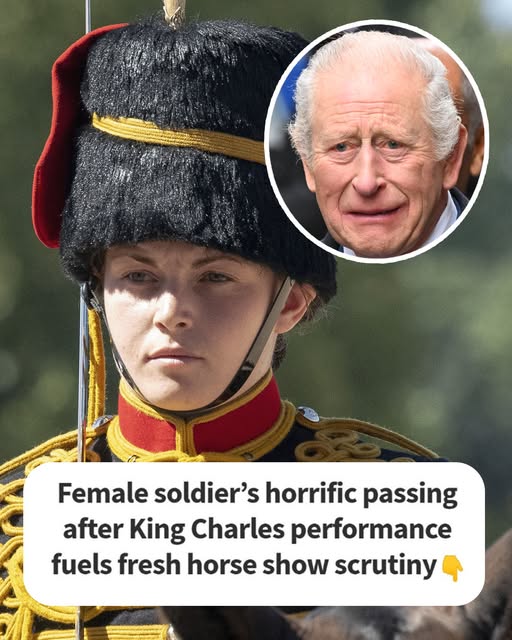
Sullivan is believed to have been riding in the rear position closest to the carriage at the time of the accident. She was also wearing the regiment’s traditional ceremonial busby hat as part of the King’s Troop full dress uniform.
Reports Describe a Horrifying Fall
Reports have stated that Sullivan was allegedly dragged under a heavy gun carriage after falling from her horse.
The circumstances of the fall have raised serious concerns because of the position she was believed to be riding in and the weight of the equipment involved.
One source described a possible visibility problem during the incident.
“The rider at the front was not able to clearly see the back of the carriage where Ciara was sitting, so could not see that she had fallen and did not know to stop.
“These carriages were invented centuries ago, before modern safety measures,” the source continued, adding that the hats are “not fit for purpose” and calling for a “serious review” of horse displays.
The comments have intensified questions about whether the traditional equipment and ceremonial clothing used in such events offer enough protection for modern safety expectations.
Calls for Safety Review
The death of Sullivan has led to critical voices calling for improved safety measures around ceremonial horse displays.
The concerns focus on several issues, including the age and design of the carriages, the visibility between riders, and the protective value of traditional headwear worn during performances.
The King’s Troop displays are rooted in history and ceremony. That tradition is part of their public significance, but critics are now questioning whether some elements need to be reviewed in light of modern safety standards.
The carriages used in the performances were designed long before current safety systems existed. Their weight and structure make them impressive in public displays, but also extremely dangerous in an accident.
The source’s comments about the busby hats being “not fit for purpose” have added another point of concern. The traditional ceremonial uniform may carry historical importance, but the tragedy has raised questions about whether it provides adequate protection during high-risk mounted displays.
Buckingham Palace Responds
Buckingham Palace issued a statement after the death, saying King Charles was deeply affected by the news.
“The King was greatly shocked and saddened to have learned subsequently of the Troop member’s death, and will be in touch with the family to share his personal condolences,” Buckingham Palace said.
The statement also expressed the wider Royal Family’s sorrow.
“The thoughts and most heartfelt sympathies of the whole royal family are with the victim’s loved ones and military colleagues at this time of grief.”
The Palace made clear that although the King and other members of the Royal Family were present at the event, they were not initially aware of the full seriousness of the incident.
The King’s planned personal condolences to Sullivan’s family underline the gravity of the tragedy and the close association between the Royal Family and the ceremonial unit involved.
A Tribute From Her Commanding Officer
Sullivan’s commanding officer paid tribute to her in deeply emotional terms, describing her as both an outstanding soldier and an exceptional rider.
She “was to all who had the privilege of serving alongside her, a bright light in any room she entered”, they said.
Her service in the King’s Troop was marked by professionalism, energy, and courage.
“An immensely professional soldier and an exceptional jockey, she approached every day within The Troop with an infectious energy – the kind that lifted those around her without effort or intention – and was unfailingly present for her comrades in both the small moments and the hard ones.”
The tribute painted a picture of a soldier who was admired not only for her technical skill, but also for her generosity of spirit and commitment to her colleagues.
Remembered as an Outstanding Soldier
Those who served with Sullivan remembered her as a role model and someone who consistently showed courage.
“An outstanding soldier and a role model to many she worked with,” they added, saying she had “natural courage that made her always the first to volunteer to the ride the most demanding of horses”.
That willingness to take on difficult challenges reflected the confidence and dedication she brought to her role.
The tribute also emphasized that her talents extended beyond equestrian work.
They continued, “Beyond her equestrian talent, she was a soldier of remarkable breadth. A skilled footballer, a dedicated presence in the gym who pushed herself and quietly brought others along with her, and someone who found cause to celebrate the smallest daily victories in those she served with.”
Those words showed that Sullivan was valued as a complete person, not only as a rider or soldier. She was remembered for her strength, discipline, encouragement of others, and ability to bring energy into daily military life.
Family Tribute Honors Her Service
Sullivan’s father shared a moving tribute on social media after her death.
He posted a photo tribute and wrote: “The honour. The service. They will never be forgotten.”
The short message captured the pride and grief surrounding her loss. It reflected the family’s recognition of her military service and the pain of losing her at such a young age.
For her loved ones, the tragedy is not only a public incident at a major event. It is the loss of a daughter, friend, and colleague whose life and service were cut short.
The public tributes from military colleagues and family members have created a portrait of Sullivan as brave, talented, and deeply loved.
Police Say the Incident Is Non-Suspicious
Thames Valley Police have said the incident remains “unexplained but non-suspicious.”
That means authorities are not treating the death as the result of deliberate wrongdoing, though the exact circumstances are still being examined.
The phrase also indicates that officials continue to look at what happened in order to understand the sequence of events that led to Sullivan’s fall and fatal injuries.
Because the incident involved horses, heavy ceremonial equipment, and a public event, investigators are expected to consider multiple factors.
These may include the movement of the carriage, the positioning of the riders, visibility between team members, and whether any safety procedures could be reviewed.
The Risks of Ceremonial Displays
The King’s Troop Royal Horse Artillery is known for displays that combine tradition, military discipline, and fast-paced horsemanship.
Those performances are admired for their precision and historical symbolism, but they are also physically demanding and potentially dangerous.
Riders must work with powerful horses while managing the movement of heavy gun carriages. Sharp turns and close formations require skill and trust between all members of the team.
Even a small mistake or moment of lost balance can become serious when horses and equipment weighing more than a ton are involved.
Sullivan’s death has brought renewed attention to those risks and to the need for constant safety evaluation, especially when historic equipment remains in active ceremonial use.
Tradition and Modern Safety Questions
The tragedy has created a difficult conversation about the balance between preserving military tradition and ensuring modern safety protections.
The King’s Troop Royal Horse Artillery performs a highly symbolic role. Its uniforms, equipment, and displays are closely tied to ceremonial history.
However, critics are now asking whether some traditional elements should be reconsidered or adapted to reduce risk.
The comments about carriages being invented centuries ago have focused attention on whether historic design can meet current safety expectations.
The concern about ceremonial hats has also raised questions about protective gear. If riders are performing high-risk maneuvers near heavy equipment, some believe traditional appearance should not come before safety.
Those questions are likely to remain part of the discussion as officials and military leaders review the circumstances of Sullivan’s death.
A Nation Shocked by a Young Soldier’s Death
The death of Lance Bombardier Ciara Sullivan has deeply affected those connected to the Royal Windsor Horse Show, the Army, the Royal Family, and the wider public.
At only 24, she had already built a reputation as a courageous soldier, talented jockey, supportive colleague, and respected member of the King’s Troop Royal Horse Artillery.
Her death during a ceremonial event has turned attention toward the dangers involved in performances that many spectators may view only as tradition and pageantry.
The grief surrounding the tragedy is now joined by calls for a careful safety review to determine whether changes are needed to protect other riders in future displays.
For now, tributes continue to focus on Sullivan’s character, service, and dedication.
She is remembered as a bright presence, a fearless horsewoman, and a soldier whose life ended in a tragic accident while serving in a unit closely tied to royal and military tradition.