
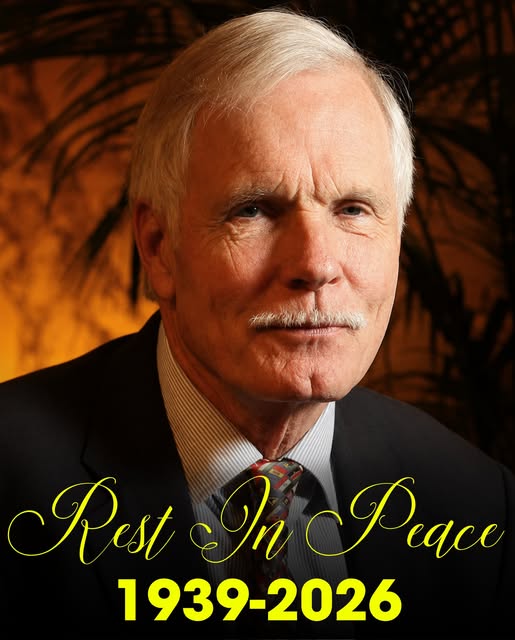
Ted Turner, CNN Founder and Transformative Media Pioneer, Dies at 87
A Defining Figure in Modern Television
Ted Turner, the influential media entrepreneur who reshaped television news by creating CNN, has died at the age of 87.
His death was confirmed Wednesday in a statement from Turner Enterprises and was reported by CNN. Turner was widely known as the founder of the first 24-hour cable news channel, a move that permanently changed the way audiences followed major events around the world.
Over the course of his career, Turner built a media empire, owned a Major League Baseball franchise, became a prominent philanthropist, and spent a decade married to Academy Award-winning actress Jane Fonda.
He was also known for his bold personality, his thin mustache, his willingness to take risks, and his deep involvement in causes ranging from environmental conservation to international affairs.
Turner’s public life stretched across business, politics, sports, entertainment, and philanthropy. His impact on television journalism remains one of the central parts of his legacy.

Health Struggles in Later Years
Shortly before his 80th birthday, Turner publicly revealed that he had been diagnosed with Lewy Body Dementia. The condition is a progressive neurological disease that can lead to cognitive decline and physical weakness.
In early 2025, he was reportedly receiving care at a rehabilitation facility after suffering a severe case of pneumonia.
Despite health challenges later in life, Turner’s reputation as one of the most consequential figures in American media remained firmly established.
His career was built on unconventional ideas, aggressive expansion, and a belief that television could operate in ways the industry had not previously imagined.
When he launched CNN in 1980, many doubted that a full-time news channel could succeed. Turner proved that constant television news coverage could not only survive, but become a global force.

The Creation of CNN
Turner launched the Cable News Network on June 1, 1980. The network began operating out of a converted Jewish country club in Atlanta.
At the time, the idea of a channel devoted entirely to news around the clock was considered risky. Traditional broadcast networks dominated television journalism, and many industry observers questioned whether viewers would watch news at all hours.
Early criticism was sharp. Some skeptics mocked CNN as “Chicken Noodle News,” a nickname that reflected doubts about its budget, production quality, and ability to compete with established broadcasters.
Turner pressed forward anyway. He expanded the network, built news operations beyond Atlanta, and pushed CNN toward international relevance.
What began as an uncertain experiment eventually became a global news organization with bureaus around the world. CNN’s rise changed expectations for how quickly breaking news could reach the public.

A Breakthrough During Global Events
CNN’s importance became especially clear during the Persian Gulf War in 1991. The network became the only American television outlet able to broadcast a live, unfiltered feed from Baghdad as bombs illuminated the night sky.
That coverage helped establish CNN as a defining source of real-time international reporting for American viewers. It also demonstrated the power of a 24-hour news network during moments of crisis.
Before that, CNN had already gained attention for its coverage of major events across the world. Its reporting included the collapse of the Berlin Wall, the student demonstrations in China’s Tiananmen Square, and the Space Shuttle Challenger disaster.
Those moments helped prove the value of continuous live news coverage. Viewers no longer had to wait for scheduled evening broadcasts to learn about unfolding events.
Turner’s model helped shift the media landscape from scheduled reporting to constant availability. That shift later influenced nearly every major news organization that followed.

Building Turner Broadcasting
Turner’s influence reached far beyond CNN. He established Turner Broadcasting System, which became the parent company of several major cable networks.
Among the brands connected to Turner Broadcasting were TNT, TBS, Cartoon Network, and Turner Classic Movies. These networks became central parts of cable television and helped define entertainment programming for millions of households.
Turner’s business strategy showed his belief in cable television at a time when the industry was still developing. He recognized that audiences could be served by specialized channels, whether focused on news, movies, sports, animation, or general entertainment.
His approach helped create a new era in television, where cable networks became powerful competitors to traditional broadcasters.
Turner’s media holdings made him one of the most visible and influential executives in American communications.
Sports, Business, and Public Persona
Turner was also the former owner of the Atlanta Braves baseball franchise. His involvement with the team became another major part of his public identity.
He was often described as colorful, outspoken, and unpredictable. His personality brought him attention almost as much as his business decisions did.
Because of his audacious style, Turner became known as “The Mouth of the South.” The nickname reflected both his Southern base in Atlanta and his reputation for speaking boldly.
His public image was defined by confidence and risk-taking. He built businesses, challenged competitors, and often placed himself at the center of public debate.
Turner also developed a legendary professional rivalry with Rupert Murdoch, whose media empire included Fox News and The New York Post.
At the same time, Turner maintained an unexpected friendship with Cuban leader Fidel Castro, another example of the unusual range of relationships that marked his public life.
Marriage to Jane Fonda
Turner was married three times and divorced three times. His third marriage, to actress Jane Fonda, brought together two of the most recognizable public figures of their era.
Turner and Fonda married in 1991. Their union lasted nearly 10 years before they separated in 2001.
The marriage drew attention because of their fame, their strong personalities, and their prominent places in American culture. Fonda was already an Academy Award-winning actress and activist, while Turner was one of the most powerful figures in media.
Even after their split, the two remained publicly connected through their shared history. Images of the former couple from later years continued to reflect the lasting interest in their relationship.
Turner’s marriage to Fonda became one chapter in a life that regularly crossed the boundaries between business, entertainment, politics, and public causes.
Philanthropy and Environmental Interests
Turner was not only a media executive. He was also a major philanthropist and conservation-minded figure.
He created the United Nations Foundation, strengthening his reputation as someone deeply interested in global issues and international cooperation.
Turner was also known as a bison rancher and environmental conservationist. His interest in land, wildlife, and conservation became an important part of his later public identity.
He was also passionate about yachting and remained active as a political advocate. His interests were wide-ranging, and he rarely confined himself to one field.
This range made him a complex figure. He could be a businessman, sports owner, philanthropist, environmentalist, media disruptor, and outspoken public personality all at once.
Tributes From Media and Political Figures
United States President Donald Trump acknowledged Turner’s death in a Truth Social post, calling him “one of the Greats of All Time.”
Trump also described Turner as “a friend of mine” who was “always willing to fight for a good cause.”
Mark Thompson, chairman and CEO of CNN Worldwide, also issued a statement honoring Turner’s impact on the network and the broader media world.
“Ted was an intensely involved and committed leader, intrepid, fearless and always willing to back a hunch and trust his own Judgement. He was and always will be the presiding spirit of CNN.”
Thompson added, “Ted is the giant on whose shoulders we stand, and we will all take a moment today to recognise him and his impact on our lives and the world.”
Those remarks emphasized Turner’s central role in CNN’s identity. Even decades after its founding, the network remained inseparable from his vision.
Rupert Murdoch Honors a Rival and Friend
Rupert Murdoch, Chairman Emeritus of News Corp and Fox Corporation, also paid tribute to Turner. The two men had long been industry rivals, but Murdoch described him with respect and affection.
“Ted Turner’s vision for 24-hour cable news transformed the media industry and gave viewers everywhere a front seat to witness history unfold. His impact as a trailblazer has left an indelible mark on our cultural landscape,” Mr. Murdoch expressed. “He was a great American and friend.”
Murdoch’s comments recognized the significance of Turner’s contribution to modern media. Even competitors who built their own news organizations operated in a world Turner helped create.
The 24-hour news model became a standard feature of television journalism after CNN proved the concept could work.
Turner’s influence was not limited to his own company. It changed the direction of the entire industry.
The Sale to Time Warner
As competitors moved into the 24-hour news space, Turner faced growing pressure. He took on significant debt while trying to protect and expand his media empire through acquisitions.
Eventually, he was pushed into selling CNN and Turner Broadcasting System to Time Warner in 1996. The deal was valued at approximately $7.34 billion.
Although the transaction was financially enormous, Turner later described it as the “worst day of my life.”
The sale marked a major turning point. Turner had built CNN as his “baby,” and losing control of it deeply affected him.
By 2000, Time Warner was acquired by AOL in a merger that became widely viewed as one of the most disastrous media deals in American history.
Turner was harshly critical of that buyout. He called it “one of the biggest disasters that have occurred to our country.”
Trump Comments on CNN’s Direction
In his Wednesday social media post, Trump also discussed Turner’s sale of CNN and what happened to the network afterward.
Trump stated: “He [Turner] founded CNN, sold it, and was personally devastated by the Deal because the new ownership took CNN, his ‘baby,’ and destroyed it.”
Trump continued, “It became woke, and everything that he is not all about. Maybe the new buyers, wonderful people, will be able to bring it back to its former credibility and glory,” Trump continued.
His comments reflected his own long-running criticism of CNN, while also framing Turner as someone who had been wounded by changes to the network after the sale.
The remarks connected Turner’s death to ongoing debate over CNN’s identity, ownership, and future direction.
Warner Bros. Discovery Responds
Warner Bros. Discovery, CNN’s current parent company, is undergoing an acquisition by Paramount Skydance. The company is led by the billionaire Ellison family, and the agreement is valued at $111 billion.
David Zaslav, CEO of Warner Bros. Discovery, addressed employees in a memo following Turner’s death. He described Turner as a foundational figure in the history of the company’s brands.
“Ted was a visionary, a trailblazer, and a foundational force behind many of the brands that are central to Warner Bros. Discovery today,” WBD CEO David Zaslav wrote in a memo addressed to employees on Wednesday.
He continued, “On behalf of our entire company, we extend our deepest condolences to Ted’s family and to the many colleagues and partners whose lives and careers were shaped by his vision. It is our responsibility to honour and carry forward the legacy he built.”
Zaslav’s statement highlighted how many of Turner’s creations remained important within the modern media landscape.
A Vision That Changed News
Turner’s most lasting achievement remains the creation of CNN. Before its launch, television news was largely organized around scheduled broadcasts.
Turner believed news could be continuous, immediate, and available at any hour. That idea became one of the most important shifts in modern broadcasting.
The concept was risky because it challenged established habits. Viewers, advertisers, journalists, and competitors all had to adjust to the idea that news did not need to wait for a nightly program.
Once major world events began unfolding live on CNN, the value of the model became obvious. The network gave viewers a sense of watching history as it happened.
That sense of immediacy became central to modern television journalism. Later cable news channels followed the path Turner opened.
A Complex and Restless Legacy
Turner’s life was marked by ambition, risk, success, regret, and reinvention. He was celebrated as a visionary and criticized at times for his blunt style.
He built businesses that changed how people consumed news and entertainment. He also experienced painful losses of control over the companies he created.
His work reached into homes around the world through CNN, TNT, TBS, Cartoon Network, and Turner Classic Movies. His public life extended into sports, philanthropy, conservation, and politics.
His marriage to Jane Fonda added another layer to his public profile, linking him to Hollywood and celebrity culture as well as media history.
Turner’s personality made him difficult to categorize. He could be combative, visionary, generous, controversial, and deeply influential.
A Media Titan Remembered
Ted Turner’s death at 87 marks the passing of one of the most important figures in the development of modern television.
He took a concept that many doubted and turned it into a global news institution. CNN’s success proved that audiences would turn to television not only for scheduled reporting, but for live coverage whenever history demanded attention.
His broader media empire helped shape cable entertainment for decades. His philanthropy and conservation work showed that his ambitions extended beyond broadcasting.
Turner leaves behind a legacy defined by transformation. He changed television news, helped build major cable networks, owned a prominent sports franchise, and became one of the most recognizable media figures of his time.
Those who paid tribute to him described him as fearless, visionary, and foundational. Even rivals acknowledged the scale of what he accomplished.
From a converted Atlanta country club to a global news network, Turner’s career showed how one disruptive idea could alter an entire industry.
His influence remains woven into the way news is watched, reported, and understood around the world.