
Wade Wilson’s Crimes and Face Tattoos Continue to Draw Public Attention After Death Sentence
A True Crime Case That Gained Wide Attention
Wade Wilson has become a widely recognized name among people who follow true crime cases and those interested in the psychology behind violent criminal behavior. His case has drawn attention not only because of the brutality of the murders for which he was convicted, but also because of the unusual public fascination surrounding him.
Wilson, a 30-year-old from Fort Myers, Florida, is also known by the nickname the ‘Deadpool Killer’. That moniker comes from the fact that he shares a name with the Marvel character Deadpool.
The nickname has helped make his case more widely discussed online, especially among people who follow criminal trials, prison cases, and unusual details connected to offenders. However, the crimes at the center of the case remain deeply serious and devastating.
Wilson was found guilty in June 2024 of the first-degree murders of Kristine Melton and Diane Ruiz. Two months after that conviction, a judge sentenced him to death for both killings.
The case has continued to attract public interest because of several factors: the timeline of the murders, Wilson’s statements to investigators, the jury’s death penalty recommendations, attention from women while he was in prison, and the dramatic change in his appearance after his arrest.
The Murders of Kristine Melton and Diane Ruiz
The killings began after Wilson met Kristine Melton during a night out at a bar in Cape Coral on October 6, 2019. Melton was 35 years old.
After meeting at the bar, Wilson and Melton later returned to her home. One of Melton’s friends also went with them, but that friend eventually left.
After the friend was gone, Wilson strangled Melton to death. He then stole her car.
The violence did not end there. Police said Wilson later encountered Diane Ruiz after leaving Melton’s home in the stolen vehicle.
Investigators said Wilson claimed Ruiz approached him asking for directions. She then got into the vehicle.
Wilson later described the encounter to police in chilling terms. “That’s all it took,” Wilson told police, according to UNILAD.
He admitted that he strangled Ruiz inside the car. His account of the killing was direct and disturbing.
“I could tell she wanted to get out, so I was like, I’m just going to kill her real quick. Grabbed her by the neck and choked her,” he said.
The sequence of events revealed how quickly the violence escalated. The two murders occurred after a night that began in a social setting and ended with two women dead.
Conviction and Death Sentence
Wilson’s trial ended in June 2024 with convictions for the first-degree murders of both Kristine Melton and Diane Ruiz. The guilty verdicts confirmed his legal responsibility for the killings.
On June 25, 2024, jurors voted in favor of the death penalty for both murders. The recommendations were not identical for each victim, but both supported execution.
For the murder of Diane Ruiz, 10 of the 12 jurors recommended the death penalty. For the murder of Kristine Melton, nine of the 12 jurors recommended execution.
Two months after Wilson was found guilty, a judge sentenced him to death for both killings. The sentence placed him among convicted murderers facing execution for their crimes.
The death sentence marked a major legal outcome in a case that had already gained significant public attention. For the families and communities connected to the victims, the case centered on the loss of two women whose lives were violently taken.
At the same time, Wilson’s appearance and public image continued to generate discussion online, sometimes drawing attention away from the victims and toward the man convicted of killing them.
Public Fascination Despite the Crimes
Despite the horrifying nature of Wilson’s crimes, reports stated that he received attention from hundreds of women who attempted to contact him in prison. That detail added another layer to public discussion of the case.
Cases involving violent offenders sometimes attract unusual attention, particularly when the offender has a distinctive appearance, a notorious nickname, or a widely publicized trial. Wilson’s case included all of those elements.
The nickname ‘Deadpool Killer’ gave the case an instantly recognizable label. His changing appearance after arrest made him even more noticeable in photographs and court coverage.
For some observers, the attention he received from women was difficult to understand given the brutality of the murders. For others who study true crime culture, that kind of fascination is part of a broader pattern in which certain convicted killers attract followers or admirers.
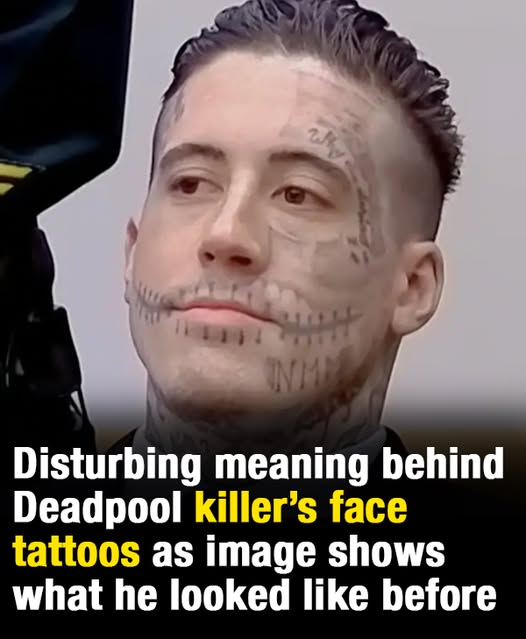
Wilson’s case became especially visible because his physical transformation was so dramatic. His face tattoos became a major topic of conversation, with many people focusing on the meaning and symbolism behind the ink.
The fascination around his appearance does not change the legal facts of the case. He was convicted of killing Kristine Melton and Diane Ruiz and sentenced to death for both murders.
A Dramatic Change in Appearance
When Wilson was first arrested in 2019, his tattoos did not extend beyond his chin. His initial mugshot showed him at age 25 with ink reaching up to his jawline.
At that time, one of the most visible tattoos was the phrase “bred for war” written beneath his chin. That tattoo was already striking, but his face was not yet covered the way it would be in later images.
Later in 2019, Wilson appeared in court with a swastika tattooed on the right side of his face. That change marked the beginning of a more extreme transformation in his appearance.
Over the next five years, his face changed dramatically as more tattoos were added. By the time later images circulated, much of his face had been covered in ink.
The transformation made Wilson more visually recognizable and contributed to the online attention surrounding him. His appearance became part of the public conversation about the case, even as the crimes remained the central reason for his notoriety.
Many people found the tattoos unsettling. The symbols, words, and placement of the ink gave his face a disturbing visual quality that stood out in court images and media coverage.
The Tattoos That Sparked Online Discussion
Among Wilson’s most discussed tattoos are the words ‘HA HA HA’ beneath his left eye. The phrase immediately drew attention because of its placement and tone.
He also has ‘why so serious’ tattooed on his face. The line is known as a quote made famous by the maniacal Joker in Christopher Nolan’s second Batman film, The Dark Night.
Those tattoos added to the disturbing public image surrounding Wilson. Their association with a fictional villain contributed to the way many people interpreted his appearance.
Wilson has also tattooed the area around his mouth in a way that gives the appearance of having been sewn shut. That visual effect became another detail that people online noticed and discussed.
In addition, commenters have speculated about the meaning of the ‘NMM’ tattoo on the left half of his jaw. Some have suggested it could be connected to the Marvel character Deadpool, who receives a similar tattoo in the comics.
The reported symbolism behind the tattoos has been described as disturbing, particularly because of the nature of the crimes for which Wilson was convicted. The tattoos intensified public attention and helped shape the image that has followed him since his arrest.
The Role of the ‘Deadpool Killer’ Nickname
The nickname ‘Deadpool Killer’ is tied to Wilson sharing the same name as the Marvel character Deadpool. That connection gave the case a label that spread easily among people following true crime stories.
Nicknames in criminal cases can make a person more recognizable, but they can also shift attention toward sensational details. In Wilson’s case, the nickname, tattoos, and violent crimes combined to create a case that drew widespread interest.
The Deadpool connection became especially noticeable because of speculation surrounding the ‘NMM’ tattoo. Commenters online linked it to the character, although the discussion remained focused on interpretation of his appearance rather than new facts about the case.
Wilson’s name, tattoos, and statements to investigators all contributed to the public perception of him. That perception grew darker as more images showed the extent of his facial ink.
Still, the nickname is secondary to the reality of the crimes. Wilson was convicted in the first-degree murders of two women and was sentenced to death for both killings.
For those following the case, it remains important to separate the online fascination with his image from the harm caused by his actions.
Disturbing Statements to Police
Wilson’s own words to investigators became some of the most disturbing details in the case. His description of what happened to Diane Ruiz was especially chilling.
He told police that Ruiz had asked for directions and then got into the vehicle. His statement, “That’s all it took,” suggested how little he claimed was needed for the encounter to turn deadly.
His later description of strangling Ruiz was even more disturbing. “I could tell she wanted to get out, so I was like, I’m just going to kill her real quick. Grabbed her by the neck and choked her,” he said.
Those words became central to how many people understood the cruelty of the crime. The statement presented the killing in a casual and horrifying way.
The murder of Melton had already occurred by that point, after Wilson met her at a Cape Coral bar and later went to her home. After killing her, he took her car, which then became part of the events leading to Ruiz’s death.
The timeline showed a chain of violence that began with one victim and then continued with another. It was that pattern, along with the circumstances of the killings, that led to the first-degree murder convictions and death sentence.
Why the Case Continues to Draw Attention
The Wade Wilson case continues to draw attention because it includes several elements that often fuel public interest in true crime. There are brutal murders, disturbing statements, a recognizable nickname, courtroom developments, and a dramatic change in physical appearance.
His face tattoos have become one of the most discussed parts of his public image. Images from different stages of the case show a major transformation from the time of his 2019 arrest to later court appearances.
Online audiences have focused on the symbolism of the tattoos, including the Joker-related wording, the sewn-mouth appearance, the swastika, and the possible Deadpool connection. These details have made his appearance a recurring point of discussion.
The attention from women attempting to contact him in prison also added to public fascination. For many people, that detail appeared shocking given the crimes involved.
At the center of the case, however, are the murders of Kristine Melton and Diane Ruiz. The legal process concluded with Wilson being found guilty and sentenced to death for both killings.
The public attention around Wilson may continue, but the foundation of the case remains the violence that ended two lives in October 2019.
A Case Defined by Violence and Notoriety
Wade Wilson’s notoriety has been shaped by more than one factor. His crimes, nickname, tattoos, and courtroom appearances have all contributed to the public discussion surrounding him.
He entered the wider public consciousness as the ‘Deadpool Killer’, a name linked to a fictional character but attached to a real case involving two murdered women. That contrast between pop culture association and violent reality has made the case particularly unsettling.
His appearance has also become part of the story. From tattoos stopping near his chin at the time of his arrest to the later ink covering much of his face, Wilson’s transformation has been viewed by many as disturbing.
The tattoos beneath his eye, the phrase ‘why so serious’, the sewn-mouth design, the swastika, and the other markings have all drawn attention. They have helped make his image recognizable, but they do not define the legal outcome.
The defining facts remain that Wilson was convicted of the first-degree murders of Kristine Melton and Diane Ruiz in June 2024 and sentenced to death two months later.
His case continues to circulate among true crime followers, but it is ultimately a story of two victims, a violent sequence of events, and a criminal conviction that led to a death sentence.
The attention surrounding Wade Wilson’s tattoos and nickname may explain why the case remains widely discussed, but the lasting weight of the story lies in the lives taken and the legal judgment that followed.