
Trump Immigration Policy Draws Attention to El Salvador’s Controversial CECOT Prison
A Prison at the Center of a Global Debate
Donald Trump’s immigration policy has brought renewed international attention to one of the world’s most controversial prison facilities. El Salvador’s CECOT, formally known as the Centre for the Confinement of Terrorism, has become a central point in a wider debate over deportation, incarceration, public safety, and human rights.
The prison is located about 70 kilometers east of San Salvador. It covers a 23-hectare site and was built as a major part of President Nayib Bukele’s aggressive campaign against gangs.
Opened in February 2023, CECOT was designed to hold up to 40,000 inmates. That capacity makes it the largest prison complex in the Americas.
The facility cost approximately $115 million and has become one of the most visible symbols of Bukele’s security strategy. His approach has been credited by supporters with helping drive a sharp drop in homicide rates across El Salvador.
At the same time, critics have warned that the methods used to achieve that change carry serious risks. Mass arrests, harsh detention conditions, and limited legal protections have raised concerns among human rights advocates and international observers.
CECOT now stands at the center of those competing narratives. To supporters, it represents strength against violent criminal organizations. To critics, it represents a dangerous model of punishment without meaningful safeguards.
Bukele’s Security Strategy
President Nayib Bukele has built much of his political identity around the promise of restoring order in El Salvador. His government’s crackdown on gangs has reshaped daily life in the country and drawn major attention abroad.
Supporters argue that the strategy has improved public safety in communities long affected by gang violence. They point to falling homicide rates as evidence that the policy has worked.
For many Salvadorans, the promise of safer streets carries enormous significance. The country’s history of gang control, extortion, and violence created conditions in which public security became a dominant national issue.
However, the same policies have also generated alarm. Critics argue that the crackdown has allowed authorities to arrest large numbers of people without sufficient evidence.
They warn that individuals may be swept into the prison system through broad accusations, weak due process, or association-based suspicion. Those concerns have made CECOT more than a prison. It has become a symbol of the tradeoff between security and rights.
The scale of the facility and the severity of its conditions have intensified the debate. Its size alone reflects a system built for mass confinement rather than ordinary detention.
A Facility Built for Isolation
The prison’s design has drawn close scrutiny. Analysts from the SAIS Review of International Affairs have described the facility as one that prioritizes “security and isolation over rehabilitation, reflecting a punitive approach to incarceration.”
That description captures one of the main criticisms of CECOT. The prison is not presented as a place focused on reintegration, education, or rehabilitation.
Instead, it is built around containment. Security, control, and isolation appear to define its purpose.
Former United Nations Subcommittee for the Prevention of Torture member Miguel Sarre described the mega prison in stark terms during an interview with the BBC. He called it a “concrete and steel pit.”
That phrase has become part of the larger criticism surrounding the facility. It reflects the fear that CECOT is not merely harsh, but intentionally designed to remove people from society under conditions that may offer little hope of return.
Critics have warned that such a model can create long-term human rights concerns, especially if prisoners are held without transparent legal processes or meaningful oversight.
Trump’s Deportation Policy Enters the Picture
The controversy surrounding CECOT expanded beyond El Salvador when Bukele offered the Trump administration a deal to hold “dangerous criminals” deported from the United States in the prison.
The proposal aligned with Trump’s hardline immigration position and his public focus on removing foreign nationals accused of crimes. It also linked U.S. immigration enforcement to one of the most severe detention systems in the region.
Trump used a little-known 18th-century wartime law to justify deporting foreign nationals accused of crimes in the United States. His administration argued that the country faced an “invasion” by violent organizations.
The use of that legal argument intensified the controversy. Critics questioned whether such a law should be used in immigration enforcement and whether accused individuals were receiving proper legal protections before being transferred abroad.
The arrangement also raised questions about accountability. Once deported individuals were sent to CECOT, observers questioned what rights, access, or oversight they would have inside the Salvadoran prison system.
The matter became not only a domestic immigration issue, but also an international human rights concern.
A $6 Million Arrangement
According to Reuters, the White House paid roughly $6 million to imprison about 300 alleged violent criminals in El Salvador for one year.
That reported payment added another layer to the debate. The arrangement suggested that the United States was not only deporting individuals, but also funding their detention in a foreign prison known for extreme conditions.
Supporters of the approach argued that dangerous people should be removed from the United States and held securely. They viewed the policy as a strong deterrent against criminal activity by foreign nationals.
Opponents argued that sending people to CECOT could expose them to abuse, indefinite detention, and conditions that violate international standards. They also raised concerns about whether all deportees had been properly convicted or whether some were accused rather than proven guilty.
The issue became even more charged after public warnings from officials tied the policy directly to fear of ending up in the Salvadoran prison.
Kristi Noem, the former Secretary of Homeland Security, issued a blunt message in March 2025.
“President Trump and I have a clear message to criminal illegal aliens: LEAVE NOW,” she warned in a social media post.
“If you do not leave, we will hunt you down, arrest you, and you could end up in this El Salvadorian prison.”
Legal Challenges and Deportation Flights
The deportations also sparked legal challenges. A federal judge attempted to block the transfers, but the ruling came after flights were already in international airspace.
The administration maintained that its actions were lawful. Critics, however, argued that the timing raised serious questions about whether judicial review had been effectively bypassed.
The episode highlighted the tension between executive immigration enforcement and legal oversight. When deportation flights are already in motion, attempts to stop them can become difficult in practice.
That practical reality has deep consequences. Once individuals are transferred to another country and placed inside a prison like CECOT, legal remedies may become far more complicated.
For human rights advocates, this is one of the most troubling parts of the policy. They argue that deportation should not become a pathway to detention conditions that would be unacceptable under U.S. standards.
The administration’s defenders have continued to frame the policy as necessary for public safety. Its critics see it as an escalation with severe human consequences.
A “Black Hole of Human Rights”
Human rights groups and international observers have strongly criticized the arrangement involving CECOT. Reports cited by the BBC describe the facility as a “black hole of human rights.”
That description reflects concerns that international standards for prisoner treatment are not being followed inside the prison. Observers have raised questions about crowding, isolation, lack of rehabilitation, and limited outside access.
Miguel Sarre also offered one of the most severe warnings about the prison’s function. He said it appears to operate as a system “to dispose of people without formally applying the death penalty.”
The statement underscores fears that once prisoners enter CECOT, they may have little realistic chance of leaving. Critics argue that a prison system built on permanent isolation can become a form of social disappearance.
The concern is not only about harsh punishment. It is about whether detainees retain any meaningful rights, legal recourse, or path toward release.
When such a system is connected to deportations from the United States, the controversy becomes even broader. It raises questions about whether one country can outsource punishment to another under conditions critics describe as extreme.
Inside CECOT
Descriptions from inside CECOT reinforce its reputation as one of the most severe detention facilities in the world. During a 2024 tour of the prison, BBC correspondent Leire Ventas was told by a prison director that the inmates represented the country’s most dangerous people.
“Here are the psychopaths, the terrorists, the murderers who had our country in mourning,” the prison director said.
That framing reflects the official view of the prison as a place built to contain people considered severe threats to society. The language used by officials emphasizes danger, control, and punishment.
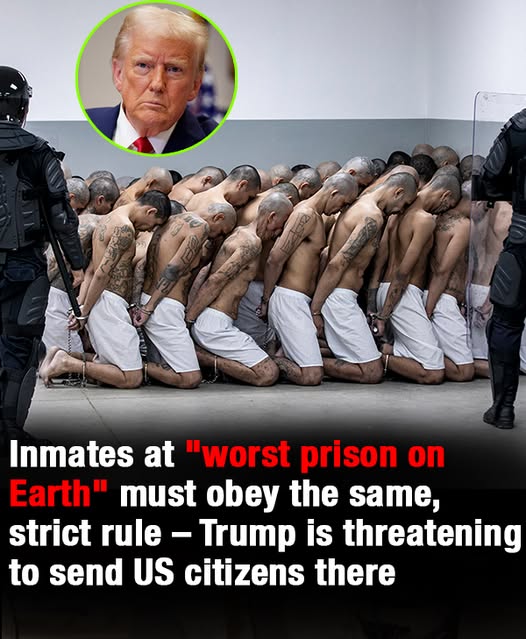
Daily life inside the facility appears tightly regulated. Uniformity is one of the most visible features.
All inmates must wear white shirts and shorts. Their heads are shaved every five days to maintain a standardized appearance.
The result is a prison environment designed to erase individuality and impose total control. Inmates appear as part of a mass system rather than as separate individuals.
Packed Cells and Strict Conditions
Ventas described rows of inmates with shaved heads packed tightly together. The image has helped shape CECOT’s reputation as an extreme and highly controlled prison environment.
During her visit, she asked the prison director about the maximum capacity of each cell. The director, who chose not to be named, gave a response that reinforced concerns about crowding.
“Where you can fit 10 people, you can fit 20,” he said.
The cells are described as windowless, with bare metal bunks and no mattresses. Such conditions leave little room for comfort, privacy, or normal human routine.
Surveillance is constant. Cameras and guards monitor prisoners closely, tracking movement and behavior throughout the facility.
Prisoners reportedly spend 23.5 hours each day confined to their cells. They receive only 30 minutes of exercise in a windowless corridor.
The level of confinement reflects the prison’s central purpose: restriction, containment, and control.
Minimal Food and Few Possessions
There is little for prisoners to do inside the cells. Each crowded cell reportedly contains only two Bibles.
Meals are minimal and consist of simple foods such as rice, beans, hard-boiled eggs, or pasta. Prisoners reportedly eat by hand because utensils are not provided.
The prison director explained the rule by pointing to security concerns.
“Any utensil can be [fashioned into] a deadly weapon,” said the director.
That explanation reflects the prison’s overall philosophy. Every object is viewed through the lens of control and potential threat.
Critics argue that such conditions reduce inmates to survival rather than rehabilitation. Supporters may argue that strict rules are necessary because the prison holds extremely dangerous individuals.
The divide between those two views is at the heart of the CECOT debate.
Deportees Describe Abuse
Accounts from deportees have added further alarm to the controversy. One deportee told 60 Minutes that arriving at CECOT felt like entering a place of suffering and hopelessness.
“When you get there, you already know you’re in hell. You don’t need anyone to tell you,” the deportee said.
He claimed that guards beat him so severely when he arrived that one of his teeth was knocked out.
The college student made the comments in a leaked segment of a controversial CBS report that was abruptly pulled from the air at the last minute.
The report included interviews with migrants sent to El Salvador’s Terrorism Confinement Center under Trump’s immigration crackdown.
Two deportees reported torture, beatings, and abuse, according to PBS. A Venezuelan man said he was subjected to sexual abuse and placed in solitary confinement as punishment.
These allegations have intensified scrutiny of the policy and the conditions facing deportees inside the prison.
A Prison Designed to Frighten
CECOT’s reputation is built not only on its size, but on the message it sends. The facility is designed to project severity.
Its scale, concrete structure, military-style order, shaved prisoners, and tightly controlled routines all contribute to an image of absolute state power.
For Bukele’s government, that image functions as part of the anti-gang campaign. It signals that the state is no longer willing to tolerate criminal organizations.
For Trump’s immigration policy, the prison has also become a warning. The message from officials has been that deported individuals accused of serious crimes could end up inside CECOT.
This use of the prison as a deterrent has drawn criticism from those who argue that fear should not replace due process. They say punishment must still be governed by law, rights, and evidence.
The controversy shows how a prison can become both a physical facility and a political symbol. CECOT is being used to communicate power, consequence, and control.
Supporters Point to Public Safety
Supporters of Bukele’s policies argue that El Salvador’s security situation demanded extraordinary action. They point to the sharp decline in homicide rates as evidence that the crackdown has saved lives.
For people who lived under the threat of gangs, the reduction in violence is not an abstract statistic. It can mean the ability to travel, work, open businesses, and live without constant fear.
Supporters of Trump’s deportation strategy make a similar argument from the perspective of U.S. public safety. They say dangerous individuals who are in the country unlawfully should be removed and prevented from harming communities.
From that viewpoint, CECOT represents a hard but necessary tool. Its harshness is seen as a feature, not a flaw.
However, critics respond that public safety cannot justify indefinite abuse or the removal of legal protections. They argue that a system can reduce crime while still violating rights.
The debate therefore centers on whether the ends justify the means, and what limits should exist even in the name of security.
Critics Warn About Due Process
One of the most serious concerns around both Bukele’s crackdown and Trump’s deportation policy involves due process. Critics worry that people may be detained or deported without sufficient evidence or a meaningful chance to challenge accusations.
When individuals are sent to a prison described by critics as a “black hole of human rights,” those concerns become even more urgent.
The question is not only whether some detainees are dangerous. It is whether every person sent there has been properly identified, lawfully processed, and given access to legal protections.
Mass enforcement systems can create mistakes. In the context of CECOT, a mistake could mean being sent into extreme confinement with little practical recourse.
This is why human rights groups continue to focus on transparency, oversight, and legal standards. They argue that security policy must not eliminate the basic protections that prevent wrongful punishment.
The issue is especially difficult when deported individuals are moved across borders, placing them under another government’s prison system.
A Debate With International Consequences
The connection between Trump’s immigration policy and CECOT has turned a Salvadoran prison into an international issue. What began as a domestic security project under Bukele is now tied to U.S. immigration enforcement.
This creates broader questions about cooperation between governments. When one country pays another to hold deportees, responsibility becomes harder to define.
Critics ask who is accountable if detainees are abused. Is responsibility held by the country that operates the prison, the country that sent them there, or both?
Supporters of the arrangement may argue that sovereign governments have the right to cooperate against violent criminals. Opponents say cooperation cannot become a way to avoid legal or human rights obligations.
The debate is likely to continue as long as deportees remain connected to the facility. The prison’s conditions, legal status, and treatment of inmates will remain under scrutiny.
A Symbol of Security and Fear
CECOT has become one of the most powerful symbols of modern hardline security policy. To some, it represents order restored after years of gang violence.
To others, it represents a dangerous collapse of human rights in the name of public safety.
Trump’s immigration policy has brought that debate into sharper global focus. By connecting deportation from the United States to confinement in El Salvador’s mega prison, the policy has raised questions about punishment, legality, and moral responsibility.
The prison’s defenders point to reduced violence and the removal of dangerous people from the streets. Its critics point to crowding, isolation, abuse allegations, and the possibility that some detainees may never leave.
The accounts from inside CECOT describe a world of shaved heads, white uniforms, bare metal bunks, constant surveillance, minimal meals, and near-total confinement.
For those sent there from the United States, the prison is more than a distant symbol. It is the place where they may spend months or years under conditions that human rights observers continue to condemn.
The Larger Question Behind CECOT
The controversy surrounding CECOT and Trump’s deportation policy raises a larger question: how far should governments go in the name of security?
El Salvador’s government argues that aggressive action was necessary to confront gangs. Trump’s administration argued that deporting alleged violent criminals to the facility protected the United States.
But critics warn that policies built on fear, mass detention, and severe confinement can cross lines that democratic societies should not accept.
The central issue is not whether crime should be addressed. It is whether the response preserves basic legal and human rights protections.
CECOT’s scale and conditions have made it a global example of that tension. It stands as both a monument to state power and a warning about what can happen when punishment is pushed to extremes.
As the debate continues, the prison remains under close international attention. Its role in U.S. deportation policy ensures that questions about its conditions will not remain confined to El Salvador.
For now, CECOT remains one of the most controversial prisons in the world: praised by some as a weapon against violence and condemned by others as a place where human rights disappear behind concrete and steel.