
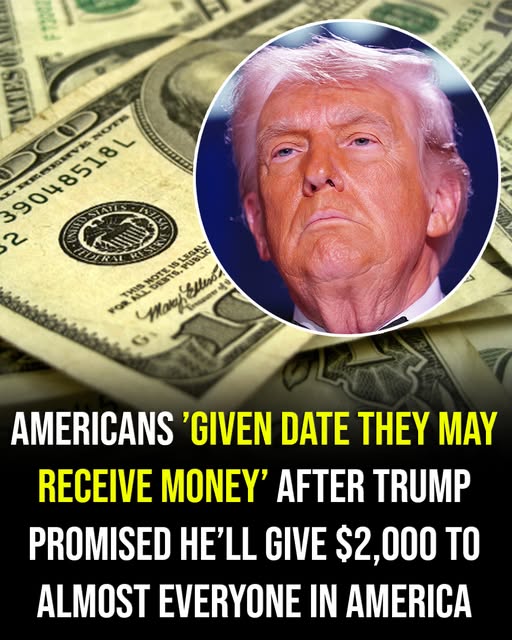
Proposed $2,000 Tariff Dividend Remains Unapproved as Public Debate Continues
Renewed Attention on a Possible Direct Payment
Recent political discussion in the United States has brought new attention to the possibility of a $2,000 payment for eligible Americans.
The idea has sometimes been described as a “tariff dividend,” because it is based on the concept of using money collected from tariffs on imported goods to fund direct payments to citizens.
President Donald Trump has publicly referenced the proposal in speeches and social media posts. In those remarks, he suggested that revenue from tariffs could be returned to Americans through direct financial payments.
Despite the attention surrounding the idea, the proposal has not become an active federal program. It has not been formally introduced as legislation, and Congress has not approved any payment plan connected to tariff revenue.
As a result, there is currently no official payment system, no confirmed eligibility process, and no scheduled distribution date for such a payment.
A Political Proposal, Not an Active Program
The $2,000 tariff dividend remains a political concept rather than a functioning government policy.
For a nationwide payment program to exist, federal agencies would need clear legal authority, approved funding, and instructions for distribution. None of those requirements have been completed for this proposal.
That means Americans should not view the payment as guaranteed or pending. No official federal agency has announced that checks, deposits, or other forms of payment are being prepared.
The idea could continue to be discussed in political speeches and policy debates, but discussion alone does not create a program.
Its future would depend on legislative action, budget decisions, administrative planning, and legal approval.
What Tariffs Are
Tariffs are taxes placed on imported goods.
They are commonly used as part of trade policy and may be intended to encourage domestic production, influence foreign trade behavior, or regulate the flow of goods into the country.
When tariffs are collected, the revenue goes to the federal government. That money becomes part of federal income and may be used for government priorities depending on budget laws and spending decisions.
The tariff dividend proposal is built around the idea that this revenue could be redirected to citizens in the form of direct payments.
However, moving tariff revenue into personal payments would require a formal legal structure. The government would need to define who qualifies, how much they receive, how payments are funded, and which agency manages distribution.
How Tariffs Relate to the Payment Idea
The term “tariff dividend” refers to the proposed redistribution of tariff revenue to American citizens.
In theory, if the federal government collects significant revenue from import taxes, lawmakers could decide to use some of that money for direct public payments.
That idea is different from an automatic system. Tariff money does not automatically flow to households once it is collected.
Federal spending must follow legal and budgetary rules. A direct payment program would need authorization before the Treasury Department or another agency could distribute funds.
Without those steps, the proposal remains conceptual. The presence of tariff revenue does not by itself create a legal right to receive a payment.
Public Statements About the Proposal
Donald Trump has referred to the idea of tariff-funded payments in public statements and online posts.
In those discussions, he described the possibility of sending money to certain Americans while excluding higher-income individuals.
That detail suggests the proposal could include income limits if it were ever developed into a formal plan.
However, no finalized eligibility rules have been released. There is no official income threshold, no application system, and no payment schedule.
The public comments have generated interest, but they have not been followed by an approved policy framework.
No Confirmed Treasury Plan
Officials within the U.S. Treasury, including Scott Bessent, have not confirmed an active policy process for tariff dividend payments.
Public statements from financial and government representatives indicate that no formal plan has been completed.
There is also no sign that an administrative payment process has begun.
This is important because federal payment programs require extensive preparation. Agencies must create systems for verifying eligibility, preventing duplication, sending funds, handling errors, and answering public questions.
No such system currently exists for the proposed $2,000 tariff dividend.
Why Congressional Approval Matters
In the United States, large federal payment programs generally require approval from Congress.
Congress must authorize funding, set the rules, and provide agencies with the legal authority to act.
This applies to nationwide direct payments because they involve major federal spending and distribution of public money.
Without congressional approval, federal agencies cannot simply create a large payment program based on political statements or general revenue collections.
For the tariff dividend proposal to move forward, lawmakers would need to pass legislation defining the program and authorizing the use of funds.
No Law Has Been Passed
As of now, no legislation has been passed to create a $2,000 tariff-funded payment.
No law has established who would qualify, how payments would be calculated, or how the program would be funded.
No federal agency has been instructed to begin distributing tariff dividends.
This makes the proposal structurally incomplete under current U.S. law.
Even if political support grows, the idea would still need to pass through the formal legislative process before any payment could be issued.
The Scale of the Potential Cost
Economists and policy analysts have discussed the possible cost of sending $2,000 payments to eligible Americans.
Depending on the number of people included, the total price could reach hundreds of billions of dollars.
The final cost would depend on the eligibility rules. A payment limited to lower- and middle-income individuals would cost less than a payment sent to nearly all adults.
Income thresholds, household size, citizenship or residency rules, and participation levels would all affect the overall expense.
Because no formal plan exists, all cost estimates remain based on assumptions rather than official program details.
Tariff Revenue Can Fluctuate
One major economic issue is that tariff revenue is not always stable.
The amount collected can change depending on trade volume, consumer demand, import patterns, global supply chains, and broader economic conditions.
If imports decline, tariff revenue may also fall. If trade patterns shift, collections can change again.
This creates a challenge for any proposal that would use tariff revenue to fund fixed nationwide payments.
A direct payment program requires predictable funding. If revenue changes from year to year, lawmakers would need to determine how to cover any shortfall.
Fiscal Challenges of a Tariff Dividend
Matching variable tariff income with fixed payments could create serious budget questions.
If the government promises $2,000 payments to eligible citizens, it must ensure that enough money is available to cover the full cost.
If tariff revenue is lower than expected, the government would need another funding source or would need to reduce the payment amount.
Economists often examine whether a proposal can be sustained over time, especially when it involves large-scale federal spending.
For a tariff dividend to become a long-term policy, lawmakers would need to plan for changing economic conditions and uncertain revenue.
How Federal Payment Programs Usually Work
Large federal payment programs typically follow a formal process.
First, Congress passes legislation. Then federal agencies develop the rules and systems needed to deliver the payments.
During past emergency payment programs, direct financial assistance was implemented through legislative acts and distributed through established federal agencies.
Such systems often rely on tax records, income data, identification rules, and payment infrastructure.
A tariff dividend program would likely need a similar structure before money could reach recipients.
The Likely Role of Federal Agencies
If a tariff dividend program were ever approved, federal agencies would likely be responsible for managing distribution.
That would require eligibility verification, income screening, fraud prevention, payment delivery, and public communication.
The government would also need to determine whether payments would be sent by direct deposit, paper checks, prepaid cards, or another method.
Administrative planning would be especially important because a nationwide program could involve millions of people.
Without that structure, payment distribution would not be operationally possible.
Public Interest and Political Debate
The proposal has generated public attention because it involves direct payments to individuals.
Supporters view the concept as a way to return government revenue to taxpayers. They argue that if tariffs generate money, citizens could benefit from that revenue directly.
Critics raise questions about feasibility, legal authority, economic impact, and budget sustainability.
The debate also reflects broader disagreements about tariffs themselves. Some view tariffs as a useful trade tool, while others worry they can raise costs for businesses and consumers.
Because the proposed payment depends on tariff revenue, discussions about the dividend are closely tied to larger debates about trade policy and taxation.
Questions About Legal Authority
Some public remarks have suggested that payments might be possible without congressional approval through alternative funding mechanisms.
However, large federal expenditures generally require legislative authorization under the U.S. budget system.
This means a direct payment program funded by tariff revenue would still need a legal basis.
Without approved legislation, federal agencies would not have clear authority to send payments on a national scale.
That legal issue is one of the main reasons the proposal has not moved beyond public discussion.
No Confirmed Funding Source
There is no officially defined funding source for a $2,000 tariff dividend.
Although tariff revenue is the central idea behind the proposal, no law has directed that revenue into a payment fund.
There is also no approved budget allocation for the payments.
For the program to become real, lawmakers would need to decide whether tariff revenue is sufficient and whether additional federal funds would be needed.
Until that happens, the proposal remains unfunded.
Media Coverage and Public Confusion
Media coverage of the idea has varied.
Some reports have focused on political statements promoting the payment, while others have emphasized the lack of legislation and the economic challenges involved.
When proposals are discussed publicly before formal details exist, confusion can spread quickly.
People may hear a dollar amount and assume a payment is already scheduled, even when no program has been approved.
Because of that, it is important to separate political messaging from official government action.
No Timeline for Distribution
There is currently no confirmed timeline for any $2,000 tariff dividend payment.
No agency has announced when payments would begin, because no program has been created.
There are also no official deadlines, application dates, or eligibility notices.
Any claim about a specific payment date would be speculative unless backed by formal government action.
For now, the proposal remains part of ongoing political and economic discussion rather than an active payment plan.
What Would Need to Happen Next
Several steps would be required before any tariff dividend could become reality.
Lawmakers would need to draft and introduce legislation creating the program. Congress would then need to debate and pass the measure.
The legislation would need to define eligibility, payment size, income limits, funding sources, and administrative responsibilities.
After approval, federal agencies would need time to build or adapt systems to distribute the money.
Only after those steps could payments be scheduled and issued.
Why Eligibility Rules Matter
Eligibility rules would be one of the most important parts of any future program.
Public discussion has suggested that higher-income individuals could be excluded, but no official income limits have been set.
Lawmakers would need to decide whether payments apply to individuals, households, taxpayers, dependents, or other categories.
They would also need to define how income is measured and which records are used to verify it.
Without these rules, it is impossible to know who would qualify or how much the program would cost.
Trade Policy and Household Payments
The tariff dividend proposal connects trade policy with direct household support.
This connection is politically significant because tariffs are usually discussed in terms of imports, domestic production, and international competition.
Using tariff revenue for direct payments would shift the conversation toward redistribution of federal income.
That raises questions about whether tariffs should be used primarily as trade tools, revenue sources, or public benefit mechanisms.
These questions remain unresolved in the current debate.
An Idea Still Awaiting Formal Action
The proposed $2,000 tariff dividend remains an idea under public discussion.
It has been mentioned by Donald Trump, debated by commentators, and examined by economists and policy observers.
However, it has not been approved, funded, or scheduled.
No federal payment program exists, and no official process is underway to distribute checks or deposits to Americans under this proposal.
The difference between political discussion and enacted policy remains central to understanding the issue.
Conclusion: No Official Payment Plan Exists
The idea of sending $2,000 tariff-funded payments to eligible Americans has attracted attention, but it remains a proposal rather than a government program.
Tariff revenue can be collected by the federal government, but using it for direct payments would require legal authorization, congressional approval, and an administrative structure.
At this time, none of those pieces are in place.
There is no confirmed timeline, no eligibility system, no application process, and no official payment plan.
The proposal may continue to be discussed as part of broader debates about trade policy, taxation, federal spending, and economic strategy.
Until formal legislation is passed and agencies are directed to act, the $2,000 tariff dividend remains a political concept, not an approved benefit.