
Trump, Pope Leo XIV, and a Rising Global Clash Over Morality, Power, and War
A Political Dispute That Became a Moral Confrontation
Donald Trump’s clash with Pope Leo XIV has developed into a broader confrontation that extends far beyond political disagreement or isolated remarks. What began as a sharp exchange of criticism has evolved into a symbolic struggle over moral authority in a world shaped by ongoing conflict and competing visions of leadership.
The tension is rooted in fundamentally different interpretations of responsibility during war and crisis. On one side stands a political figure whose public identity is closely tied to themes of strength, national interest, and decisive action. On the other is a religious leader whose role emphasizes moral reflection, human dignity, and the ethical limits of power.
When these two frameworks collide, the result is not simply disagreement but a deeper challenge over who has the authority to define what is acceptable, justified, or necessary in moments of global violence.
The Pope’s Condemnation and the Question of Civilian Harm
The situation intensified when Pope Leo XIV condemned the bombing of civilian infrastructure and spoke against what he described as the “idolatry of self and money.” This statement went beyond political critique and entered the realm of moral philosophy, directly questioning the values that guide decision-making during war.
The condemnation of civilian infrastructure attacks placed human suffering at the center of the discussion. By highlighting the impact on non-combatants, the Pope’s message reframed the conflict not in terms of strategy or victory, but in terms of human cost and ethical responsibility.
The phrase “idolatry of self and money” added another layer to the criticism, suggesting that deeper motivations behind political and military decisions may be tied to pride, power, and material interest rather than moral duty. This framing challenged not only specific actions but also the broader mindset that can shape policy choices in times of conflict.
For supporters of more forceful approaches to geopolitical crises, such statements are often interpreted as interference in political judgment. For others, they represent a necessary reminder that moral boundaries must remain present even during war.
Giorgia Meloni’s Response and Political Alignment Pressures
The reaction from Giorgia Meloni added a further dimension to the unfolding dispute. By describing Trump’s words as “unacceptable,” she signaled discomfort with the direction and tone of the exchange. Her response highlighted the sensitivity of political alliances when moral and strategic disagreements emerge at the highest levels of leadership.
This reaction also reflected the broader pressure faced by political figures who must navigate relationships between influential global actors while maintaining domestic and international credibility. In moments of heightened tension, even leaders who may share certain political interests can find themselves diverging on issues of public morality and rhetoric.
The use of the term “unacceptable” emphasized the seriousness of the disagreement. It suggested that the boundaries of acceptable political discourse had been crossed, at least in the view of those concerned with maintaining diplomatic stability and moral consistency in public communication.
Such responses illustrate how quickly individual statements can escalate into broader diplomatic and ideological friction, especially when they intersect with ongoing global conflicts and sensitive humanitarian issues.
JD Vance and the Clash Over Theological Authority
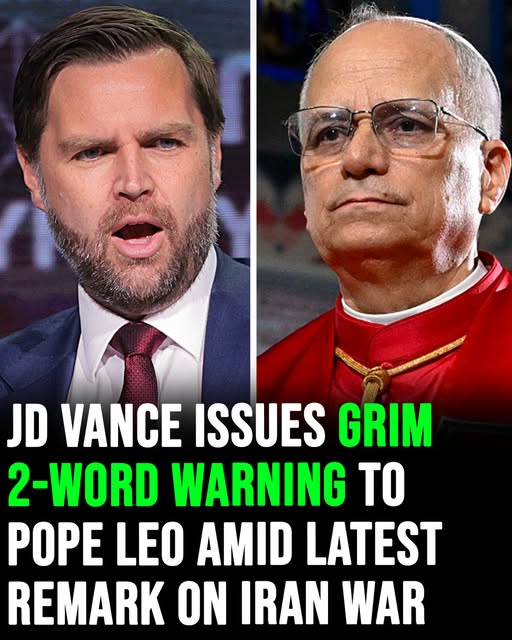
The situation became even more complex following JD Vance’s response. As a Catholic convert, his intervention carried symbolic weight, particularly because it involved directly addressing the Pope on matters of theology and moral interpretation.
His message framed the Pope’s comments as overstepping into areas outside his role, effectively challenging the idea that religious authority should shape or critique political decision-making. By suggesting that the Pope should remain within a defined scope, the response inverted traditional expectations about the relationship between spiritual leadership and political power.
This exchange introduced a new layer of tension: not only was there disagreement over policy and war, but also over who holds the authority to define moral truth itself. The implication that political figures may be the final arbiters of truth represents a significant shift in how authority is framed in public discourse.
At the same time, the response invoked historical references to World War II, attempting to place current conflicts within a narrative of justified struggle and necessary resistance. This framing seeks to align present actions with historical moments widely understood as morally justified, even when involving significant destruction and sacrifice.
However, this interpretation does not directly address the central concern raised by the Pope: the human cost of war, particularly the suffering of civilians. The emphasis remains on justification and historical parallel rather than on immediate humanitarian impact.
The Core Dispute: Morality Versus Strategy
At the heart of this confrontation lies a fundamental disagreement over how morality interacts with political and military strategy. One perspective prioritizes strategic necessity, national security, and historical precedent as guiding principles for action. The other emphasizes moral restraint, human dignity, and the protection of innocent life regardless of strategic goals.
These perspectives are not easily reconciled because they operate on different assumptions about responsibility and consequence. In one view, difficult decisions in war may be justified if they lead to perceived greater stability or security. In the other, certain actions remain unacceptable regardless of outcome if they result in significant harm to civilians.
The Pope’s focus on civilian suffering places ethical limits at the center of the discussion, challenging the idea that strategic objectives alone can justify widespread destruction. This position calls attention to the immediate human reality of conflict rather than its long-term geopolitical framing.
In contrast, political responses that emphasize strength and historical comparison often seek to contextualize present actions within broader narratives of necessity, survival, or defense. This creates a tension between abstract justification and direct moral concern.
The Image of Strength and Its Moral Challenges
Donald Trump’s political identity is closely associated with an image of strength, decisiveness, and assertive leadership. This image resonates strongly with supporters who value direct action and clear prioritization of national interests.
However, the Pope’s condemnation of certain wartime actions introduces a moral counterweight to that image. By focusing on civilian harm and ethical limits, the critique challenges the idea that strength alone is sufficient justification for any outcome.
The phrase “idolatry of self and money” intensifies this challenge by suggesting that power and material interests can distort moral judgment. In this framing, strength without ethical grounding becomes vulnerable to criticism as self-serving rather than protective or just.
This creates a broader cultural and ideological conflict over what leadership should represent. Is leadership defined primarily by effectiveness and decisiveness, or by adherence to moral principles even when they complicate or constrain action?
Civilian Suffering at the Center of the Debate
One of the most significant elements of this dispute is the emphasis on civilian suffering. The condemnation of bombing civilian infrastructure brings attention to individuals who are not directly involved in military decision-making but are deeply affected by its consequences.
This focus shifts the discussion away from abstract strategy and toward immediate human impact. It raises questions about how responsibility is assigned in situations where non-combatants are affected by actions taken in the name of political or military objectives.
The repeated emphasis on children, the elderly, and the sick highlights the vulnerability of those least able to influence or escape conflict. Their presence in the moral argument serves as a reminder that war is not only a matter of states and leaders but also of ordinary lives disrupted or destroyed.
This perspective challenges frameworks that prioritize strategic necessity by insisting that ethical evaluation must include those who bear the consequences without participating in the decisions.
Competing Narratives of Justification
The dispute also reflects competing narratives about how to interpret war itself. One narrative frames conflict as a continuation of historical struggles where difficult actions may be necessary to achieve security or justice. This approach often relies on comparison with past global conflicts to establish moral legitimacy.
Another narrative rejects this framing, arguing that each instance of civilian harm must be evaluated on its own terms, regardless of historical analogy. From this perspective, referencing past wars does not eliminate present ethical responsibility.
These narratives exist in tension because they lead to different conclusions about the acceptability of certain actions. One emphasizes continuity and precedent, while the other emphasizes immediate ethical accountability.
The disagreement between these interpretations contributes to the broader instability of the debate, making resolution difficult as each side operates from a different moral framework.
Conclusion: A Dispute Over Who Defines Moral Limits
The confrontation involving Donald Trump, Pope Leo XIV, Giorgia Meloni, and JD Vance represents more than a disagreement over specific statements. It reflects a deeper struggle over the boundaries of moral authority in a world shaped by conflict.
At its core, the dispute raises a fundamental question: who has the right to define the limits of acceptable action during war? Is it political leaders, guided by strategy and national interest, or religious and moral voices emphasizing human dignity and ethical restraint?
The Pope’s focus on civilian suffering challenges political narratives that prioritize strength and historical justification. The political responses, in turn, challenge the scope of religious authority in shaping public judgment on matters of war and policy.
This ongoing tension reveals a broader global uncertainty about how morality, power, and responsibility intersect. As long as these frameworks remain in conflict, similar disputes are likely to continue emerging whenever political decisions collide with ethical expectations.
In the end, the debate is not only about words spoken by leaders, but about the deeper question of whose suffering is acknowledged, whose perspective is prioritized, and who ultimately gets to define what it means to act rightly in a world marked by violence and division.