
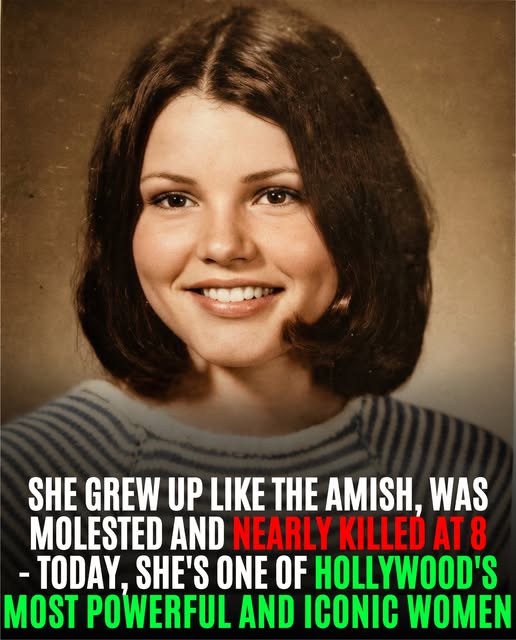
Geena Davis: From Sheltered New England Childhood to a Defining Hollywood Career
A Quiet and Strict Upbringing in New England
Born on January 21, 1958, in Wareham, Massachusetts, she grew up in a household shaped by discipline, simplicity, and limited exposure to the outside world. From an early age, she felt drawn to performance and storytelling, sensing that entertainment would become a central part of her life.
She once reflected on those earliest memories of wanting to perform, saying, “I was three years old, and how I even knew it was a job, I have no idea, because we were only allowed to watch Disney movies, which were animated.”
Her parents, Bill and Lucille, maintained a practical and traditional lifestyle that heavily influenced her childhood environment. She once described them as so old-fashioned that they “would have been Amish had they heard of being Amish.”
Life at home emphasized discipline and manners, along with a strong sense of routine. She and her older brother, Dan, were raised with a focus on politeness and proper behavior in all situations.
Looking back on her upbringing in New England, she described a household built on self-sufficiency and minimal outside influence. “My parents are both from Vermont, very old-fashioned New England. We heated our house with wood my father chopped. My mom grew all of our food. We were very underexposed to everything.”
A Childhood Experience That Left a Lasting Mark
Despite the quiet and sheltered environment of her early years, she experienced moments of genuine danger that shaped her understanding of responsibility and voice.
At just eight years old, she was involved in a frightening car ride with her 99-year-old great-uncle Jack. During the drive, the vehicle drifted repeatedly into oncoming traffic while she sat silently alongside her parents. In one near-catastrophic moment, an approaching car sped toward them before Jack corrected the steering at the last second, narrowly avoiding a head-on collision.
That experience left a lasting impression on her, particularly about the difficulty of speaking up in tense situations, especially when politeness and silence feel expected.
Later in life, that theme became central to her memoir, Dying of Politeness, where she examined how early conditioning can influence behavior in critical moments.
Childhood Trauma and the Weight of Silence
She also revealed another deeply distressing experience from her childhood involving a neighbor who assaulted her while she was delivering his newspaper. At the time, she did not fully understand what had occurred or its significance.
She later spoke about the emotional confusion that followed, saying, “It caused a lot of shame in me that that happened because I didn’t know what he was doing when he was touching me in that way. I didn’t know that it was wrong. I had no reaction to it, and then to see my mother’s reaction, [it was like], ‘Oh, my God, this was a big deal. I did something terribly wrong,” she told Vanity Fair.
Her mother confronted the neighbor directly and instructed him to never touch her again. However, no formal report was made, and the situation was not fully explained to her at the time.
She later reflected on how the lack of explanation created confusion and emotional isolation. “I knew that he was also to blame because she strolled up the street and told him never to touch me again and then told me never to go up the stairs to his apartment again. But she didn’t explain what had happened or why it was bad to do the thing that he was doing, so it just felt like this horrible secret that I was carrying around.”
That experience shaped a long-lasting internal belief about silence and self-restraint. “My big lesson in life was you can’t ever complain about anything,” she said.
She added, “You can’t draw that kind of attention to yourself by complaining about something. So I didn’t talk about it, but I wanted to talk about it.”
Standing Out in School and Early Self-Consciousness
During her school years, her height became a defining feature that set her apart from classmates. While she later embraced it as part of her identity, at the time it contributed to feelings of insecurity and discomfort.
She explained her experience with school sports and physical education, saying, “They always wanted me on the basketball team, but I wasn’t too good,” she told The Chilliwack Progress in 1985. “Track was my thing. I did high jumps and hurdles on the girls’ team. But it was hopeless if you were taller than everybody else.”
She also reflected on her self-image during adolescence, stating, “I was tall from minute one,” she later told The View. “I was very self-conscious and shy, and the last thing I wanted to do was stand out, and yet, every minute, I stood out.”
Her height also made her a target for teasing among classmates. “The boys’ nickname for me in high school was Kareem Abdul-Jabbar, which, you know, is so charming,” she recalled.
Outside of athletics, she participated in music by playing flute in the marching band. During her senior year, she also studied abroad in Sweden, where she became fluent in the language.
Education, Independence, and Early Career Steps
She initially attended New England College in New Hampshire before transferring to Boston University to study drama. Her parents supported her academic choices, despite uncertainty about the practicality of an acting career.
She later explained their perspective on her ambitions, saying, “I think they knew so little about it, and it would be incredibly rare and freaky if I was able to have a successful career,” she told The Gentle Woman.
After finishing her studies, she moved to New York City in 1977, where she worked a variety of jobs including window mannequin, sales clerk, and waitress while pursuing modeling opportunities.
She eventually signed with the Zoli Agency and appeared in the Victoria’s Secret catalog, a step that helped open doors into acting.
She explained her career thinking at the time, saying, “I knew I wanted to be in movies, as opposed to theater,” she told NPR.
She continued, “I decided that I would try becoming a model first because, at that time, Christie Brinkley and Lauren Hutton were being offered parts in movies. And I thought, OK, well, I’ll just become a model, and then they’ll just offer me parts because obviously, it’s so much easier to become a supermodel.
It ultimately all worked out for me, but the likelihood of becoming a famous model was actually pretty slim, and I didn’t. I did get work, and it was through my model agency that I got my first acting job.”
Breakthrough Into Film and Rising Fame
Her entry into Hollywood accelerated when director Sydney Pollack noticed her work in a catalog and cast her in the 1982 film Tootsie. Acting alongside Dustin Hoffman, she gained attention for her performance and quickly moved to Los Angeles, where her career momentum continued to build.
She went on to appear in the television series Buffalo Bill in 1983, followed by Sara in 1985. Although Sara was short-lived, it marked another step in her growing visibility in the industry.
She also appeared in the film Transylvania 6-5000 alongside Jeff Goldblum, though the project struggled commercially.
A year later, she reunited with Jeff Goldblum in The Fly, a performance that became a major turning point in her career and expanded her recognition in film.
Her success continued with Beetlejuice in 1988, where her role further established her presence in Hollywood. In 1989, she starred in The Accidental Tourist, a film that earned multiple Academy Award nominations and brought her an Oscar for Best Supporting Actress.
Thelma & Louise and Cultural Impact
Her most iconic role came with Thelma & Louise, directed by Ridley Scott. The film became a defining cultural moment and is widely associated with her career at its peak. She also developed a strong friendship with co-star Susan Sarandon during production, which influenced her confidence and perspective in the industry.
She has described Sarandon as someone who “very simply and clearly said what she thought.”
Following Thelma & Louise, she appeared in A League of Their Own, reinforcing her role in films centered on strong female characters. She noted that the response to these films highlighted how uncommon it still was for women-led stories to reach mainstream success.
At the height of her career, she was widely recognized for both her appearance and the depth she brought to her roles. Speaking about public perception, she said, “People always ask, ‘Do you think you’re beautiful?’ What am I going to say?” she told Vogue in 1992, adding, “But when I see myself in a movie, I sometimes think, Oh, that’s really nice. I look good.”
She also recalled attending major award events with a sense of wonder and disbelief. “I’m just from this small town, and I’m actually going to the Oscars. Of course I want to wear something glamorous,” Davis said, noting how distant that world felt from the one she grew up in. She also remembered that her parents lived simply—and that “the only makeup my mother wore was red lipstick.”
Career Changes, Family Life, and Later Work
As she approached 40, opportunities in Hollywood began to shift significantly, a transition she described plainly: “I fell off the cliff,” she told The Guardian in 2020.
“The great roles were incredibly scarce. It was a big difference.”
Her personal life included four marriages, among them a relationship with her The Fly co-star Jeff Goldblum. Later in life, she became a mother at 46 and eventually had three children: daughter Alizeh and twin sons Kaiis and Kian.
She married plastic surgeon Reza Jarrahy in 2001, and together they built a family life centered on parenting. She became particularly protective of her children, especially her daughter, wanting to shield her from pressures within the entertainment industry.
Her experiences as a parent also shaped her advocacy work. In 2004, she founded the Geena Davis Institute on Gender in Media after noticing patterns of inequality in film and television. She has highlighted the imbalance in representation, noting that most films continue to be directed by men.
Ongoing Work and Legacy
Now 69, she continues to remain active in the entertainment industry. She is set to appear in the Duffer Brothers’ upcoming Netflix supernatural mystery, The Boroughs, a series centered on a group facing an otherworldly threat in a retirement community where time itself becomes a critical factor.
Her journey reflects a life shaped by discipline, early challenges, major success, and continued evolution both on and off screen.