
Grief and Questions Surround the Real Bodies Exhibition Dispute
A Mother Searching for Answers
The controversy surrounding the traveling Real Bodies exhibition is closely tied to the unresolved grief of a Texas mother, Kim Erick, whose son died unexpectedly in 2012.
Her 23-year-old son, Christopher Todd Erick, was found deceased at his grandmother’s home in Midlothian, Texas.
At the time, officials concluded that he likely suffered two heart attacks linked to an undiagnosed cardiac condition.
The sudden loss left his family devastated and searching for understanding.
Disagreement Over Cremation
Shortly after Christopher’s death, his body was cremated.
The decision was reportedly made by his father and grandmother.
Kim Erick later said the choice happened without her full consent or involvement.
This situation left her feeling excluded from a deeply personal decision.
Lingering Doubts About the Circumstances
The cremation meant that physical remains were no longer available for further medical examination.
For Kim, this created lingering uncertainty about the exact cause of her son’s death.
Without the possibility of additional forensic testing, many of her questions remained unanswered.
Her search for clarity continued in the years that followed.
A New Investigation Begins
In 2014, Kim raised concerns after reviewing photographs taken during the initial investigation.
She believed she noticed bruising that might suggest something other than natural causes.
These concerns prompted authorities to open a homicide investigation.
The case was presented to a grand jury for review.
Grand Jury Findings
After examining the available evidence, the grand jury reported that there was no proof of foul play.
Investigators ultimately left the official cause of death listed as undetermined.
Without physical remains to examine further, the case reached a practical conclusion.
However, for Christopher’s mother, the lack of certainty made closure difficult.
An Unexpected Discovery Years Later
Years after the investigation, Kim encountered images from a touring anatomical exhibition known as Real Bodies.
The exhibit features preserved human remains that are displayed to educate visitors about anatomy and the human body.
As she viewed the photographs online, one particular display caught her attention.
The specimen appeared strikingly familiar to her.
The Specimen Called “The Thinker”
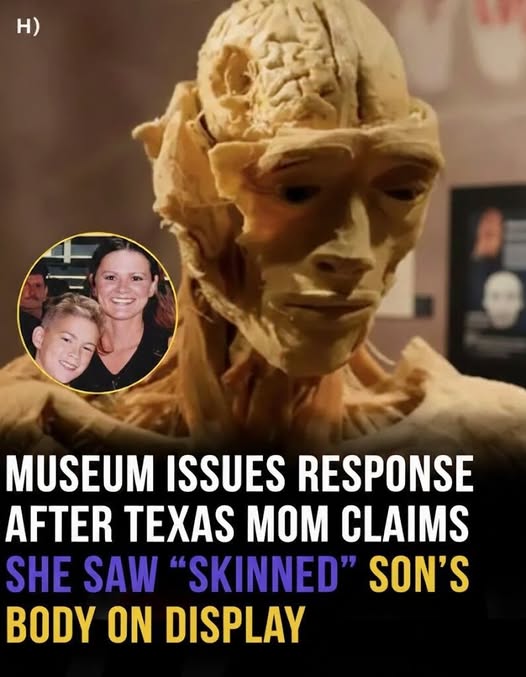
The figure that raised her concerns is known within the exhibition as “The Thinker.”
The plastinated cadaver is positioned in a seated pose intended to illustrate human musculature.
Kim believed certain details resembled features she remembered from her son.
This resemblance prompted her to examine the images more closely.
Perceived Similarities
According to Kim, the skull structure and certain marks on the body reminded her of Christopher.
She also believed that an area of missing skin could correspond to where her son once had a tattoo.
These observations convinced her that the body might belong to him.
The possibility deeply unsettled her.
A Call for DNA Testing
Convinced that further investigation was necessary, Kim asked the exhibition’s organizers to conduct DNA testing.
Her goal was to determine definitively whether the cadaver could be linked to her son.
She hoped that a scientific comparison could resolve the uncertainty.
The request quickly became a public point of dispute.
The Exhibition Organizer Responds
The exhibition is operated by the company Imagine Exhibitions, Inc.
Company representatives responded by explaining the documented origin of the specimen.
They stated that the cadaver had been legally sourced from China.
According to their records, the body had entered the collection in the early 2000s.
Timeline of the Specimen
Archived documentation shows that the specimen identified as “The Thinker” had already been displayed years earlier.
Records indicate it appeared in exhibitions as early as 2006.
This timeline places its public display several years before Christopher Erick’s death in 2012.
Because of this chronology, the company maintains that it cannot be connected to him.
Independent Reviews of the Claim
Independent reviews and fact-checking efforts have examined the available documentation.
These assessments generally support the timeline presented by the exhibition’s organizers.
The evidence suggests that the specimen was part of the exhibition long before Christopher’s death.
Based on those records, investigators consider the identification unlikely.
Investigators Consider the Case Closed
With the timeline established, authorities and fact-checkers regard the matter as resolved.
There is no evidence indicating that the cadaver displayed in the exhibit belongs to Christopher Erick.
The documented dates make such a connection chronologically impossible.
However, the emotional aspect of the story remains significant.
The Emotional Weight of Unanswered Questions
For Kim Erick, the situation is not purely about timelines and documentation.
Her son’s death still carries unanswered questions and unresolved grief.
Without the opportunity for further examination of his remains, uncertainty continues to linger.
This emotional dimension has kept the issue alive in public discussion.
Debate Over Human Remains in Exhibitions
The situation has also raised broader questions about how human remains are displayed in public exhibits.
Exhibitions such as Real Bodies and similar anatomical displays aim to educate audiences about human anatomy.
However, they sometimes generate debate regarding sourcing and transparency.
Critics argue that clear documentation is essential for maintaining public trust.
Calls for Greater Transparency
Kim Erick has said that her experience strengthened her belief that exhibition organizers should be transparent about the origins of displayed remains.
She believes families deserve reassurance that the bodies on display were obtained ethically and legally.
Her concerns echo broader discussions about ethical standards in anatomical exhibitions.
These debates continue among educators, scientists, and museum professionals.
A Personal Quest for Closure
Ultimately, the controversy reflects a deeply personal search for closure.
For Kim Erick, the loss of her son remains a painful and unresolved chapter.
Even though investigators consider the case settled, her questions persist.
The experience illustrates how grief can shape perceptions long after official investigations end.
The Story Behind the Headlines
While the scientific and chronological evidence suggests the exhibit specimen is unrelated to Christopher Erick, the emotional story continues to resonate.
It highlights the lasting impact of sudden loss and unanswered questions.
For many observers, the situation underscores the importance of compassion when discussing sensitive cases.
Behind every public controversy lies a family navigating grief and memory.
A Conversation That Continues
Today, the dispute remains a reminder of the complex intersection between science, ethics, and personal loss.
Although the factual investigation may be complete, the emotional journey for those involved continues.
Kim Erick’s search for answers reflects a universal human desire to understand tragedy.
Her story has sparked ongoing conversations about transparency, accountability, and empathy in the handling of human remains.