
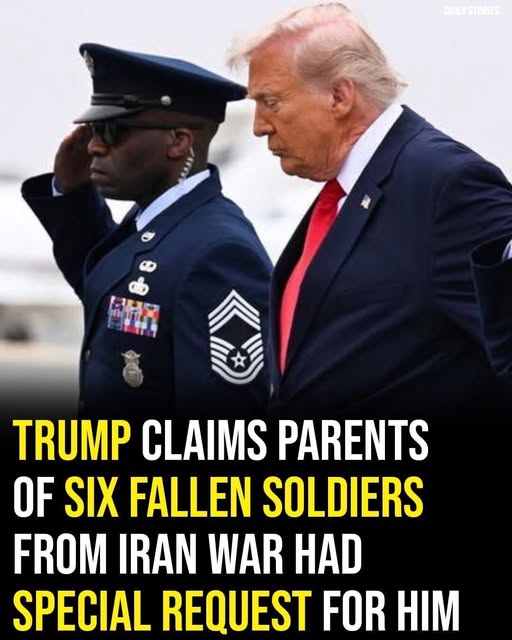
Trump Says Families of Fallen Soldiers Urged Him to “Finish the Job” as Conflict Escalates
A Solemn Setting at Dover Air Force Base
Dover Air Force Base has long served as a place where the nation pauses to honor service members who have died overseas. The ceremonies there are marked by silence, folded flags, and the weight of grief carried by families who have lost loved ones in war.
At one such moment, Donald Trump described standing among relatives of six soldiers whose lives were cut short during a violent escalation of conflict in the Middle East.
The soldiers had been killed when an unmanned aircraft struck a command center in Kuwait.
The attack occurred amid a widening regional confrontation following U.S.-Israeli military actions that resulted in the death of Iran’s Supreme Leader.
In recounting his conversation with the grieving families, Trump said they all expressed the same request.
According to his description, each family asked him to ensure that the mission their children were part of would be carried through to completion.
Trump summarized their message with the words they repeated to him: “Finish the job.”
The Loss of Six Soldiers
The deaths of the six soldiers became a stark reminder of how quickly the conflict had intensified. The unmanned aircraft strike on the command center in Kuwait was one of the most severe incidents in the expanding confrontation.
Military personnel stationed at the site were performing operational duties when the attack occurred.
The sudden strike caused immediate casualties and triggered alarm across military installations in the region.
For the families of those killed, the shock was overwhelming.
Parents, relatives, and loved ones were left grappling with the sudden absence of people who had recently been part of their daily lives.
The loss was not only personal but symbolic of the risks faced by those serving in areas where tensions had rapidly escalated.
At Dover Air Force Base, the return of the soldiers’ remains was marked by solemn ceremonies attended by family members and military personnel.
A Conflict That Escalated Quickly
The attack that killed the six soldiers came during a period of intense instability in the region.
The confrontation followed joint U.S.-Israeli strikes that had targeted key figures and locations tied to Iranian leadership.
Among the most consequential outcomes of those strikes was the death of Iran’s Supreme Leader.
The killing of such a central figure dramatically altered the political and military landscape.
Iran responded with missile and drone attacks that spread across multiple areas in the region.
The exchange of strikes created a rapidly evolving conflict that placed military forces and civilians under heightened threat.
Within days, the situation had transformed from a limited confrontation into a broader regional struggle.
The Families’ Message
In his account of the events at Dover Air Force Base, Trump emphasized the words spoken by the soldiers’ families.
Standing with parents who had just lost their children, he described a moment filled with emotion and determination.
According to Trump, each family repeated a similar request.
They wanted the mission that their sons had been part of to continue.
The families’ words reflected the belief that the sacrifice of the soldiers should lead to a meaningful outcome rather than being remembered only as a tragic loss.
Trump summarized their message as a call to continue the military effort.
He recalled their shared appeal in simple terms: “Finish the job.”
Grief and Resolve
For many parents who lose children in military service, the pain of that loss is accompanied by a desire to understand the purpose behind the sacrifice.
In moments like the one described at Dover, grief often merges with determination.
The families of the six soldiers were confronted with the sudden reality that their loved ones had died in a conflict that was still unfolding.
For them, the request to complete the mission reflected a hope that the deaths would carry meaning within the broader struggle.
The sentiment expressed by those families resonated deeply with some who view military service as a commitment to defend national interests regardless of the risks involved.
Others heard the message as a powerful expression of grief transformed into resolve.
A War Trump Calls “Very Complete”
Trump has described the military campaign connected to the conflict as progressing successfully.
In public remarks, he said the operation was “very complete” and moving ahead of schedule.
Those statements have framed the conflict as one nearing a decisive outcome.
However, the situation on the ground remains volatile.
Iran’s response has included repeated missile launches and drone strikes targeting various locations throughout the region.
These attacks have kept military forces on high alert and maintained the atmosphere of uncertainty that surrounds the conflict.
Despite the declaration that the campaign is advancing quickly, the ongoing strikes demonstrate that hostilities are far from over.
Continuing Attacks Across the Region
The region affected by the conflict has experienced a steady stream of retaliatory actions.
Missiles and drones have been deployed in waves, striking both military targets and strategic sites.
Air defense systems have been activated repeatedly as forces attempt to intercept incoming threats.
The exchange of attacks has underscored the unpredictable nature of the confrontation.
Military analysts have noted that conflicts involving missile and drone warfare can escalate rapidly because of the speed and range of such weapons.
Each strike carries the possibility of provoking additional retaliation.
As a result, the region remains on edge while the conflict continues to unfold.
Interpretations of the Families’ Words
Trump’s recounting of the conversation with the soldiers’ families has become a central part of the narrative surrounding the conflict.
For some observers, the words “Finish the job” symbolize determination in the face of loss.
They represent a belief that the sacrifices made by military personnel should contribute to achieving strategic goals.
Others hear the same phrase differently.
To them, the words echo a familiar pattern that has appeared in previous wars.
Throughout history, conflicts have often been framed as missions that must be completed to honor those who died.
Yet those promises have sometimes led to extended campaigns that produced additional casualties.
Memories of Past Conflicts
The emotional power of the scene at Dover Air Force Base reflects a long tradition of honoring fallen soldiers.
Every return of service members to that base is accompanied by ceremonies that recognize both sacrifice and national service.
For families, the moment represents the final stage of a journey that began when their loved ones deployed.
For the nation, it is a reminder of the human cost of military operations.
Over decades, similar scenes have unfolded whenever conflicts claimed American lives overseas.
Each ceremony carries its own story of loss, courage, and remembrance.
The Weight of the Moment
Trump’s description of the families’ request places their words at the center of the ongoing debate about the conflict.
Their appeal has been interpreted as a call for determination in the face of tragedy.
At the same time, the phrase highlights the emotional complexity of war.
Families who lose loved ones often struggle with the idea that those deaths might not lead to a clear resolution.
In that context, the call to “Finish the job” becomes both a statement of resolve and a reflection of grief.
A Conflict Still Unfolding
Despite statements that the campaign is nearing completion, the conflict continues to evolve.
Missile strikes and drone attacks remain a regular occurrence in several parts of the region.
Military forces remain deployed in positions intended to deter further escalation.
Diplomatic tensions have also increased as governments respond to the rapidly changing situation.
The future course of the conflict remains uncertain.
Each new development has the potential to shift the balance between escalation and stabilization.
The Human Cost of War
The story of the six soldiers killed in Kuwait serves as a reminder of the personal consequences of military conflict.
Behind every strategic decision and military operation are individuals whose lives are directly affected.
For the families who gathered at Dover Air Force Base, the loss is permanent.
The words they shared with Trump were shaped by grief, pride, and the hope that their children’s sacrifices would carry meaning.
As the conflict continues, the memory of those soldiers remains part of the broader narrative surrounding the war.
A Moment That Resonates Beyond the Ceremony
The scene described by Trump now stands as a powerful image within the unfolding story of the conflict.
At Dover Air Force Base, the families’ message was spoken quietly but carried significant emotional weight.
Whether interpreted as a call for perseverance or as a reflection of sorrow, the words remain tied to the memory of six lives lost.
As missile strikes and drone attacks continue across the region, the phrase “Finish the job” lingers as both a demand and a reminder of the human cost behind every war.