
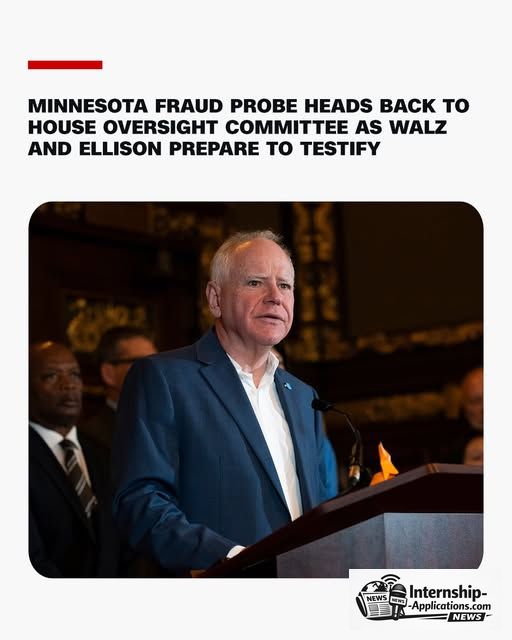
Minnesota Welfare Fraud Controversy Returns to Capitol Hill as Key Officials Testify
Congressional Hearing Reopens National Debate
A major political controversy surrounding alleged welfare fraud in Minnesota has returned to the national spotlight as members of Congress reopen their investigation on Capitol Hill.
The House Oversight Committee convened a new hearing Wednesday morning to examine allegations involving the misuse of public funds connected to social service programs in the state.
Minnesota Governor Tim Walz and State Attorney General Keith Ellison were scheduled to provide testimony during the hearing, marking their first formal appearances in the federal probe tied to the controversy.
The issue has become a significant political flashpoint, drawing attention from federal authorities, lawmakers, and national political figures over the past several months.
The latest congressional session follows an earlier hearing in January that became highly contentious as lawmakers debated the scope of alleged fraud and the responsibility of state leadership.
Allegations That Officials Ignored Warning Signs
Hours before the hearing began, the Republican-led House Oversight Committee released a report outlining accusations that Walz and Ellison were aware of credible fraud concerns years earlier but did not take sufficient action.
The report claims that their failure to respond effectively allowed fraudulent activity to expand, allegedly resulting in billions of dollars in taxpayer losses.
Committee leaders argue that the investigation is necessary to determine how such activity could have continued for years without stronger intervention.
Republican Chairman James Comer described the hearing as part of Congress’ responsibility to examine the situation thoroughly and pursue stronger protections against fraud.
“We look forward to questioning Governor Walz and Attorney General Ellison under oath to ensure transparency and accountability for the American people and to consider meaningful reforms that prevent waste, fraud, and abuse of taxpayer funds,” Comer said.
Officials Maintain They Did Nothing Wrong
Both Walz and Ellison have consistently denied accusations that they ignored or enabled fraudulent activity during their time in office.
The hearing was expected to include testimony addressing those allegations and providing additional information about actions taken by state authorities.
Ellison planned to highlight efforts undertaken by his office to prosecute individuals accused of defrauding government programs.
His office indicated that the attorney general would discuss prosecutions involving people accused of stealing from Medicaid and other programs designed to assist vulnerable populations.
Ellison also intended to encourage lawmakers to move beyond political disputes and cooperate in efforts to combat fraud in public benefit systems.
Origins of the Allegations
Claims of fraudulent activity connected to Minnesota safety net programs stretch back nearly a decade and have resurfaced multiple times as investigations expanded.
The issue gained renewed national attention shortly after Christmas when a conservative content creator posted a YouTube video alleging that childcare centers operated by members of Minnesota’s Somali community were fraudulently collecting funding meant for low-income families.
The video quickly spread online and attracted millions of views.
Prominent national figures shared the video, amplifying the allegations and pushing the controversy further into public debate.
As the claims circulated widely, federal authorities increased their presence across the Twin Cities area.
Federal Agencies Intensify Their Response
Following the surge of attention surrounding the allegations, federal agencies expanded their involvement in examining the claims.
The Department of Homeland Security and the Federal Bureau of Investigation increased operations in the region as part of the broader effort to investigate potential wrongdoing.
Federal funding tied to childcare programs in Minnesota was temporarily frozen while investigators reviewed the allegations.
The freeze was intended to prevent additional funds from being distributed until authorities could determine whether the claims had merit.
This federal response marked one of the most visible developments in the controversy, further raising the stakes of the ongoing political dispute.
Feeding Our Future Case Remains Central
Much of the current discussion about fraud in Minnesota has been shaped by an earlier case involving Feeding Our Future, a nonprofit organization accused of falsely claiming to provide meals to children during the COVID-19 pandemic.
Prosecutors alleged that the organization and several associates submitted fraudulent claims for reimbursement through programs designed to provide meals to children in need.
Federal authorities began filing criminal charges in connection with the case in 2022.
Dozens of individuals were charged as part of the investigation, with many of those accused identified as members of Minnesota’s Somali community.
The case has remained a key reference point in the broader debate about oversight of public assistance programs in the state.
Congressional Investigation Expands
The House Oversight Committee first launched its investigation into the Minnesota controversy in December.
At that time, Chairman Comer sent requests to Walz and Ellison seeking documents and communications related to the allegations.
The committee sought information about what state officials knew about the reported fraud and whether steps were taken to address the problem.
As the investigation continued, additional requests were made to federal agencies, including the U.S. Treasury and the Department of Justice.
Lawmakers stated that the goal of the inquiry was to gather a clearer picture of how the alleged schemes developed and whether oversight failures allowed them to continue.
Report Details Interviews With State Officials
The report released ahead of the hearing included excerpts from interviews conducted with several current and former Minnesota state officials.
Members of the committee spent roughly 40 hours questioning individuals connected to oversight of state programs.
During those sessions, officials were asked about integrity concerns within government departments and whether pressure existed to limit investigations.
The report claims that whistleblowers who attempted to raise concerns about fraud were ignored or faced retaliation.
It also alleges that the lack of stronger oversight allowed fraudulent actors to continue receiving government funds intended for public assistance programs.
Political Tensions Intensify
The controversy has sparked sharp political divisions between Republicans and Democrats at both the state and national levels.
Republican lawmakers have argued that stronger oversight should have been implemented earlier to prevent taxpayer money from being misused.
They have also demanded stricter safeguards to ensure public funds are distributed only to legitimate recipients.
Democratic leaders have pushed back against those claims, maintaining that their administrations have actively pursued investigations and prosecutions where evidence supported them.
The dispute has transformed the issue into a broader political confrontation over government accountability and social service programs.
January Hearing Marked by Heated Exchanges
The committee’s first hearing on the matter in January was marked by intense debate and moments of open confrontation among lawmakers.
Several Republican members of the Minnesota House of Representatives testified during that session, presenting claims that they had warned about fraud in the state years earlier.
The lawmakers argued that programs intended to provide childcare assistance had been exploited by criminal networks.
They alleged that funds meant for social services were diverted to luxury purchases, including homes, vehicles, and property overseas.
Those claims were strongly disputed by Democrats, leading to heated exchanges that dominated the hearing.
National Attention Continues to Grow
The January session occurred during a period of heightened tension surrounding federal enforcement actions in Minneapolis.
While lawmakers debated the allegations in Washington, an immigration enforcement officer shot and killed 37-year-old Renee Good on the streets of Minneapolis.
The incident triggered weeks of protests and legal challenges involving federal authorities.
Although separate from the fraud investigation, the event intensified public scrutiny of government actions in the region.
Political leaders and community groups continued to debate the broader implications of both developments.
Focus on Oversight and Accountability
As the congressional inquiry moves forward, lawmakers say they aim to determine whether structural failures in oversight allowed fraud to occur.
Committee leaders argue that identifying weaknesses in monitoring systems will be essential to preventing similar cases in the future.
The investigation remains ongoing as additional testimony and evidence are gathered.
Lawmakers from both parties have acknowledged the importance of protecting public assistance programs while ensuring that taxpayer funds are not misused.
The outcome of the hearings could shape future reforms to federal and state oversight of programs intended to support vulnerable communities.