
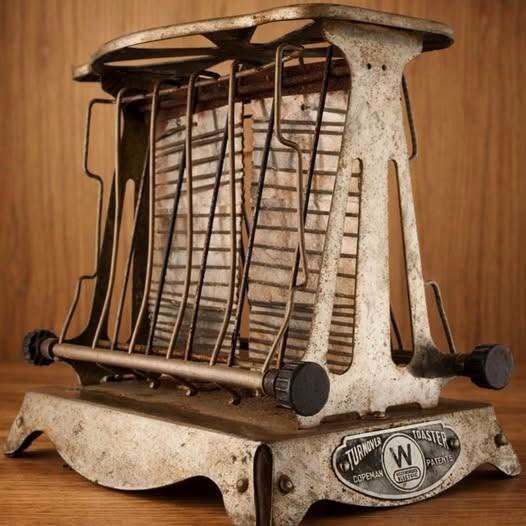
Forgotten Metal Kitchen Appliance Leaves Viewers Confused Before Its Everyday Use Is Revealed
At first sight, the old metal device looks less like something from a kitchen and more like an object from a workshop. Its exposed frame, visible wires, open heating elements, and cage-like holders give it an appearance that feels unusual, severe, and almost experimental to modern viewers.
For people used to today’s smooth and enclosed kitchen appliances, the object can be difficult to identify. It does not resemble the compact, polished machines now used on kitchen counters, and its bare construction makes it look far more complicated than its actual purpose.
That confusion is one reason the device has attracted attention online. Many people who see it without explanation try to guess what it once did, with some imagining that it was used for tools, machinery, medical equipment, or some form of industrial heating.
The truth is much simpler. The forgotten metal object was once a turnover toaster, a household appliance designed to do one of the most familiar morning tasks: toast bread.
A Strange-Looking Tool With a Familiar Job
The turnover toaster was made for breakfast tables. Its purpose was not mysterious, dangerous, or industrial. It existed to brown slices of bread before the fully automatic toaster became common in homes.
Unlike modern toasters, this early appliance did not hide its working parts behind a sealed metal shell. The user could see the heating coils, the wire structure, and the small holders that kept the bread close to the heat.
That open design is what makes the appliance seem strange today. Modern users are accustomed to dropping bread into a slot, pressing a lever, and waiting for the toast to rise when finished. The turnover toaster worked in a more direct and visible way.
The person using it had to watch the bread as it browned. When one side appeared done, the slice had to be turned manually so the other side could toast.
This simple action gave the appliance its name. It was a toaster that required the bread to be turned over by hand.
Why the Design Looks So Different Now
Modern kitchen appliances are usually designed to appear safe, clean, and simple. Their heating elements, wires, and moving parts are concealed inside protective shells.
The turnover toaster came from an earlier period of home appliance design. It showed its function openly. The heat source was visible, the frame was exposed, and the bread sat near the coils in plain view.
To today’s eyes, that can look alarming. The glowing coils and exposed metal suggest danger, especially when compared with the enclosed appliances now associated with everyday kitchen safety.
However, the device made sense in its own time. It was built to perform a clear task, and its open structure allowed the user to monitor the bread closely while it toasted.
There was no hidden process. Electricity heated the coils, the coils browned the bread, and the person standing nearby controlled the result by turning the slice at the right moment.
A Breakfast Routine That Required Attention
Using a turnover toaster was not a task that could be ignored once it began. The person preparing breakfast had to remain nearby and pay attention to the bread.
There was no automatic pop-up mechanism. There was no sensor to decide when the toast had reached the right shade. The user had to judge the result by sight.
As the coils heated, the bread slowly browned on one side. If it stayed too long, it could burn. If it was turned too soon, it might remain pale and underdone.
That meant every slice required timing and judgment. The appliance made toast, but it did not remove the human role from the process.
Compared with modern standards, the method may seem inconvenient. Yet for families of that period, the device represented useful progress. It brought electric heat directly to the breakfast table and made a familiar food in a new way.
Part of the Early Electric Home
The turnover toaster was more than a small machine for bread. It belonged to a time when electricity was beginning to change domestic life.
Before electric appliances became common, many household tasks depended on stoves, open flames, or other heat sources that required more effort and created more mess. Electric devices promised cleaner, more controlled ways to perform ordinary routines.
For families adopting these appliances, the toaster represented modern convenience. It allowed bread to be browned with electricity rather than through older cooking methods.
The appliance may look rough or unfinished today, but in its own era it carried a sense of innovation. It showed that electricity could be used for small daily comforts, not only for lighting or larger machinery.
Progress did not always arrive through dramatic inventions. Sometimes it appeared as a metal device on a breakfast table, glowing beside a slice of bread.
Why People Mistake It for Something Else
The turnover toaster confuses modern viewers because it no longer matches the common image of a toaster. Most people think of a toaster as a closed appliance with slots, a lever, and a pop-up function.
This older device has none of those familiar features. Its open cages, exposed coils, and visible frame make it look more like a piece of equipment than a kitchen tool.
Without context, the eye focuses on the sharp lines and mechanical parts. The object appears too dramatic for something as simple as toast.
That contrast is what makes the reveal surprising. Once people learn that the device was made for bread, its strange features become easy to understand.
The cages held the slices. The coils provided heat. The open frame allowed the user to watch the bread and flip it when necessary.
The mystery disappears, but the object remains fascinating because it shows how much everyday design has changed.
A Hands-On Appliance From a Slower Era
The turnover toaster came from a time when convenience still required participation. It reduced some effort, but it did not automate the entire task.
The user had to stand nearby, observe the bread, and decide when to turn it. The machine provided heat, but the person controlled the timing.
That makes the appliance feel very different from modern devices. Today, many kitchen tools are designed so users can press a button and step away.
The older toaster kept the process visible and interactive. The browning happened in front of the person using it, and the final result depended on attention.
This hands-on quality gives the device a certain charm. It reminds people that early household technology did not always remove human involvement. Instead, it often changed the way people worked while still keeping them close to the task.
From Common Appliance to Collectible Object
What was once an ordinary household item has now become a curiosity. Few people today would look at a turnover toaster and immediately imagine using it during breakfast.
Its exposed construction makes it feel outdated and unfamiliar. Many modern users would likely see it as unsafe compared with the enclosed appliances they know.
For collectors, however, that old design is part of the appeal. The turnover toaster preserves a moment in the history of domestic technology.
Its metal frame, heating coils, and manual turning mechanism show how early electric appliances were built and used. They also show how new technology entered homes gradually, through practical objects designed for daily routines.
The appliance has value not only because of what it did, but because of what it represents. It is a reminder of a period when electric convenience was still visibly mechanical and new.
The Hidden History of an Ordinary Meal
The most surprising part of the turnover toaster’s story is how ordinary its purpose was. It was not a specialized machine for a rare task. It was a tool for making toast.
That simplicity is what makes the device so interesting. It shows that even the most familiar comforts have a design history.
A slice of toast may seem too ordinary to think about, but the tools used to make it have changed dramatically over time. The turnover toaster represents an earlier stage in that evolution.
Modern toasters hide the heat, control the timing, and release the toast automatically. The older appliance exposed the entire process and required the user to complete it manually.
Looking at the device now is like looking at a different relationship between people and technology. The machine helped, but it did not take over.
Why Forgotten Tools Capture Online Attention
Objects like the turnover toaster often become popular online because they create a small mystery. They are familiar enough to seem useful but unfamiliar enough to make their purpose unclear.
People enjoy guessing what forgotten tools once did. The process turns an ordinary antique into a puzzle.
The turnover toaster is especially effective because its appearance suggests something far more dramatic than its function. It looks intense, mechanical, and possibly hazardous, yet its job was gentle and domestic.
That contrast makes the reveal satisfying. The object that looked like a laboratory device was actually part of a breakfast routine.
It also invites reflection on how design changes over time. A device that once seemed modern can later appear strange simply because newer versions have made its form obsolete.
A Reminder of Visible Technology
The turnover toaster belongs to a time when technology often showed its workings. The wires, coils, and frame were not hidden because the design was focused on direct function.
Today, many appliances are built to conceal complexity. Users are not expected to see the heating element or understand the movement inside the machine.
The older toaster did the opposite. It made the process obvious. Heat appeared in the glowing coils, bread sat beside them, and browning happened where the user could see it.
This visible design can look crude to modern eyes, but it also has a kind of honesty. The appliance did not disguise its purpose or its method.
Everything about it told the user what was happening.
Small Machine, Larger Meaning
The turnover toaster did not transform the home through size or complexity. Its importance came from the way it brought electricity into one of the most routine parts of family life.
Breakfast is an ordinary moment, but ordinary moments are where technology often has the greatest everyday impact. A machine that saves a little effort each morning can become meaningful through repeated use.
The toaster allowed families to prepare a familiar food in a cleaner and more modern way. It also helped introduce the idea that electric appliances could make household tasks easier.
Even though the user still had to watch and flip the bread, the appliance represented a step toward the automated kitchen tools that later became standard.
Its open frame may look outdated now, but that design tells the story of progress in a clear and physical way.
Why the Turnover Toaster Still Matters
The renewed interest in the turnover toaster is about more than nostalgia. It reflects a broader curiosity about the everyday objects that shaped home life before modern automation.
Forgotten appliances reveal how people once cooked, cleaned, worked, and lived. They show the steps that newer machines eventually removed.
The turnover toaster shows a moment when electrical convenience was still hands-on. It made toast easier than older methods, but it still required attention and care.
That combination makes it a useful symbol of early domestic technology. It was modern for its time, yet far from the effortless appliances people now expect.
Its design reminds viewers that progress often begins in imperfect forms. Before appliances became enclosed, automatic, and polished, they were open, practical, and direct.
An Everyday Object With an Unusual Legacy
The old metal device may look strange today, but its purpose was simple and familiar. It helped families make toast.
That everyday function is exactly what gives the appliance its lasting appeal. It shows how much can change around even the simplest household task.
A tool once common enough for the breakfast table can become so unfamiliar that modern viewers mistake it for something dangerous or mysterious. That change reveals how quickly technology can disappear from memory once newer designs replace it.
The turnover toaster is now remembered less as a practical appliance and more as a piece of domestic history. It represents a time when electricity was entering the home in visible, useful, and sometimes awkward ways.
Its exposed coils, metal cages, and manual flipping process tell a story that modern toasters hide. They show the work behind a simple slice of toast.
What first appears to be a confusing metal contraption is really a reminder that ordinary comforts had to be invented and refined. The turnover toaster belongs to that history, standing as a small but memorable example of how progress once glowed openly on the kitchen table.